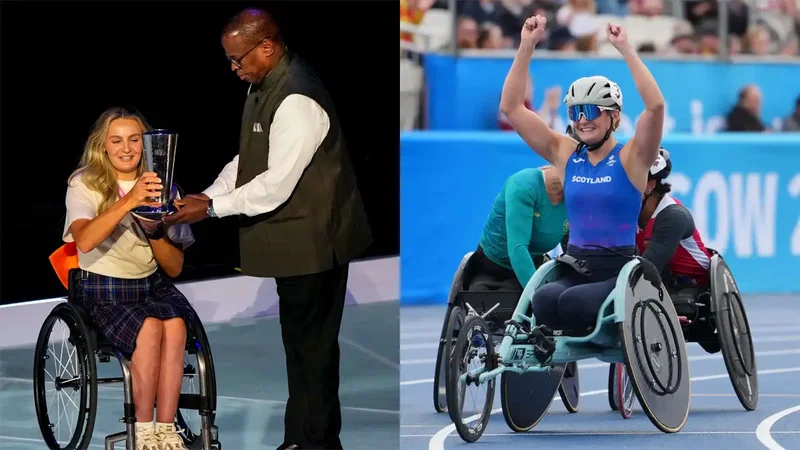
Scottish wheelchair racer Melanie Woods capped an unforgettable home Commonwealth Games by winning the prestigious David Dixon Award, recognising her as the outstanding athlete of Glasgow 2026 after a campaign defined not only by two gold medals but also by extraordinary resilience, sportsmanship and composure under unprecedented circumstances.
The David Dixon Award, voted for by fellow athletes, honours the competitor who best combines sporting excellence, fair play and contribution to their team. Woods embodied all three qualities during one of the most dramatic stories of the Glasgow Games.
Her remarkable journey saw her win the women's T54 1500m title twice in less than 40 hours before adding a second gold in the T54 400m, making her one of the defining faces of the Games.
ALSO READ: Over to Ahmedabad! Neeraj Chopra, PT Usha receive CWG flag as India's 2030 countdown begins## A champion tested like never before
The defining moment of Woods' Games came in the women's T54 1500m final, where she initially stormed to victory in a Commonwealth Games record time of 3:33.39.
However, celebrations were short-lived.
A chaotic first-lap crash involving several athletes prompted a series of protests and appeals. Canada's Nandini Sharma collided with Mauritius' Noemi Alphonse, triggering a chain reaction that also brought down Australia's Eliza Ault-Connell, Scotland's Joanna Robertson and England's Ellis Kottas.
Although Woods had avoided the incident and crossed the finish line well clear of the field, officials later upheld appeals from Australia and Mauritius, voiding the result and ordering a complete rerun of the final â one of the most extraordinary decisions in Commonwealth Games history.
Instead of expressing frustration after losing a gold medal she believed she had rightfully earned, Woods accepted the ruling with grace, respecting both the appeals process and her fellow competitors.
Her calm response quickly became as admired as her racing ability.
Winning twice to remove all doubt
Less than 40 hours later, Woods returned to Scotstoun Stadium with the pressure of having to prove herself all over again.
She responded in the best possible fashion.
Taking the lead within the opening 100 metres, the Scot controlled the race from start to finish and crossed the line in a new Commonwealth Games record of 3:32.20, improving upon the mark she had already set in the original final.
"I'm happy, I'm excited, but it feels like relief, to be honest," Woods said after reclaiming the title. "It's created a bit of a storyline and I feel like people have been following for the plot, so I'm just happy to be able to do it again."
Remarkably, Woods had barely any time to celebrate.
Just 90 minutes after reclaiming her 1500m crown, she returned to the track for the heats of the women's T54 400m, where she qualified fastest for the final.
The following evening, she completed a memorable double by winning the 400m title to secure her second gold medal of Glasgow 2026.
The performances cemented her place as Scotland's standout athlete at the home Games.
Why Melanie Woods received the David Dixon Award
While medal winners often dominate headlines, the David Dixon Award has never been based solely on podium finishes.
It recognises athletes who combine exceptional performances with integrity, respect and leadership.
Woods' response to the controversial rerun perfectly captured those values.
Rather than allowing disappointment to overshadow the event, she accepted the unprecedented decision with dignity, returned to the start line and produced an even faster, more convincing victory.
Her resilience, sportsmanship and outstanding performances earned widespread admiration from fellow competitors, who voted her the recipient of the David Dixon Award.
By the end of Glasgow 2026, Melanie Woods had achieved something few athletes ever experience â winning the same Commonwealth Games title twice, setting two Games records and leaving as the athlete who best represented the spirit of the Games.