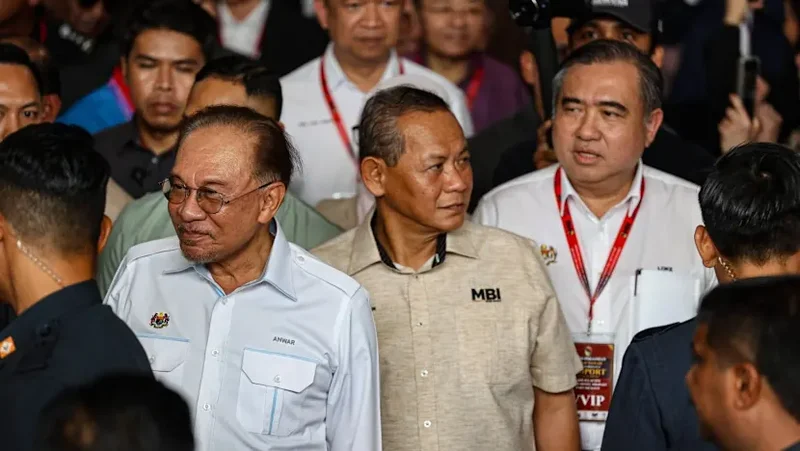
Commentary: With PH’s Negeri Sembilan defeat, PM Anwar is running out of states and time
Prime Minister Anwar Ibrahim’s Pakatan Harapan coalition losing in the latest state polls is not an isolated incident. It is the third and most devastating strike in a series that has transformed the political map of Malaysia, writes CNA’s Leslie Lopez.
KUALA LUMPUR: There is a particular cruelty in watching your deputy prime minister celebrate your misery.
On Saturday night (Aug 1), as the results from the Negeri Sembilan state assembly elections rolled in, Deputy Prime Minister Ahmad Zahid Hamidi stood shoulder-to-shoulder with Perikatan Nasional (PN) coalition leaders Hamzah Zainuddin and Takiyuddin Hassan – men his own federal government officially opposes – to claim a supermajority victory over Prime Minister Anwar Ibrahim’s Pakatan Harapan (PH) coalition that governed the state for eight years.
The Barisan Nasional (BN) coalition, which is led by Mr Zahid’s United Malays National Organisation (UMNO), and PN had won 25 out of 36 state assembly seats.
PH fell from 17 seats to 11.
Aminuddin Harun, the PH caretaker chief minister who steered Negeri Sembilan through the COVID-19 pandemic, had been humiliated in this Linggi constituency. Transport Minister Anthony Loke, the secretary-general of the Democratic Action Party (DAP), a key PH ally, had been evicted from his Chennah constituency after three terms.
And Mr Anwar – Mr Zahid’s boss in government and architect of the Unity Government – was left to issue a polite Facebook congratulation to the very coalition that had dismantled his state government.
WALLS CLOSING IN FOR ANWAR
For Prime Minister Anwar Ibrahim, the walls are closing in.
Can the federal government survive when its coalition partners are openly fighting each other in the states?
If the past eight months are any guide, the answer is no. And the countdown to the country’s 16th general election – only due sometime in early 2028 – has begun.
The Negeri Sembilan defeat is not an isolated incident. It is the third and most devastating strike in a series of episodes that have transformed the political map of Malaysia.
The first came in November 2025 when Sabah fell. The Gabungan Rakyat Sabah coalition, which is aligned to PN, captured the state government, effectively showing that the opposition could capture a state.
The second breach came in July in Johor when PH was trounced by the UMNO-led BN, which had forged an informal electoral pact with PN, which is led by the right-wing Parti Islam Se-Malaysia (PAS) and also includes a smaller Parti Wawasan Negera.
The Negeri Sembilan defeat demonstrates that a pattern is shaping. It shows that UMNO, PAS and Wawasan, all three parties representing the country’s political dominant Malay majority, can set aside old rivalries to unseat Mr Anwar’s PH.
The supermajority BN and PN have in Negeri Sembilan gives the new coalition unchecked power to redraw constituencies, amend the state constitution and govern without any meaningful opposition.
The arithmetic is sobering. Malays, who count for about 60 per cent of the population, make up the majority in 123 of the 222 parliamentary wards. If the BN and PN consolidation holds, with UMNO recovering its rural base and PAS retaining its religious constituency, there is no need for non-Malay votes to win federally.
Malaysia is witnessing a recalibration of national politics – a retreat from a multi-racial experiment to a more Malay-centric contest. Non-Malay parties, like the DAP that anchor PH, are discovering state by state that they are no longer essential to the calculus of power.
RESURGENCE OF UMNO AND ZAHID
The PH collapse across three state elections stands in sharp contrast to UMNO’s resurrection and Mr Zahid’s remarkable makeover, comebacks that have defied every political obituary after the party’s disastrous performance in the November 2022 general election.
Mr Zahid’s political career appeared doomed when he was hit with a raft of corruption charges in 2023, but he was subsequently cleared of all charges after further investigations found insufficient evidence.
Likewise, UMNO had been cast as a terminal patient and reduced to 26 parliamentary seats – its worst ever electoral performance. When Mr Anwar formed the Unity Government after the inconclusive 15th general election held in November 2022, Mr Zahid delivered UMNO’s bloc and extracted the deputy premiership position and a raft of Cabinet appointments.
While Mr Anwar used UMNO to stabilise his federal government, Mr Zahid used his position in the administration to consolidate the party, rebuild its machinery and reassert UMNO’s dominance among the Malays with access to federal funding.
ANWAR’S OPTIONS
The shift in the Malay voter sentiment isn’t because UMNO has reformed. It is due to the failure of the narrative that carried Mr Anwar to the prime ministership in late 2022.
Pledges of institutional reform, the promise of a new Malaysia beyond the race debates, and the end to corruption and cronyism, have been dulled over the nearly four years of compromise and coalition management.
Mr Anwar, who turns 79 this month, is now faced with a clutch of unenviable options.
He could take his chances and move against Mr Zahid by removing him from his Cabinet and also dissolving the UMNO alliance. The general consensus is that this would be political suicide after back-to-back rejections in Johor and Negeri Sembilan.
But this may in fact be the least worst option.
The BN-PN state-level pact works in by-elections and state assembly polls because the stakes are low and the constituencies are numerous enough to satisfy all political parties.
In a general election, the math is more brutal. UMNO, PAS and Wawasan will all be vying for a minimum number of the 123 Malay-majority seats in the lower house to justify their relevance to their respective bases.
All three are basically competing for the same voter poll, and seat allocation would become a messy subject that could break the electoral pact that is still work in progress. A snap election would help PH exploit any BN-PN seat allocation fault line.
Should Mr Anwar wait, not only would BN and PN have the time to formalise their pact and work out a seat arrangement agreement that avoids multi-cornered fights and vote-splitting that would follow.
For Mr Anwar, the path of least resistance is also the path to a slow political death. In the run-up to the Johor state assembly elections, he argued that UMNO’s state pacts with PN did not invalidate the federal coalition and his government remained stable.
But that logic only goes so far. Each state loss erodes Mr Anwar’s authority, demoralises his PH base and signals to financial markets that his is a lame-duck administration.
What’s more, there could be more state battles. An election in Melaka, an UMNO stronghold, looms as the next test with a dissolution of the state assembly expected this month or in September. That could be followed by fresh polls in Perak, where PH and BN currently share power. Pahang, which is controlled by UMNO, could then follow suit.
Increasingly, Mr Anwar is finding himself trapped in a prison of his own making. He is running out of states and time.