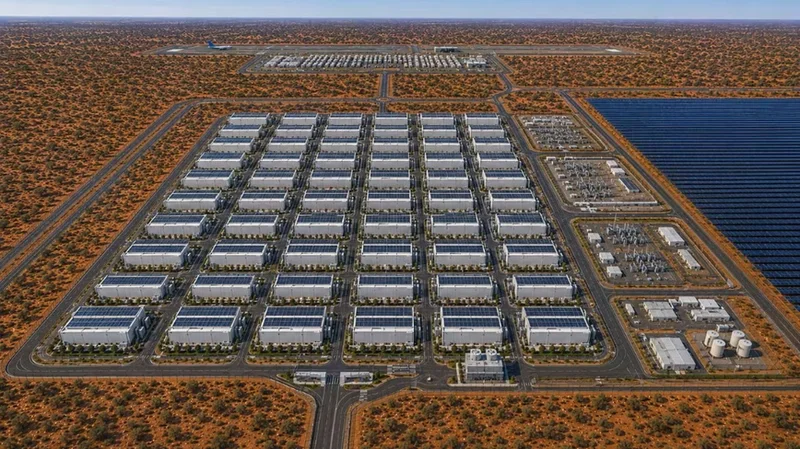
On a cattle station deep in the Northern Territory outback, roughly 683km south of Darwin, a Singapore-headquartered developer wants to build one of the largest data centres in the southern hemisphere.
The plan leans on a resource the region has in abundance and the electricity grid does not reach out to supply: gas.
Energy North lodged the proposal, called Project Ares, with Australia’s federal environment department in June, and it is now open for public comment.
The off-grid campus would sit at Murranji Station in the gas-rich Barkly region, near the Beetaloo basin, and run on a mix of gas-fired power, solar, and batteries. It arrives as Australian regulators tighten the energy rules around AI infrastructure.
The numbers are large and, in one important place, unsettled. Energy North expects to invest about AU$11.9 billion in the first phase alone, according to Data Center Dynamics.
Bloomberg, which reported the region’s appetite for the scheme, put the full project at around $28 billion, a figure that has not surfaced in any other outlet and whose currency and build-out stage the report does not spell out.
The first phase would deliver 1 gigawatt of computing capacity, built in two 500MW stages, with the campus designed to scale beyond 5GW over time.
Powering it would fall to roughly 1,038MW of gas-fired generation, described as hydrogen-ready, alongside 3GW of solar and 16GWh of battery storage.
The data centre halls would occupy about 90 hectares; the site as a whole runs to some 19,150 hectares, with the solar farm alone sprawling across as much as 7,000.
Building behind the meter, entirely off-grid, sidesteps a problem that is starting to bite closer to the coast.
Grid operators have warned that data-centre capacity around western Sydney is close to exhausted, pushing developers inland toward cheap land and, increasingly, dedicated power of their own.
Microsoft’s A$25 billion commitment and a run of hyperscale plans have made Australia one of the busier markets in the region, and the Territory, with more sun and space than customers, is now fielding a share of them.
Project Ares has been awarded Commonwealth Major Project Status, which streamlines federal coordination but stops well short of approval.
The Northern Territory Environment Protection Authority is assessing the referral, and the project still needs a decision under the Environment Protection and Biodiversity Conservation Act before it can break ground.
Energy North is owned by Raggiana Global and led by Scott Criddle, a former chief executive of the engineering contractor Decmil.
The company describes itself as an independent Australian green-energy developer, and frames the gas component as a bridge, generation for reliability that is meant to give way to renewables as the site matures.
Nvidia-backed data centres elsewhere in the country are making similar promises about cleaning up over time.
The gas itself has a ready source. The Beetaloo basin beneath the Barkly has long been pitched by Canberra as the centrepiece of a gas-led recovery, and a data centre that consumes its own supply on site turns a stranded resource into a customer.
That logic is part of what makes the remote Territory, thinly populated and short on grid, suddenly attractive to hyperscale developers.
It also sharpens the tension in the pitch, since a campus sold on eventually running clean would begin life burning gas at close to a gigawatt.
A final investment decision is targeted for 12 to 18 months after approvals land, with the first phase built in a similar window after that.
Project Ares is one of roughly a dozen data-centre proposals now lodged across the Territory, alongside Energy North’s own Project Sol, a green hydrogen and ammonia venture at an earlier stage.
Whether the outback can host that much computing, on power that is meant to clean up as it goes, is the question the next 18 months will begin to answer.