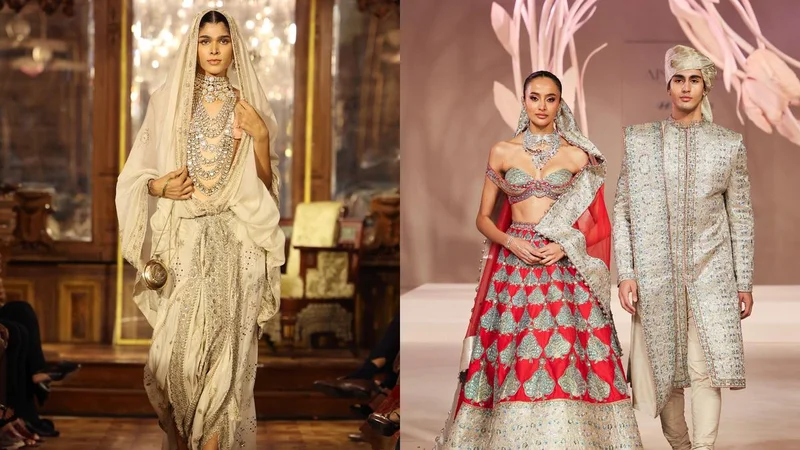
Anamika Khanna’s India Couture Week (ICW) opening show in Hyderabad and Rahul Mishra’s finale in Delhi offered a glimpse of high fashion’s dual goals – spotlighting Indian creativity on a global stage and seizing the commercial opportunity at home, in centres outside Delhi and Mumbai.
At ICW’s inaugural showcase, Khanna’s models walked the runway in pieces adorned with embroidery from Barmer and Kalighat paintings, at the Taj Falaknuma Palace in Hyderabad, a city with a growing number of ultra-rich individuals where she also opened a new store in 2025.
In a first for ICW, the inaugural show occurred in a city outside of Delhi, highlighting the growing significance of centres such as Hyderabad, which boast of high-spending and discerning clients. Meanwhile, Rahul Mishra’s finale was an expansion of his Paris Couture week showcase, with added signature embellished gowns, saris and skirts, which will easily find takers at lavish Indian weddings at home and abroad. Mishra forayed into Hyderabad with a new store in Banjara Hills in 2024.
From pearls, to the khada dupatta and majestic jewels of the Nizams of Hyderabad, high fashion isn’t new to Hyderabad. The city also has its own crop of designers, such as Jayanti Reddy, Anushree Reddy, Aisha Rao, and Suhani Pittie, but some of India’s top designers have only recently started to expand their physical presence in the city, helped by investments from Mukesh Ambani’s Reliance Brands Limited (RBL) and the Aditya Birla Group, besides the allure of a growing class of wealthy individuals.
According to Knight Frank’s 2026 wealth report, 80% of India’s ultra-high-net-worth individuals (UHNWIs), those with a net worth $30 million or more, are concentrated in five cities – Mumbai, Delhi, Bengaluru, Hyderabad and Chennai, with the capital of Telangana accounting for 6.3% of the uber rich.
While Mumbai and Delhi continue to be key markets, Indian fashion and luxury is seeing notable growth from consumers outside of these centres. “Now, aspirations are exactly the same everywhere,” says Neelesh Hundekari, partner and head of fashion and luxury for Asia-Pacific at Kearney, adding the comparatively lower cost of venues and related services means wealthy consumers can dedicate a larger share of the wedding budget to jewellery and designer clothing.
The cost of real estate is lower in cities such as Hyderabad, Chennai, Kolkata, Bengaluru and beyond, compared to Delhi and Mumbai, which could translate into higher margins for brands. Besides, “big cities are saturated. (Consumers in smaller cities) have aligned themselves with whatever’s happening in the world,” says designer JJ Valaya.
Designers believe fashion consumers are more aware everywhere in India, thanks to social media and growing affluence. “When we first started experimenting with metal and came up with the steel saree, brides were unsure. They wanted to wear it but sought advice from their relatives if it would be apt for the occasion. Now, women know exactly what they want, they’re not seeking approval,” says Rimzim Dadu. She notes the label’s clients from cities such as Hyderabad, Kolkata and Nagpur attended her show in Delhi.
Beyond Delhi and Mumbai
Last year, her new store opened its doors to consumers in Hyderabad’s upscale Banjara Hills. The city was also the location for Tarun Tahiliani’s grand 30th anniversary show earlier this year. Sabyasachi unveiled new boutiques in Bengaluru and Hyderabad in 2025; Indian and global luxury and fashion brands across value segments are solidifying their presence in cities such as Chennai, Kolkata, Ahmedabad, Pune, Raipur, Ludhiana, and others, which also act as a catchment area for the region.
Earlier this year, Off-White opened a store in Bengaluru, multi-brand watch retailer TimeVallée opened a boutique in Chennai, Ralph Lauren forayed into Kolkata in 2025, while Aditya Birla’s multi-brand fashion chain The Collective, which retails brands such as Karl Lagerfeld and Michael Kors, has expanded into Patiala, Jalandhar and Raipur within the last two years. Ogaan unveiled a new Chennai location in 2025, while Sanjay Garg debuted a Raw Mango boutique in Kolkata last year.
Valaya, who has a JJV Kapurthala store in Ludhiana, says the idea behind his bridge to luxury line was to make it more accessible. “It resonated with so many people that I’m able to take this line into smaller cities. I wouldn’t have thought of Ludhiana for couture… I can think of it now, I can seriously think of Chandigarh, Jaipur, or Ahmedabad. There is a whole ecosystem opening up, tier 2 and tier 3 cities are becoming very open to embracing luxury,” he says.
Designers also testify to working with consumers from geographies they traditionally didn’t cater to. “We’ve established that cities like Raipur or Nagpur shop a lot but when someone travels from somewhere like Guwahati for a wedding, that’s still a big thing for me. It’s not just the distance but Guwahati is barely ever in mainstream fashion conversation,” says Rimzim, adding clients from Bangladesh and Nepal are becoming common too. “We kind of forget these places in our regular fashion chatter.”
At her stores, the designer notes that while the core product design remains consistent, merchandising strategies are tailored to specific city markets. Clients in Hyderabad tend to shop more spontaneously, often just one to two weeks before an event, according to Rimzim, which means her store in the city is merchandised with pieces that have shorter production lead times or are readily available off-the-rack.
Arpita Mehta, who presented her debut couture collection at ICW highlights how every city has its own approach to occasion dressing. “Hyderabad has a refined sense of dressing that feels elegant and sophisticated, often favouring timeless craftsmanship. Chandigarh brings a playful energy, with an openness to experimenting…Chennai has a quieter, more understated approach,” she says.
While each city brings its own distinct style to couture shopping, designers highlight regional preferences are becoming more fluid. Designer Aisha Rao believes personal style now plays a far greater role than location. It is, however “exciting to see couture resonate across emerging markets throughout the country, where customers are increasingly seeking pieces that balance individuality, craftsmanship and modern elegance,” says Aisha.
Most top designers report higher demand from smaller cities, yet they remain cautious about physical expansion, a stance that may shift as corporate investors push for commercial growth through expansion in profitable new markets.
Published - August 03, 2026 07:25 am IST