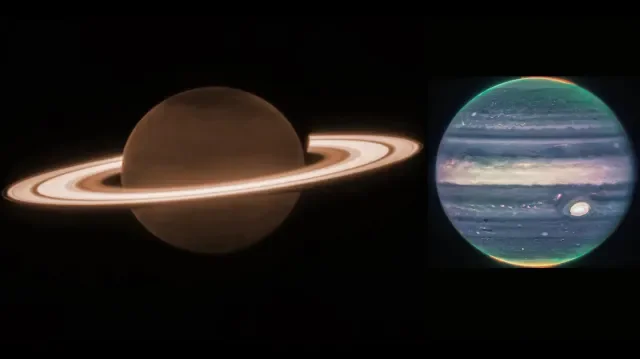
Our Solar System has gas giants, rocky planets, moons, asteroids, and more. By size, it’s clear that the gas giant worlds vastly outstrip any of the terrestrial planets, and this is true for mass as well. Although Saturn is nearly the same physical size as Jupiter, it contains just 21% of the planetary mass in the Solar System, compared to Jupiter’s whopping 71%. Mass is the largest factor in determining whether a planet has an atmosphere or not, but other factors such as temperature, history, and composition can play major roles as well. Credit: CactiStaccingCrane/Wikimedia Commons But few of these worlds keep and maintain an atmosphere. Although Earth and Venus are the two largest rocky objects in the Solar System, Mars, Mercury, as well as over 100 of the largest moons, asteroids, and Kuiper belt objects have all achieved hydrostatic equilibrium. Ganymede and Titan are larger than Mercury, but Callisto, at 99% of Mercury’s size, has just one-third of Mercury’s mass. Although it may come as a surprise, the largest bodies on this list don’t necessarily have the thickest atmospheres, as Mercury and the Moon have very thin atmospheres compared to Triton and Pluto, despite their larger sizes. Credit: Emily Lakdawalla. Data from NASA / JPL, JHUAPL/SwRI, SSI, and UCLA / MPS / DLR / IDA, processed by Gordan Ugarkovic, Ted Stryk, Bjorn Jonsson, Roman Tkachenko, and Emily Lakdawalla Which ones, then, have the thickest atmospheres? Of the eight planets in our Solar System, the four gas giant worlds are the least dense, with less than half the density of the least dense rocky planet (Mars), and with Saturn being even less dense than water. While the four gas giants have the thickest atmospheres, there are many moons and other worlds with thicker atmospheres than either the planet Mercury or the Moon possesses. Credit: NASA/Lunar and Planetary Institute 1-4.) Jupiter, Saturn, Uranus, and Neptune: with thick, volatile envelopes. These four images show the four gas giants as imaged by JWST, with the sizes of the images rescaled to reflect their relative actual size to one another, rather than the observed sizes perceived by JWST’s cameras. Jupiter has the thickest atmosphere, followed by Saturn’s, with slightly larger-and-less-massive Uranus thought to possess a thicker atmosphere than Neptune does. Credit: NASA. CSA. ESA. STScI and various collaborations; Composite: E. Siegel Mass enables thick hydrogen-helium atmospheres, with denser Neptune’s atmosphere thinner than Uranus’s. Although it will take a dedicated orbiter mission (and perhaps also a probe) to Uranus and Neptune to know for certain, models indicate that Neptune, although smaller than Uranus, is denser, and has a hydrogen-and-helium atmosphere that’s thinner than that of Uranus, implying that Uranus has the third-most substantial atmosphere in the Solar System, about 3000 miles (5000 km) thick, behind Jupiter and Saturn, and that Neptune’s, at about two-thirds the thickness of Uranus’s, is fourth overall. Credit: Burkhard Militzer, UC Berkeley 5.) Venus: with 92 times Earth’s barometric pressure. The WISPR data from the Parker Solar Probe, in monochrome, clearly matches the surface features seen by the significantly longer-than-optical wavelengths of the orbiter Magellan, shown in assigned color. The view of Venus from the Parker Solar Probe represents the first time the clouds of Venus have ever been seen parting, revealing the surface below. Venus’s atmosphere is the thickest of all worlds in the Solar System, by far, after the four gas giants. Credit: NASA/APL/NRL (monochrome); Magellan Team/JPL/USGS (color) Volcanically created, the pressure equals being 3000 feet (900 meters) underwater on Earth. Venus has about 4 times as much nitrogen in its atmosphere as Earth does in ours, but its much thicker atmosphere is dominated by carbon dioxide: thought to be driven by extensive volcanic activity on Venus. Only the gas giant worlds possess a thicker atmosphere than Venus does, which has approximately 92-93 times the pressure at its surface than Earth experiences at its surface. Credit: Junkcharts/Wikimedia Commons 6.) Titan: with 1.5 times Earth’s atmospheric pressure. This ultraviolet image of the limb of Titan was acquired by the Cassini spacecraft in 2005, which discovered a large number of layers to the tholin-rich haze atop the nitrogen and methane-rich atmosphere. Among the rocky worlds in our Solar System, only Venus’s atmosphere is thicker. Credit: NASA/JPL-Caltech/Space Science Institute Despite Titan’s low mass, its thick nitrogen-methane atmosphere enables liquid methane on its surface. At an estimated mass of 9 quintillion kg, Titan’s atmosphere is nearly double the mass of Earth’s and, despite Titan’s smaller size and lower gravity, creates about 1.5 times the pressure at Earth’s surface. Even at Titan’s cold temperatures, this allows methane to exist in the liquid phase on its surface, with a thick atmosphere of nitrogen, methane, and sunlight-induced hazes atop its surface. Credit: NASA-JPL 7.) Earth: whose nitrogen-oxygen atmosphere enables surface liquid water at Earth-like temperatures. As light strikes the Earth from space, it must pass through the various layers of the atmosphere, where it’s distorted by turbulence, clouds, and molecules, and can be absorbed and/or reflected as well. The atmosphere distorts incoming light, which is a huge obstacle for ground-based astronomers. Our thin-but-substantial atmosphere is very rare in the Solar System, with only Titan having comparable pressures to Earth, and with only Earth possessing the right pressure-temperature combination for liquid water on its surface. Credit: Fyodor Yurchikhin/Russian Space Agency 8.) Mars: with a current atmosphere just 0.7% as thick as Earth’s. Mars, like most rocky worlds in the Solar System, is full of craters and has an impact-rich history. Despite how easily visible the Martian atmosphere is from orbit, it’s very thin, just 1/140th the thickness of Earth’s atmosphere and less than 1/200th of the mass of Earth’s atmosphere. Credit: NASA/Viking 1 orbiter With pressures below water’s triple point, the liquid phase is a past relic of Mars. Oxbow bends only occur in the final stages of a slowly flowing river’s life, and this one is found on Mars. While many of Mars’s channel-like features originate from a glacial past, there is ample evidence of a history of liquid water on the surface, such as this dried-up riverbed: Nanedi Vallis. However, today’s atmosphere on Mars is too thin, with the pressure below the triple-point of water, to enable water to be in the liquid phase on the Martian surface. (Credit: ESA/DLR/FU Berlin (G. Neukum)) 9.) Triton: whose methane-CO2 atmosphere is 0.0014-0.005% as thick as Earth’s. Triton’s south polar terrain, as photographed by the Voyager 2 spacecraft and mapped to a spheroid of the appropriate shape and size. About 50 dark plumes mark what are thought to be cryovolcanoes, with those dark trails colloquially called ‘black smokers.’ Triton is a captured Kuiper belt object, having most certainly cleared out almost all of Neptune’s original moons. Of all moons in the Solar System, Triton has the 2nd thickest atmosphere. Credit: NASA; PlanetUser/Wikimedia Commons Thin layers of frozen volatiles sublimate into gas during Tritonian summer, driving Triton’s weather. This portion of JWST’s NIRCam image of Neptune focuses on its giant moon, Triton. Appearing blue in this assigned color image, ice-rich Triton brightly reflects the near-infrared light emitted by the Sun to the tune of ~70%. By comparison, Neptune only reflects a tiny fraction of the incident sunlight in the infrared, as methane, one of Neptune’s primary components, is a spectacularly successful infrared absorber. The eight-spike pattern unique to JWST is clearly visible around Triton, but Triton’s atmosphere was best revealed by Voyager 2 measurements and during occultation events. Credit: NASA, ESA, CSA, and STScI 10.) Pluto: whose nitrogen-dominated atmosphere has 0.00014-0.001% Earth’s pressure. As New Horizons flew by Pluto, it acquired views of this distant world from several different angles. Here, 15 minutes after closest approach, New Horizons looked back and captured this image, revealing layers of atmosphere and planetary hazes, along with shadows cast along the planetary surface by towering ice mountains reaching up to 11,000 feet (3500 meters) high. Pluto’s atmosphere is about two-thirds as thick as Triton’s atmosphere, owing to its lower overall mass and greater distance from the Sun. Credit: NASA/JHUAPL/SwRI Conditions mirror Triton’s, but Pluto is smaller and colder. Just 15 minutes after passing by Pluto on July 14, 2015, the New Horizons spacecraft snapped this image looking back at the faint crescent of Pluto illuminated by the Sun. The icy features, including multiple layers of atmospheric hazes, are breathtaking, and provide us with the best-ever measurements of Pluto’s atmospheric properties. As Pluto rotates on its axis and ventures closer-and-farther from the Sun, certain volatiles can vaporize and condense, leading to various forms of precipitation, such as nitrogen and methane snow. It is yet possible that Eris, as well as other Kuiper belt worlds whose atmospheres remain unmeasured, will have substantial atmospheres as well. Credit: NASA/JHUAPL/SwRI Io’s sulfur and salt-rich atmosphere (0.5-40 nanobars) is next, These images of Jupiter’s innermost major moon, Io, showcase a volcanic eruption (center), coming from the volcano Prometheus. When Galileo was in Jupiter’s shadow (upper left), it showcased Io’s sodium cloud, while sulfur is the primary component of Io’s atmosphere. Overall, Io has the 3rd thickest atmosphere of any moon in the Solar System, behind only Titan and Triton. Credit: NASA, NASA-JPL, DLR followed by Ganymede, Callisto, and Europa, Although Earth contains the most liquid water on its surface of any of the 8 planets in our Solar System, the most water in any form is found on Jupiter’s moon Ganymede. Next in order is Saturn’s Titan, Jupiter’s Callisto, and Jupiter’s Europa. When ultraviolet sunlight splits apart water molecules on Ganymede, Callisto, and Europa, the heavy oxygen persists, forming the 12th-through-14th thickest atmospheres in the Solar System. Credit: NASA whose oxygen atmospheres arise from split-apart water molecules. NASA’s Galileo spacecraft was an orbiter mission around Jupiter in the 1980s and 1990s, and took these four images of Jupiter’s four largest moons: Io, Europa, Ganymede, and Callisto. Io is the closest to Jupiter and has the thickest atmosphere: #3 among moons in the Solar System and #11 among all Solar System worlds, followed by Ganymede and Callisto, and then Europa, as sunlight splits water molecules apart on those latter three worlds, where hydrogen escapes but oxygen remains behind in a thin atmosphere. Credit: NASA/Galileo mission Mostly Mute Monday tells an astronomical story in images, visuals, and no more than 200 words. This article Which 10 atmospheres are the Solar System’s thickest? is featured on Big Think.
Which 10 atmospheres are the Solar System’s thickest?