For decades, specialty suit retailer Aoyama Trading had firmly held the top position in the industry in Japan. But in the fiscal year that ended in March 2026, the company relinquished that title to rival Aoki Holdings in terms of consolidated sales for the first time.
The change reflects more than a shift in corporate rankings between Aoyama Trading, based in Fukuyama, Hiroshima Prefecture, and Aoki Holdings, based in Yokohama. It illustrates how Japan’s businesswear market is being reshaped by a shrinking workforce, changing office dress codes and the growing need for retailers to find new engines of growth beyond suits.
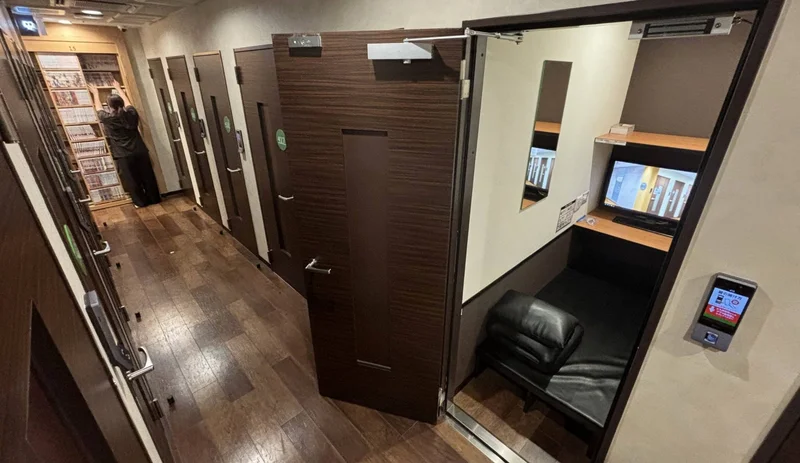
One of Aoki’s biggest growth drivers is its Kaikatsu Club internet cafe chain. At an outlet opened in January in Tokyo’s Higashi-Ginza district, rows of locked private booths line both sides of a quiet corridor. Behind each door is a compact, cushioned room of just 2 or 3 square meters, used for everything from remote work and studying to staying overnight for a reasonable accommodation.
“We see strong demand from young people and women taking breaks during business trips or sightseeing,” said Kaikatsu Club Manager Tsuyoshi Umehara. “Occupancy rates remain high.”
The Higashi-Ginza outlet consists entirely of lockable private rooms, reflecting Aoki’s strategy of repositioning its internet cafes as a premium shared space for a diverse range of users rather than simply offering an entertainment venue.
“Kaikatsu Club is our growth engine,” Aoki Holdings President Haruo Tamura said.
Diversification
Japan’s suit retailers have faced headwinds for years. As the country’s working-age population has been shrinking since the mid-1990s, both Aoki and Aoyama have been diversifying their businesses while retaining their suit market shares.
Aoyama entered the printing business through mergers and acquisitions in 1997 before expanding into restaurant operations and repair services.
Aoki followed a similar timeline, launching karaoke bars in 1998 and opening its first internet cafe outlet in 2003.
While the two companies began diversifying around the same time, the scale and speed of their efforts ultimately made the difference.
In Aoki’s earnings for the year to March 2026, apparel accounted for 51.6% of its consolidated sales, while its entertainment businesses — including Kaikatsu Club and karaoke facilities — have grown into a second pillar, contributing roughly 40% of total sales.
Kaikatsu Club itself has expanded from a single location to around 500 outlets nationwide today, making it the dominant player in Japan’s internet cafe industry. Among the 724 member stores of the Japan Complex Cafe Association, Kaikatsu Club outlets account for a nearly 70% share.
“We had a strong sense of crisis over the future of suit business,” Tamura recalled. “Leveraging our financial strength, we accelerated openings of internet cafes dramatically, sometimes launching dozens of stores at once.”
The result is a business portfolio in which growth in entertainment segment offsets weakness in the company’s mainstay apparel operations.
Aoyama, by contrast, remains overwhelmingly dependent on its core business. Its businesswear division still generates ¥124.2 billion ($761 million) in annual sales — the largest in the suit industry by apparel revenue alone.
The company has diversified into businesses ranging from ¥100 shops and yakiniku barbecue restaurants to printing services, yet none of those operations account for more than 10% of consolidated revenue. Together, its non-apparel businesses contribute only about one-third of total sales.
Looking back, Aoyama President Taizo Endo acknowledged that the company may have been too cautious.
“We may have needed to invest more aggressively in restaurant and repair-service businesses and expand those operations further,” he said.
The company’s heavy reliance on businesswear also left it particularly exposed to changing consumer behavior.
Revenue from its officewear segment fell 6.6% in the latest fiscal year to March as casual business attire has become increasingly accepted following the spread of remote work during the COVID-19 pandemic. Record-breaking summer heat has further reduced demand for suits.
Having dominated the industry for years, Aoyama has been less aggressive in investing in new businesses than its chief rival — and has paid the price as market conditions shifted.
New shopping experience
However, Aoyama is now making efforts to turn the tide.
The company has started offering a new suit shopping experience by introducing Aoyama Plus concept stores to target younger customers.
At an Aoyama Plus store that opened near JR Hachioji Station in western Tokyo in February, touch-screen terminals are positioned throughout the sales floor.
The system automatically measures customers using full-body imaging technology, recommends outfits based on facial characteristics and also allows shoppers to order colors unavailable in-store for home delivery.
The digitally driven format, introduced last year, is designed to attract younger customers who have been drifting away from traditional suit retailers.
By choosing convenient urban locations and minimizing staff interaction, the company hopes to improve accessibility for businesswear. It also aims to raise profitability by reducing inventory.
“We’re rebuilding our foundation with the mindset of being a challenger,” Endo said.
Expanding its lineup of casualwear is another priority.
The pandemic accelerated a casual shift in business dress codes, while casual clothing chains such as Uniqlo and Shimamura have steadily increased their businesswear offerings, intensifying competition.
In response, Aoyama launched its “Everyone’s Suit” collection last November, through which it offers affordable garments that combine the appearance of traditional suits with greater comfort and versatility.
In May, the company also introduced shorts for business use and an expanded lineup of innerwear. “This is the year we restart our casual assortment,” Endo said.
At the same time, Aoyama is placing greater emphasis on diversification.
In July, it established a new division dedicated to mergers and acquisitions. The company aims to increase the share of non-businesswear revenue from roughly one-third now to 50% within five years.
Womenswear
Aoki, meanwhile, is not standing still either.
The company plans to raise the share of casual apparel and womenswear in its clothing segment from the current 16% and 22%, respectively, to 30% each over the next decade.
As part of that strategy, Aoki last year renovated its flagship Ginza store in Tokyo, expanding the women’s floor space by 70% and positioning the outlet as a prototype for future stores.
Until the targets are met, the internet cafe business will remain Aoki’s earnings driver. Tamura, the firm’s president, said the company intends to continue nurturing new businesses while pursuing further diversification through acquisitions.
At the same time, he stressed, “fashion will remain our most important business.”
Whether Aoyama can regain its position at the top of Japan’s suit industry remains to be seen.
Retail analyst Akihito Nakai argues that the contrast between the two companies lies in the boldness of their diversification strategies.
“Compared with its rival, which ventured into completely different industries such as internet cafes, Aoyama has been more conservative in challenging itself through diversification,” Nakai said.
To reverse the tide, “the management will need to make decisions for taking greater risks,” he said.