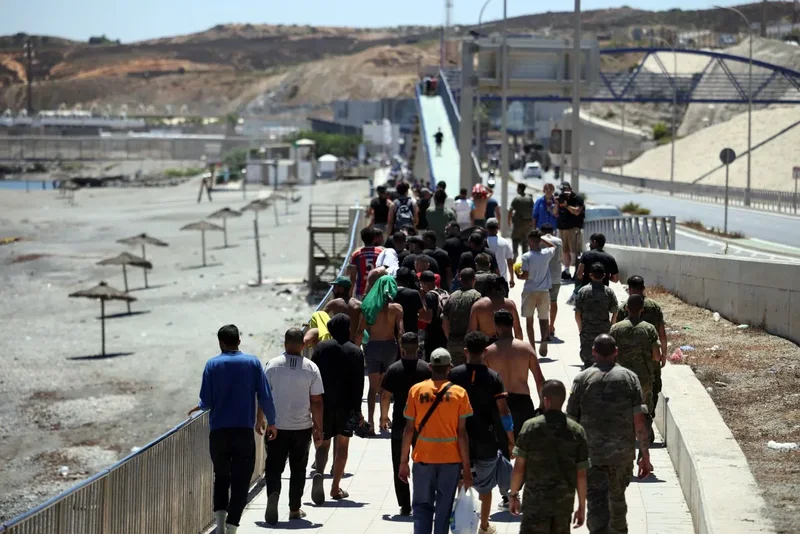
**Morocco blames human trafficking gangs for mass crossing into Spain **
The Moroccan government released its first official statement late Sunday regarding the migration crisis in Ceuta, attributing it to disinformation on social media, human trafficking networks, and misunderstandings surrounding the Spanish Supreme Court's ruling on summary returns.
The Moroccan Ministry of the Interior stated that what happened in Ceuta was not the result "of either spontaneous circumstances or circumstantial factors", but a combination of "the malicious exploitation of digital space and the activity of human trafficking networks", along with "the promotion of misleading information and misinterpretations that accompanied the recent decisions issued by the Spanish judicial authorities".
These "misinterpretations", stemming from misinformation," reinforced among some of those who wished to migrate the conviction that it was possible to avoid immediate return", the Interior Ministry stated.
Rabat also reported that 40,000 migrants have arrived in the autonomous city and that eleven have died on Moroccan territory.
The figures differ somewhat from those offered by Pedro Sánchez's government, which estimated that more than 50,000 people crossed the Ceuta border crossing, most of whom have already returned, and also puts the number of migrants who died on Spanish soil at 72.
On Sunday, Spanish police estimated that some 73,500 migrants have left Ceuta for Morocco in recent days.
Spain's wildfire crisis improves
Forest fires continue to dominate the news in various parts of Spain, although the situation has improved compared to the most critical days of this summer's wildfire season.
The large fires that affected Zamora, Ávila , Madrid, and Castellón over the past week are progressing favourably, while new fires in Extremadura, Castilla-La Mancha, Andalusia, Murcia, and Aragón are yet to be brought fully under control.
However, high temperatures and low humidity mean the risk of new blazes remains high.
Madrid aims to prevent young people with mental issues ending up homeless
Madrid City Council will launch two day centres for vulnerable young people between the ages of 18 and 30, according to sources in the Department of Social Policy.
The new spaces will not be residential but will function as a central hub where young people can go during the day for social, psychological, and employment support.
The goal is to help these young people "regain independence, find employment, or be referred to stable housing when needed, preventing them from ending up in more severe situations of exclusion," the sources explained.
One of the aspects they will focus on is emotional well-being. Mental health professionals will address issues such as migration-related grief, difficulties adapting, language barriers , and social isolation, with the aim of preventing these problems from leading to mental health disorders or addictions.
22 EU countries blame migrant amnesty for Morocco crossing
Twenty-two EU governments have signed a joint letter warning that Spain's mass regularisation of undocumented migrants acted as a "pull factor" which instigate non-EU nationals to attempt to enter the bloc.
This comes just days after 60,000 people stormed the border of the North African Spanish enclave of Ceuta, an event which made headlines across the world, cost 71 people their lives and drew international condemnation.
The letter, spearheaded by Rome and Berlin, has garnered support from countries as diverse as the Netherlands, Hungary, Poland, and Greece, leaving Spain facing a tense extraordinary meeting of its interior ministers on August 4th.
READ ALSO: EU countries call for talks over migrant influx into Spanish enclave
In the letter, the signatories warn that "we cannot allow uncontrolled mass crossings, the instrumentalization of migration, or other hybrid threats to create the perception that it is possible to enter the European Union illegally."
They add a phrase that directly targets Spanish migration policy: "a migrant's illegal entry can become a legal stay."
For the 22 member states, this idea encourages further attempts and weakens common policy.