Eric Stehr was unsure what to think when he first saw fake videos about himself.
He describes his reaction as "mixed feelings," somewhere between amusement and concern, laughter, and helplessness. "I don't want something like that online," he told DW. "But at the same time, I know there's nothing I can do about it."
A German student, Stehr is running for the state parliament in Saxony-Anhalt as a candidate for the socialist Left party. Being second on the party list, he has a good chance of winning a seat in the election on September 6.
But social media posts about him have falsely claimed that:
- He murdered his grandmother to inherit her apartment (archived video on archive.org)
- He killed a webcam model out of jealousy (archived video on archive.org)
- He organized underground LGBTQ+ sex parties at a German university (archived video on archive.org)
- He helped Bauhaus University Weimar give better grades to students from western Germany (archived video on archive.org)
The false reports have been cleverly designed so that they appear to come from major German media outlets, including the Frankfurter Allgemeine Zeitung, Stern TV, ARD and Spiegel TV. But the videos are as false as the allegations they make.
A spokesperson for the police confirmed to DW that Stehr is not under investigation and has not been suspected of murder. Meanwhile, a Bauhaus University Weimar spokesperson confirmed to DW that there are no reports of alleged university sex parties or an alleged grading scandal.
More than 180 fake posts ahead of elections
According to DW Fact Check findings, the videos are part of the Russian influence operation known as Matryoshka, also referred to as Operation Overload. DW Fact Check has identified more than 180 fake posts on X, Bluesky and TikTok ahead of the upcoming elections.
The data comes from a detailed archive maintained by the anonymous investigative collective Antibot4Navalny, which was originally founded to expose disinformation targeting late Russian opposition leader Alexei Navalny and now tracks Russian influence operations online.
DW reviewed several fake posts published since June 24. Notably, the campaign operates only on weekdays, with disinformation activity dropping off on weekends.
Many of the posts target candidates running in the upcoming German elections in Saxony-Anhalt, Mecklenburg-Western Pomerania, Lower Saxony and Berlin, all scheduled for September. The votes are seen as an indicator of Germany's political mood and a test for the country's recently reshuffled federal government.
Operation Matryoshka reaches new level
Observers were not surprised to see Germany become a target of the campaign, but the scale of the operation has raised concerns.
"This influence campaign has been active across multiple platforms since September 2023," said Julia Smirnova, researcher at the Berlin-based Center for Monitoring, Analysis and Strategy (CeMAS). "Its targets have included Germany's federal election, elections in Moldova and Armenia, and the Olympic Games in France."
What is new, Smirnova said, is the focus on relatively obscure individual candidates in local elections. "It is unusual for Russian influence campaigns to target specific candidates in regional elections." According to her observations, candidates from all parties have been targeted, except for the far-right Alternative for Germany (AfD) and the left-wing populist Sahra Wagenknecht Alliance (BSW).
"What we're seeing now ahead of the state elections is a continuation of Russia's long-term strategy: Supporting parties perceived as more Russia-friendly while discrediting other parties and candidates," said Smirnova.
Pablo Maristany de las Casas, a specialist in foreign information manipulation and interference campaigns at the London-based Institute for Strategic Dialogue (ISD), sees similar patterns. Like Smirnova, he says the narratives mirror earlier Russian influence operations. The messages, he argues, are once again "pro-Russian, anti-German and anti-EU."
Who is behind Operation Matryoshka?
While no definitive link to the Russian state has yet been established, there is evidence that Russian-speakers are behind some of the posts, according to Maristany de las Casas. For example, a Spanish-language post on X was found to contain a revealing clue: The post, which targeted candidates Lydia Hüskens and Andreas Silbersack of the Free Democratic Party (FDP), abbreviated their party's name as "SvDP," which would the Russian version: Svobodnaya Demokraticheskaya Partiya.
The OSINT research group Gnida Project, which investigates Russian disinformation campaigns, has previously linked Matryoshka to Russian actors. According to its findings, the operation is technically and operationally connected to Storm-1516, a well-known unit reportedly controlled by Russia's military intelligence agency, the GRU, and which was also active in the lead-up to Germany's federal election in 2025.
For Smirnova, the evidence points strongly in one direction. "With a very high degree of probability, this is a Russian campaign carried out on behalf of the presidential administration," she said, before adding that such operations are often executed by private companies specializing in digital marketing and political influence campaigns.
How can Matryoshka fakes be distinguished from real media reports?
The fake videos are professionally produced, but small inconsistencies often reveal that they are imitating established media brands.
Key questions can help identify manipulated content:
- Is the video published on an official account belonging to the media outlet?
- Do the design and typography match the outlet's actual branding?
- Where does the footage come from, and does it support the story being told?
- Does the video present any verifiable evidence for its claims?
In the current wave of fakes, these questions quickly expose a familiar pattern: Fabricated stories, stolen footage, cloned logos, and imperfect copies of genuine video formats. Many of the discrepancies become apparent only upon closer inspection.
What narratives are being spread ahead of the elections?
The campaign's messaging broadly falls into two categories.
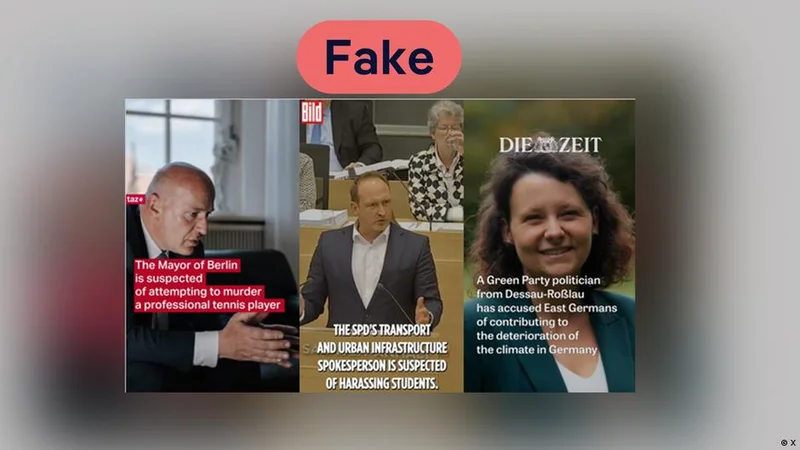
Discrediting candidates: In one case DW spotted a video about Berlin Mayor Kai Wegner (archived video on archive.org) of the Christian Democrats (CDU), in which he is falsely accused of murdering a professional tennis player. The voice of the video is AI-generated and no evidence is provided. Berlin police confirmed to DW that no professional tennis player had recently been killed in the city and that there are no investigations involving Wegner.
Candidates from the CDU, the Social Democrats (SPD), Greens, the Left Party, and the FDP have also been targeted with false allegations of corruption, drug use, and, in dozens of cases, fabricated sex scandals.
Deepening divisions between eastern and western Germans: One fake video masquerading as a Eurostat report (archived video on archive.org) claims that a large majority of western Germans consider reunification a "historic mistake." The supposed survey is not described in any detail, and no evidence of its existence can be found.
In a statement to DW, Eurostat said: "This is a fake video. Eurostat did not produce it. Eurostat did not conduct the "survey" mentioned in the video." In fact, genuine polling paints a different picture of western Germans sentiments: According to an ARD DeutschlandTrend survey from October 2025, 64% of respondents in western Germany said they were satisfied with the state of German reunification.
Numerous other posts claim that eastern Germans face systematic discrimination, that eastern Germany receives less investment in security and infrastructure, or even that experts predict a new division of Germany by 2030. One video goes so far as to claim there are plans to build a new Berlin Wall. None of these claims are true. Some posts even use the hashtag #TimeToDivideGermany.
"The goal is to pit eastern and western Germans against one another, or to suggest that people in eastern Germany are despised, hated, or discriminated against by western Germans," Smirnova said. "It is also about harming specific politicians through false accusations."
How effective is the disinformation campaign?
The operation remains active, with new fake content appearing regularly, but experts interviewed by DW say the campaign's impact appears limited so far. "The impact is really not that significant, as we can see from this artificial amplification of content," Maristany de las Casas said.
Many posts receive tens of thousands of views, sometimes more than 100,000, yet generate little genuine engagement. Comments, shares, and other interactions remain relatively low, and previous research suggests that disinformation campaigns such as Matryoshka/Overload have achieved only modest influence.
Another reason may be platform moderation. Unlike X, platforms such as Bluesky and TikTok often remove the content relatively quickly.
Eric Stehr, however, does not want to rely on that. He plans to file a criminal complaint over the fake videos. His attempt to have one of the videos removed from X was unsuccessful, he said, because the platform said it "saw no reason to take it down," and for now, the disinformation campaign targeting German politicians continues.
Additional reporting by Asya Lokina, Aldo Sanchez Vera and Anwar Ashraf.
Edited by Ben Knight