August marks the start of the countdown to the Northeast monsoon, the season that poses Chennai’s major annual challenge. Even as the city is dealing with the impact of a weak Southwest monsoon, the focus has shifted to ensuring Chennai is ready for the ensuing monsoon, presenting the new government with its first major monsoon test.
The stakes are higher this year as meteorologists continue to monitor the evolving El Nino conditions. While the Northeast monsoon is known for its volatile nature, and often springs surprises, El Nino, a complex climate phenomenon that influences extreme weather, has added another layer of uncertainty this year. In its outlook for the second half of the Southwest monsoon, the India Meteorological Department has observed that the currently moderate El Nino conditions are expected to strengthen through the remaining part of the Southwest monsoon.
The outlook also presents a mixed picture on the global weather factors. While forecasts indicate that neutral Indian Ocean Dipole (IOD) conditions are likely to persist, some international forecasting centres suggest that a positive IOD may develop in September, raising expectations of countering the impact of El Nino.
Officials of the Regional Meteorological Centre note that El Nino is usually favourable for enhanced rainfall during Northeast monsoon. Recalling that 2015 was a strong El Nino year when Chennai experienced a deluge, officials say Northeast monsoon behaviour is shaped by a complex interplay of atmospheric and oceanic conditions and cannot be associated with a single weather phenomenon.
Given that the Northeast monsoon could still produce short, intense rainfall episodes, meteorologists underscore the need for robust flood preparedness alongside measures to safeguard water security. In response to the evolving climate scenario and growing concerns, the government has formed an expert advisory committee to monitor and assess the potential impact of a possible strong El Nino condition this year and recommend measures for preparedness and mitigation. The government on Friday (July 31) ordered allocation of ₹340 crore to augment drinking water sources across the State to ensure no shortage of drinking water in view of the rainfall deficit during this monsoon.
Prepared, but not fully ready
While the city appears to be partly prepared, a significant amount of work is still waiting to be completed before the onset of the Northeast monsoon. A major concern among the residents is whether the remaining stormwater drain work, missing gaps in the drains, and canal improvement projects will be completed in time. For instance, residents of flood-prone areas of Velachery note that the civic agencies have informed them that pumps will be positioned at identified flood-prone locations and additional boats will be kept ready ahead of the Northeast monsoon. However, completion of long-pending flood mitigation projects remains crucial.
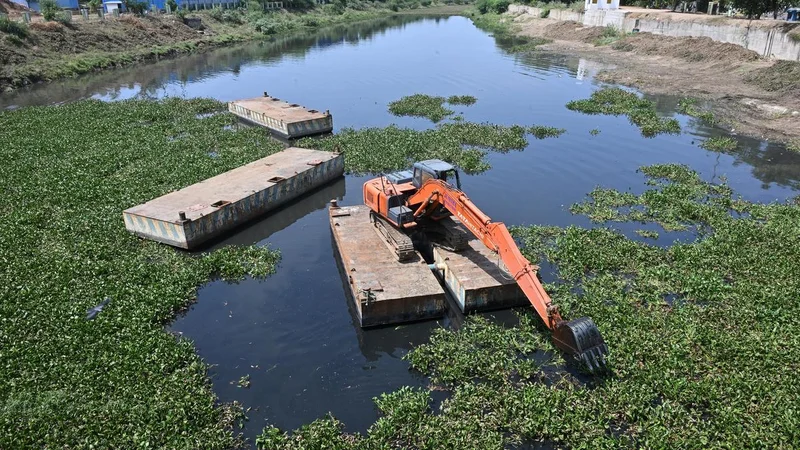
T.R. Subhash of Velachery says the 3.5-km macro drain from the Vijayanagar bus terminus to Thoraipakkam has not been desilted since its construction, despite being the area’s main stormwater carrier. While water hyacinth is being removed from Velachery Lake, a major groundwater recharge source, Geetha Ganesh, secretary of the AGS Colony Residents’ Welfare Association, says, “Velachery Lake should be desilted, wherever feasible, and made free of sewage before the Northeast monsoon. The focus should be on protecting the lake rather than on cosmetic beautification.”
The Greater Chennai Corporation (GCC) identified 87 locations prone to chronic inundation — based on the data from the 2024 monsoon — in its City Disaster Management Perspective Plan 2025. The report showed 26 high vulnerability and 27 medium vulnerability areas, while 34 locations were categorised as low vulnerability.
Councillors flag gaps
Elected representatives from some parts of the city, too, note that flood mitigation projects remain incomplete in their wards.
Puzhal’s Tamilaga Vettri Kazhagam councillor E. Settu says large parts of his ward still lack stormwater drain connectivity. Unless Puzhal Lake is cleared of encroachments in some portions near Surapet, the neighbouring area will remain vulnerable to flooding during the upcoming monsoon.
Some elected representatives have also alleged that they have not been invited to the government’s monsoon preparedness review meetings this year. Complaining that councillors were not informed of the decisions taken at the monsoon preparedness review meetings held at the Ripon Buildings, Communist Party of India (Marxist) councillor R. Jayaraman says that about 10 stormwater drain links remain incomplete in his ward in the Tiruvottiyur Zone because short-term tenders were not being sanctioned. The Corporation Council would pass more than 100 resolutions at this time of the year, including several related to monsoon preparedness. Only fewer than 30 resolutions were passed in each of the past two months. As ward development funds have not yet been released, councillors could not take up local projects, he says.
Mayor R. Priya has also alleged that the elected representatives had not been invited to the government’s monsoon preparedness review meetings this year. Such meetings enable elected representatives to raise constituency-level issues, particularly canal connectivity and flood mitigation requirements, she says.
Noting that monsoon preparedness work has started later than usual, she says canal desilting started a week ago. This year, tenders were issued only in July owing to funding constraints. No new civic projects are being cleared and even small projects and work on connecting the missing stormwater drain links are put on hold because of funding constraints and delays in administrative approval.
Mobilisation of volunteer groups for monsoon preparedness has not taken off either. Snehasri S., one of the two volunteers who submitted reports on monsoon preparedness following the flooding caused by Cyclone Michaung, says she has not heard if the GCC is re-engaging its volunteer network this Northeast monsoon. A senior official, however, clarifies that recruitment of volunteers will soon begin.
Every year, the Water Resources Department (WRD) launches comprehensive monsoon preparedness projects to desilt waterways and waterbodies in and around the city, ahead of the Northeast monsoon. With the government order for these projects being delayed, the department launched a special drive earlier this week to desilt some of the vulnerable sites with the support of non-governmental organisations and under corporate social responsibility initiatives.
This year, NGOs and citizen volunteers have been roped in. The drive has been extended to the catchments of key reservoirs, including Poondi and Red Hills. As many of the ambitious flood mitigation projects may not begin until early next year, the WRD is eyeing short projects, to be taken up with the State Disaster Mitigation Fund, to remove bottlenecks in the waterways and reduce flood risk.
Major projects under scrutiny
Concern has also been voiced over two ongoing projects — Chennai Port-Maduravoyal Elevated Corridor and Mamallan Reservoir — with environmentalists and residents pointing to increased flood risk, if adequate mitigation measures are not in place.
Councillors have demanded a study on the impact of the existing bridges and Metro Rail work on the Cooum’s carrying -capacity. Responding to the worries, GCC Commissioner G.S. Sameeran says the civic body has recognised the long-term importance of assessing the hydraulic impact of permanent structures on the Cooum riverbed. The WRD has entrusted Anna University with carrying out a scientific impact assessment of the piers constructed for the elevated corridor. The university will also recommend mitigation measures, he says.
While the WRD noted that it would coordinate with NHAI on the removal of work platforms during the monsoon, official sources in the NHAI say the elevated corridor design has been changed. The entire double decker structure stands on only one pillar. The NHAI monitored the water flow in the past two seasons, and there was no flooding due to the pillars. Work platforms are removed from October to January.
Similarly, environmental groups and fishing communities have alleged that the proposed Mamallan Reservoir, conceived as Chennai’s drinking water source, could increase flood risk in the low-lying coastal landscape between Old Mahabalipuram Road and East Coast Road. According to J. Prasanth, of Chennai Climate Action Group, converting this dynamic tidal landscape into a freshwater reservoir, enclosed by embankments and regulators, could obstruct the discharge of floodwaters during extreme rainfall, especially when heavy rain coincides with high tides or cyclonic storm surges.
Metrowater faces different challenge
This monsoon could present another set of challenges to Chennai Metrowater. The agency is strengthening water sources to sustain uninterrupted water supply until early next year, upgrading many sewage pumping stations and desilting sewer lines. However, the ongoing infrastructure projects to build new stormwater drains or gas pipelines often lead to recurring damage to sewer and water pipelines. In July, Metrowater received nearly 1,850 complaints, mostly pertaining to sewage block or overflow, following the collapse of ageing pipelines or the damage to the network.
Officials note that the issue continues despite sharing of maps of the agency’s underground infrastructure. They attribute the problem to the lack of coordination with other agencies when projects are executed. To address power outages during the monsoon, the Tamil Nadu Power Distribution Corporation Limited (TNPDCL) has instructed officials to prioritise buildings, including hospitals, public water supply and communication towers, for precautionary measures. Special teams have been formed for restoration.
TNPDCL Chairman and Managing Director V. Arun Roy has emphasised the need for speeding up maintenance work, including pruning of tree branches, to avoid snapping of overhead power lines and replacement of the damaged poles. TNPDCL has also identified sub-stations that got flooded in the past. A senior official says 18 sub-stations, including Perumbakkam, Manali, and Tondiarpet, were affected during Cyclone Michaung. Steps are being taken to prevent flooding.
Urban planning experts note that accelerated urbanisation, particularly near river basins, has intensified flood vulnerability by disrupting natural water retention areas. Anna University’s former professor of urban engineering K.P. Subramanian says that besides low-lying topography and inadequate stormwater drains, rapid but unplanned urbanisation is the pre-eminent cause of recurring floods in Chennai. Shrinking waterbodies have also led to flooding. “The government may consider making one of the secondary cities (Coimbatore, Madurai, and Tiruchi) as an administrative capital. Such a strategy may lead to the decentralisation of Chennai, making it less vulnerable to flooding and other natural disasters,” he says.
(With inputs from Aloysius Xavier Lopez, R. Aishwaryaa, R. Srikanth, Geetha Srimathi, and Deepa H. Ramakrishnan)
Published - August 02, 2026 06:00 am IST