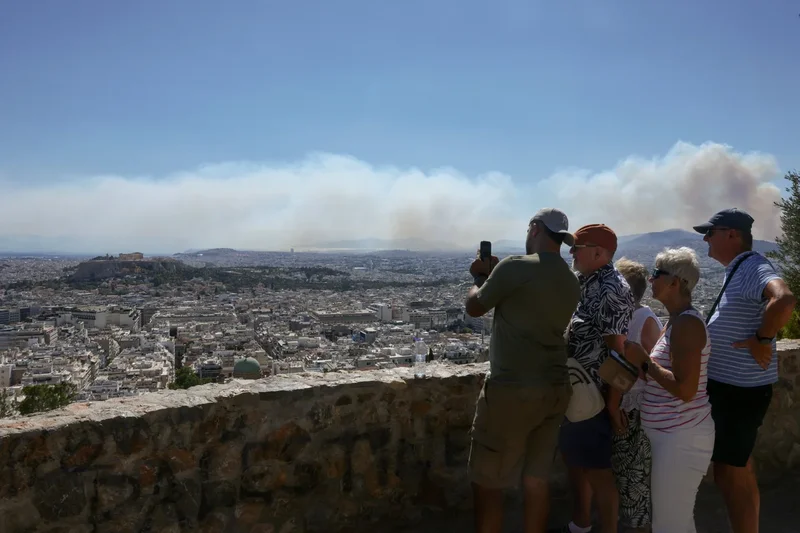
This summer is on track to become Europe’s worst season for wildfires in history, as devastating blazes rip across countries, forcing thousands to evacuate and homes burned to the ground.
At the end of July, the amount of burnt areas in the EU reached almost 435,000 hectares, with concerns that dry and hot temperatures are only increasing the potential for more fires to start.
Residents in countries such as France, Spain and Greece have been forced to evacuate from the hardest hit areas, while many tourists on holiday have also been moved out of their hotels or turned away from popular resort towns.
Travellers who have a holiday booked this summer may now realise they have limited cancellation cover if they no longer want to go abroad due to concerns over wildfires.
While regional authorities in Gironde, where some of the worst wildfires have erupted, have urged tourists to avoid the area until the situation is under control, flights to Bordeaux are still operating, and the UK Foreign Office has not warned against travelling to the area.
The Independent spoke to Simon McCulloch, the chief growth officer of holiday insurance company Staysure, who explained what holidaymakers need to know about their rights as the wildfires continue to disrupt and destroy in Europe.
My holiday has been cancelled. What is my next step?
Mr McCulloch says that claiming money back on a cancelled trip can depend on whether it’s a package holiday.
He explains: “If you've booked a package holiday [and it gets cancelled] then you should be covered by Atol or Abta, the UK travel providers' protection systems. So what that means is effectively it's their job to get you home … and provide you with some sort of refund, a rebook or credit.
“If you arrange everything yourself, then that's where you would be looking for travel insurance to help.”
Travel disruption cover, which is included as standard in a lot of insurance, will help with additional costs that travellers have in terms of getting back to the UK.
My holiday has not been cancelled. But I don’t want to go
While policies can differ between insurance providers, travel insurance will usually cover three main perils: medical care while away, baggage and cancellations due to unforeseen circumstances like illness or injury.
“It doesn't cover any circumstance. It covers something that happens to you, rather than a change of mind,” Mr McCulloch says. “So, for example, if you saw the wildfires on TV and you just thought, I don't like the look of that. I think I'll just cancel. You wouldn’t be covered under a normal travel insurance policy.”
This is different when the UK’s Foreign Office (FCDO) declares that you should not travel to a country.
In the case of France, Spain, Greece, and other countries experiencing devastating wildfires, the FCDO has not declared any new “do not travel” alerts.
The bottom line: if the government does not declare a “do not travel” warning, and package holidays, hotels and airlines are happy to carry out bookings, then there is not a lot of scope in getting money back if you cancel your holiday.
Mr McCulloch says that in the future the insurance industry will have to adapt its policies to include disruption caused by natural disasters, as wildfires have shown unprecedented severity in recent years.
France is on track for its worst season for wildfires since satellite records began in the early 2000s, recording three of the 15 largest wildfires since the European Union began recording data 20 years ago.
Even if you do not think you are covered for wildfires, Mr McCulloch says it is always worth checking with your travel insurance provider just in case.
“My recommendation would be, other than airlines and package holiday providers, contact your travel insurer anyway, because a lot of people don't necessarily know the full detail of what their policy covers,” he explained.
What should I know when buying insurance in the future?
Mr McCulloch reminds people that you cannot buy travel insurance when you are already on holiday because “that's what they call a known event”. You have to buy the cover before.
He says when buying travel insurance, it’s worth considering a travel disruption extension.
Mr McCulloch explains: “It would probably cost you an extra tenner or so. That would cover things like geological or weather events, emergencies, or situations that are extreme that are not to do with a medical [condition] that affects you.
“We're seeing about 20 per cent of customers looking at that as an add-on to their normal travel insurance policy now, which is up significantly from where it was a year or two ago.”
He also says there is a new policy emerging in the market called “cancel for any reason” cover, which means you can cancel your trip and claim insurance on almost any grounds, but it is very expensive.
Read more: The European tourist destinations under threat from wildfires and heatwaves