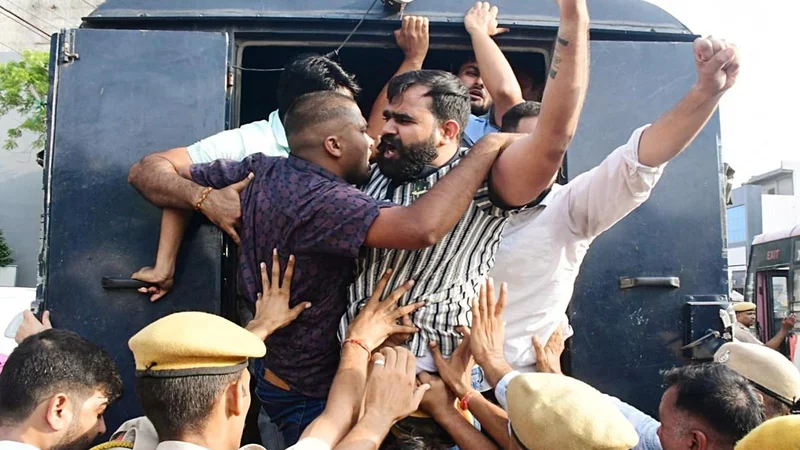
The Supreme Court on Monday (August 3, 2026) clarified that its July 28 order would not prevent the NCT of Delhi or any other State from closing or withdrawing proceedings arising out of FIRs registered against student protesters, wherever permissible in accordance with law.
The clarification came after the Centre submitted that it was “serious” about its assurance that amnesty would be granted to students who had participated in demonstrations over the NEET examination paper leak, including the July 20 Parliament march in Delhi and subsequent protests in several States.
A Bench headed by Chief Justice of India (CJI) Surya Kant also clarified the scope of its earlier direction restraining the police from taking coercive action against protesting students unless they had criminal antecedents. The Bench said the protection would not extend to persons accused of serious offences, including rape and other heinous crimes.
The Bench also suggested that the FIRs registered across the States could first be identified and classified, following which the authorities could take recourse to the appropriate statutory procedure in each case.
“If you can gather information from other States on how many FIRs were registered... After this classification, you can then take recourse [to law],” the Chief Justice remarked.
Justice Joymalya Bagchi added that the court could “enable” the process once both sides arrived at an agreement on the cases that could be considered for closure or withdrawal. He pointed out that the investigating agencies could file closure reports under Section 193 of the Bharatiya Nagarik Suraksha Sanhita, 2023 (BNSS), while the concerned public prosecutors could seek withdrawal from prosecution in accordance with the statutory procedure.
Solicitor General Tushar Mehta, representing the Union government and the Delhi Police, submitted that senior counsel appearing for the petitioners could engage with the “leaders” of the protests and the government to work out the “semantics” of implementing the assurance.
“I have instructions to say that the government is serious on the commitment... We are working on that... Those who are leading the protests are in touch with the government so that semantics can be worked out... Let them sit with the government,” Mr. Mehta said.
The Bench also reiterated that it would consider laying down a comprehensive and uniform protocol governing the use of pellet guns as a crowd-control measure, including the circumstances in which their use may be permissible.
The Bench posted the matter for further hearing on August 18 and directed the Union government to file its response in the meantime.
Published - August 03, 2026 01:59 pm IST