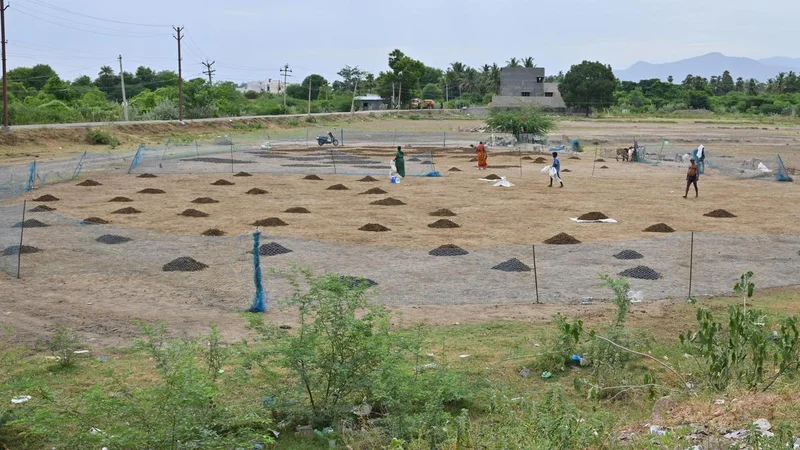
As Tamil Nadu Chief Minister C. Joseph Vijay’s Tamilaga Vettri Kazhagam (TVK) government gears up to present its first agricultural Budget on August 6, 2026 expectations run high across the State. Farmers and traders in the agricultural-heavy southern region, in particular, are looking forward to bold announcements that could revitalise the local farm economy.
Starting from the government’s recent farm loan waiver announcement which has sparked widespread discussion, with farmers now demanding that the policy include all outstanding cooperative crop loans issued up to February 28, 2026—regardless of whether the farmer is classified as small, marginal, or otherwise to demand for resolving the ongoing issues in the procurement centres across the State, the farmers have a bucketful to be redressed/solved by the government.
Reeling from drought and the severe impacts of El Niño, farmers across the Delta and southern districts have expanded their list of demands to include immediate financial compensation for their lost crops.
S. Rethinavelu, founder and president of the Agri and All Trade Chamber, has put forward key proposals to tackle future climate change challenges by preserving micro water bodies for irrigation and improving agricultural marketing.
Noting that nearly 60% of irrigation tanks remain below half capacity despite receiving around 33 cm of rainfall due to encroachments and blocked supply channels, he highlighted the specific issue at Nilayur Kanmoi near Thirupparankundram.
The damage to its northern and western bunds causes rainwater to flood residential areas like Thanakkankulam and Thoppur while wasting vital water resources.
To fix this, he suggested desilting the tank, strengthening and raising the bunds, and constructing a perimeter road to boost water storage and improve local connectivity.
On the agricultural front, Mr. Rethinavelu pointed out that farmers often sell crops at farm gates without proper drying, cleaning, or grading, securing low prices that discourage younger generations from entering farming.
To counter this, he urged the Department of Agriculture to upgrade Agri Regulated Markets with comprehensive infrastructure such as mechanical and solar drying units, cleaning and grading facilities, cold storage, transparent auctions, full-fledged testing laboratories, and low-interest bank loans against warehouse receipts.
Observing that current Tamil Nadu market committees lack these facilities, he recommended acquiring 100 to 200 acres per location to establish large-scale market infrastructure similar to models used in several North Indian States.
Mr. Rethinavelu said that the market fee on agricultural produce, originally introduced in 1933, has become obsolete under the modern progressive taxation system, especially since most agricultural and value-added goods are already taxed under the Goods and Services Tax (GST).
Continuing this fee constitutes double taxation, particularly given that Tamil Nadu’s GST collection reached ₹1.31 lakh crore in the 2025-26 financial year.
Pointing out that the controversial fee yields less than ₹150 crore annually while allegedly breeding corruption, he urged the State government to abolish the market fee on agricultural products to protect farmers and processors from unnecessary financial burdens.
M. Muthuramu, State vice-president of the Tamil Nadu Vivasayigal Sangam, emphasised that the primary demand of farmers in southern districts like Ramanathapuram and Sivaganga is the completion of the stalled Cauvery-Vaigai-Gundar linking project, which is essential to secure adequate water for local farming.
He also called for resolving ongoing issues at Direct Procurement Centres (DPCs), urging both State and Union governments to increase the procurement price of paddy from ₹24 to ₹35 per kg to reflect the hard work involved.
Highlighting market exploitation, he noted that while farmers receive low prices during harvest—such as ₹1,050 for a 62 kg bag—private traders hoard the stock and resell it for up to ₹2,000 during high demand.
Additionally, he demanded the immediate abolition of illegal commissions ranging from ₹30 to ₹50 per bag charged by middlemen at village-level DPCs, where vulnerable farmers are forced to comply out of fear that their paddy will be unfairly rejected over moisture concerns, particularly in regions like Thiruvadanai, the rice bowl of Ramanathapuram.
Published - August 02, 2026 08:23 pm IST