How Israeli presence in Forest City exposes the Zionist-aligned underbelly of Malaysia
On 15 July, Anwar Ibrahim, the prime minister of Malaysia, said authorities would deport any Israeli nationals found in the Southeast Asian country, while strongly expressing that Malaysia would "not compromise" on its immigration policies.
"If we find any Israeli, we will deport them immediately because we do not recognise Israel," the prime minister said, according to local media reports.
His comments came as officials investigated allegations that Israelis were involved in a private residential and technology community in the southern state of Johor.
Johor Chief Minister Dato Onn Hafiz Ghazi stated that at the state level, the Iskandar Puteri City Council (MBIP) and relevant agencies would re-examine the Network School's business regulations.
He also called on the federal bodies of the Home Affairs, Immigration Department, Police and Customs Department to investigate the allegations of Israelis in the Network School. Malaysia's federal Home Affairs Ministry later that day ordered a probe.
After two rounds of investigations, the Immigration Department said there were no violations among the 379 foreign nationals it investigated at the Network School, adding that 19 individuals' movements could not be traced.
The Immigration Department's Director-General Dato Zakaria Shaaban said that these individuals could have entered or left the country illegally. He added that authorities are on the lookout for the untraced individuals.
Then, on 17 July, Ghazi issued several notices to the Network School after authorities found that one of the premises linked to the school was operating without a valid business licence.
On 23 July, the United States summoned Malaysia's ambassador to the US, Tan Sri Muhammad Shahrul Ikram Yaakob, to explain the nation's position on Israel. The Malaysian government stated that it would not change its immigration stance towards Israel.
Founder of the Network School, Balaji Srinivasan, announced on X that he wanted an audience with the prime minister to restore his confidence in Malaysia as an investable jurisdiction.
Balaji Srinivasan: Venture capitalist and Zionist ally
Balaji Srinivasan, a former Silicon Valley venture capitalist and Stanford professor, publicised the Network State in 2022.
Marketing it vaguely as a startup society focused on peace, Srinivasan proposed building a "startup country" from the internet up.
The Network State describes the idea on its website as "crowdfunding territory" and "eventually gaining diplomatic recognition from pre-existing states".
The website calls this new state a composition of an "ethnic diaspora" in which emigrants are connected with "the motherland" and come together in person to build dwellings and structures.
"In a sense, you can think of each physical outpost of this digital community as a cloud embassy," it says, adding that "recruits can visit either the virtual or physical parts of a network state, beta test it, and decide to leave or stay".
Along with Srinivasan, the Network State is financed by tech entrepreneurs Peter Thiel, Marc Andreessen, Joe Lonsdale, Patri Friedman, as well as crypto firms like Coinbase and Praxis.
Peter Thiel's Palantir has invested in Israeli military and surveillance startups accused of providing technological support to Israeli intelligence in the Palestinian genocide.
Praxis, a company funded by Marc Andreessen, Sam Altman and Peter Thiel, has proposed building a tech-owned city on Greenland after US President Donald Trump's repeated threats to take the territory by force. Trump has also shared the intent to build a Trump luxury resort in Gaza.
Critics argue that the Network State model resembles historical settler projects because it envisions digitally organised communities purchasing or controlling physical land.
Some scholars have also pointed to Srinivasan's frequent references to Israel as an example of successful nation-building, arguing that his writings draw inspiration from Israel's state-building experience.
In 2024, centring the pitch around proximity to Singapore, Srinivasan formed the Network School in Malaysia's Forest City, in the southern state of Johor.
Making of Forest City: Fisherfolk and reclaimed land
The project's location in Malaysia's Forest City in Johor has added another layer of complexity. In a recent video podcast, Srinivasan alludes to the Network School being born out of "nothing into something".
The "nothing" on which the multibillion-dollar development is built is termed "reclaimed" land in Johor and has faced criticism for its environmental impact on coastal ecosystems and local fishing communities.
Forest City is a joint venture between China's Country Garden Group and Malaysian private company Iskandar Esplanade Danga 88 Sdn Bhd (EDBS), whose shareholders include Johor's Sultan Ibrahim and interests linked to the United Malays National Organisation, a Malay nationalist political party.
Between July 2024 and June 2025, Malaysia attracted about $759m in data centre investments, with Johor emerging as a key hub alongside the Johor-Singapore Special Economic Zone.
An extensive investigation by Mongabay revealed how a Chinese builder began construction in the Forest City without an environmental impact assessment, devastating local seagrass and sparking strong community protests.
The project also saw massive sand dumping, which destroyed marine habitats and hundreds of hectares of traditional fishing grounds.
Rights groups have previously raised concerns that most of Forest City's workforce comprised low-wage labourers from South Asia, especially Bangladesh.
The project has drawn controversy again, after allegations circulated online that Israeli nationals were participating in the Network School.
The dispute exposed contradictions between Malaysia's pro-Palestine foreign policy and its efforts to attract international technology investment, even as government officials have maintained that enforcement actions were based on regulatory compliance rather than political considerations.
Neocolonial Malaysia: US imperial base, pro-Zionist hub
The developments surrounding the Network School have fuelled a wider debate over Malaysia's balancing of its support for the Palestinian cause and economic relationship with the United States and western capitals.
The country is shaped by a constitutional monarchy, where political and economic power is concentrated among the federal government, state authorities and royal institutions.
The Federation of Malaysia was formed in 1963 and has since come down heavily on the people's movement in Malaya (West Malaysia) and Borneo (East Malaysia), allowing projects like the Network State to be built without much public resistance.
In 2024, Malaysia allowed a subsidiary of BlackRock to join a consortium to take ownership of Malaysia Airports (MAHB), Khazanah Nasional and the Employees Provident Fund (EPF), under the jurisdiction of the finance ministry led by Prime Minister Anwar Ibrahim.
Civil society organisations in the country called on Ibrahim to make "the right and conscionable decision" by excluding the "Zionist entity conducting a settler-colonial and racist genocide in Gaza".
Local media reported that the administrations "launched an aggressive media campaign to discredit critics of the plan".
In April, several international defence companies with business relationships with the Israeli military participated in the Defence Services Asia (DSA) and National Security (Natsec) Asia 2026 exhibition in Kuala Lumpur.
Companies included Lockheed Martin, a US defence contractor that supplies aircraft and other military equipment to Israel, MBDA, a European missile manufacturer whose products have been exported to Israel, and Colt's Manufacturing, a US firearms producer whose weapons are used by the Israeli military.
Civil society members pointed to investment links between Malaysian conglomerate Sime Darby and Caterpillar, whose bulldozers have been used by the Israeli military in demolitions in the occupied Palestinian territories.
They also cited the operations of Australian rare earths producer Lynas in Malaysia, arguing that rare earth minerals are used in global defence supply chains, including those serving Israel.
Campaigners in Malaysia have alleged that Malaysian ports have been used to facilitate shipments linked to Israel's military supply chain.
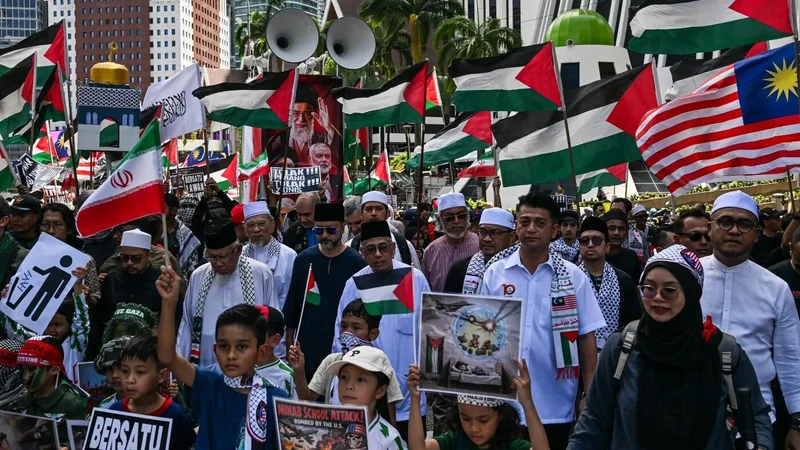
In 2025, Ibrahim welcomed Trump during the ASEAN Summit despite protests against his visit.
Police maintained tight security, while rights groups accused Malaysian authorities of detaining and intimidating pro-Palestine protesters during peaceful demonstrations.
While officials have maintained that the country cannot sever ties with every international company that has business links to Israel, the Network School controversy has exposed Malaysia's projection of a pro-Palestine foreign policy alongside its ambition to attract foreign technology investment.
Johor remains a key destination for data centres and AI investments as part of the Johor-Singapore Special Economic Zone.