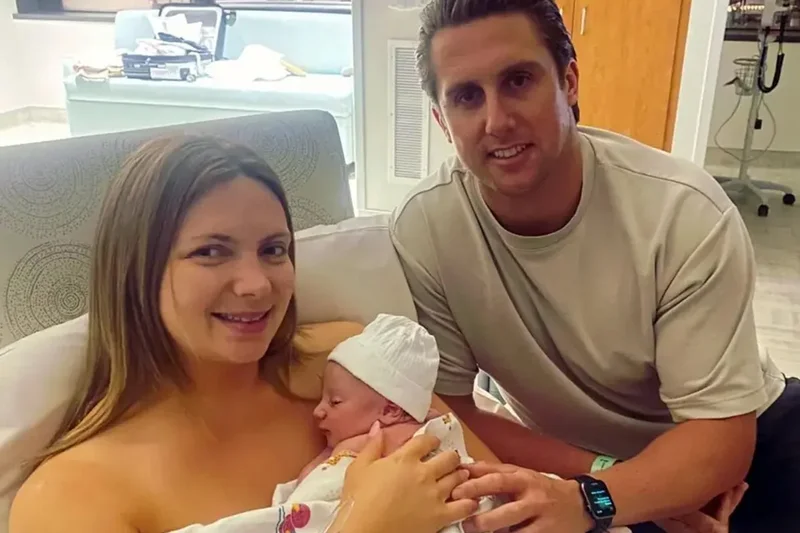
A baby boy has made medical history as the first child from the UK to undergo pioneering surgery for a rare condition while still in his mother’s womb.
The groundbreaking US-performed procedure offers new hope for infants diagnosed with gastroschisis – a birth defect where the intestines develop outside the body.
Maisie Savage, 29, from London, was 26 weeks pregnant when her son, Theo, had the operation over in the US.
The complex operation took place at Texas Children’s Hospital as part of a clinical trial, in partnership with London’s Great Ormond Street Hospital (Gosh) and KU Leuven in Belgium.
Surgeons partially exposed Ms Savage’s womb to carefully place Theo’s intestines back into his body. This innovative technique mirrors procedures for spina bifida, where doctors operate to close spinal gaps, typically between 19 and 26 weeks of gestation.
Theo was carried to full term and born in Texas in February. Ms Savage described her son as a "little miracle." He is the first UK baby to benefit from this procedure, and only the third worldwide.
Gastroschisis affects approximately one in 3,000 babies born in the UK annually, usually detected during the mother’s 20-week scan. Current treatment involves surgery soon after birth, followed by weeks in intensive care and tube feeding. Severe cases can necessitate multiple operations, extended hospital stays, and can sometimes be fatal.
Paolo De Coppi, a professor of paediatric surgery at UCL Gosh Institute of Child Health and consultant at Gosh, expressed optimism.
He stated: "Previous success rates with spina bifida indicate this could essentially offer a cure for gastroschisis.
“If the results are positive, we hope this could become the standard operation for complex gastroschisis cases,” Professor De Coppi added.
He noted that families could "go home sooner after birth with a healthy baby that shows few signs of their bumpy start in life – the whole process has been very exciting and a big team effort." He confirmed that Theo is "doing remarkably well."
Should the trial prove successful, this life-changing procedure could be offered to patients within the UK, marking a significant advancement in foetal medicine.