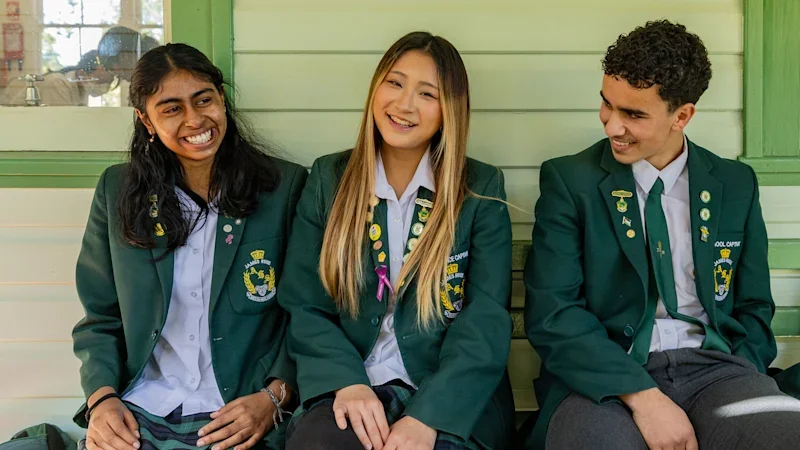
Students at James Ruse Agricultural High recorded the highest average scores of any public school in the Higher School Certificate last year.
A Herald analysis of hundreds of public schools’ HSC results found James Ruse students’ average mark across all subjects was 91.3 last year, placing it just above students at North Sydney Boys and North Sydney Girls.
Selective schools dominated the top performers, taking out 19 of the top spots.
But several non-selective single-sex schools – including Willoughby Girls, Balgowlah Boys and Cheltenham Girls – outperformed several partially selective ones.
The Herald analysis uses precise average subject marks, contained in public high schools’ annual reports, across all subjects.
This analysis stands in contrast to the Herald’s end of year HSC league tables, which use limited performance data provided by the NSW Education Standards Authority each December. That data shows the proportion of students at a school scoring in the top band, with a mark over 90 per cent in each subject. On that measure, North Sydney topped the state, but on averages alone, it placed second to Ruse.
Inside his office this week, James Ruse principal Matt Dopierala refused to be drawn on his school recording higher average marks than North Sydney Boys. He simply said his school’s success was driven by a culture of collaboration.
“We’re one team, all heading for the same goal– to turn academic success into well-rounded young people who can succeed in anything they do,” he said.
In staff meetings over the past two years, there’s been a greater focus on discussing pedagogical approaches while some teachers get release time off class so they can observe how their colleagues deliver a lesson.
“You become a better educator, a better student, or a better learner, no matter who you are, by being part of Ruse,” Dopierala said.
The school might have the best results, and an even better reputation. But for some prospective parents whose children are offered a place, it is not always enough.
Dopierala says that is because an offer from Ruse is a “very good lure” to the private school system because it acts almost as “a guarantee of good performance” for how a student will perform.
“So the private schools are very willing then to offer places to these families, and sometimes with a scholarship,” he said.
“The shiny things can be attractive to families, but you can’t buy the people who are here.
“When you come here, it’s like making the Olympic team. You don’t say no to that. You continue to compete. You continue to extend yourself. You continue to engage because then you’re going to be the best you.
“And when you’re joining the others that are just like you, that excellence is amplified. It’s not diluted.”
Year 11 Ruse student Zain Abdu, who is an incoming school captain, said his friends outside of school had a certain stereotype of James Ruse.
“If I tell one of my friends from, I don’t know, Punchbowl Boys for example, they’ll think, ‘Oh, how much do you study? Is it seven or eight hours a day?’ And ‘Oh wow, you’ve come out of the study den, you’ve finally come to see us’.”
While his friends might be facetious, the reality is different, he says.
“If I were to describe what it’s like to be a James Ruse student: I come to school to engage in extracurricular activities, and then at some point maybe I start thinking about studies the day before the assignment or something.”
Catholic and private schools were not included in the analysis because most do not publish comparable data.
An exception is selective private school Sydney Grammar, which last year had an average score of 90.63.
Sydney Grammar headmaster Stuart McPherson said the school took every HSC course “very seriously” but was also committed to a broad education because a “liberal course of education” was written into the act that established the school in 1854.
“That’s why at Grammar we require boys to take 12 units (not the standard 10) in year 12,” he said.
It equipped students with a broad-based education, he said, across humanities, social sciences, languages and creative arts, alongside English, maths and the sciences.
“This means that boys at our school can’t do the English, Maths Extension 2, two sciences set of subjects that is common amongst other high-achieving academic environments.”
Chatswood High was the top-scoring partially selective school, where the average student result in a subject was 81.88. It was followed by partially selective Parramatta High and Sydney Secondary College Blackwattle Bay.
NSW Education Department Secretary Murat Dizdar said the outstanding HSC results reflect the sustained hard work of students, the expertise of teachers and school leaders, and the strong focus on explicit, evidence-based teaching in schools.
“They are a powerful reminder to parents of the quality of education available at their local public high school, where students are supported to pursue excellence, their passions and realise their full potential,” Dizdar said.