Good morning,
I am happy to be back, and not a moment too soon. When I scheduled this vacation I knew I would come back to a flood of earnings news; I’m going to focus on working through those this week, but I also think this was a very productive break in terms of thinking bigger picture about AI and its implications. I’m very excited to get back to writing, both about these near term results and long-term considerations.
In case you missed it, on the last Sharp Tech episode, Andrew and I discussed rogue OpenAI models, intelligence as a commodity, and the Chinese model conundrum. I also recorded an episode of Dithering on vacation about Jensen Huang’s open letter.
On to the Update:
Meta Earnings
From Bloomberg:
Meta Platforms Inc. gave a disappointing quarterly revenue forecast, stepping up pressure on Chief Executive Officer Mark Zuckerberg to allay investor concerns that the company isn’t swiftly benefiting from its massive outlay on artificial intelligence. The stock fell. The social media giant also reported the lowest free cash flow in years, a sign of ballooning expenses for AI bets, including data centers and smart glasses, which could amount to $145 billion this year. Meta shares slid about 8% to $539.03.
In part because it doesn’t yet have a cloud-computing business and its AI products have at times been considered less competitive than some other AI labs’ work, Meta has faced recurring investor skepticism that it will recoup this spending. Meta announced several new AI-related business lines in recent months, including a consumer chatbot subscription and a pay-to-use AI model for developers, though those are in early stages.
On the call Wednesday, Zuckerberg teased another potential business line: A cloud computing business where Meta would sell computing power to other companies. The CEO said that a “substantial” amount of Meta’s computing power currently goes toward training its own AI models, a necessity for being a leading AI lab. But he also said that Meta has a “large number of offers” from companies interested in buying its computing power at a “meaningful premium” over what Meta spent to acquire it. That has created an opportunity, he added, saying that Meta must now think through the tradeoff of selling the computing power it has for a profit versus continuing to use it for its own products and services. These calculations are happening at the same time that Meta is also buying computing power from independent data-center operators — so-called neoclouds — as well.
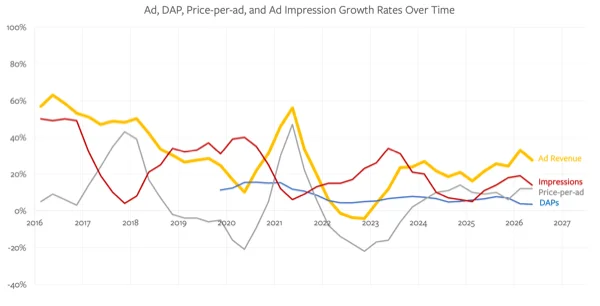
I did, of course, have to start with Meta, given that I already wrote what I thought Zuckerberg should say on the earnings call. I’ll get to what extent he met my expectations in a moment, but first a quick check-in on my favorite long-running Meta earnings chart:
The most interesting lines on this chart are always impressions growth and price-per-ad growth, which historically move in opposite directions for what should be an obvious reason: more impressions growth means more supply, which given stable advertiser demand, results in decreased price growth; less impressions growth means less supply, which given stable advertiser demand, results in increased price growth. That means the most extraordinary results for the underlying business are when both impressions growth and price-per-ad growth are increasing, because demand growth is outpacing supply growth. This happened most notably in 2023 when Meta finally figured out ATT (improving advertiser demand) even as the company started to heavily monetize Reels (increasing ad supply).
I was a bit concerned throughout 2025 that the company was juicing supply by increasing ad load; Meta characterized this as “ad load optimization” and evidence that their spending was justified through increased monetization. And, last quarter, it all seemed to come together: impressions growth increased, and price-per-ad growth increased; if Meta could keep that trend up then perhaps investors would tolerate their capex spend simply because the core business was on a 2023-type of expansion.
Unfortunately, while this quarter’s results are still very good, they’re not quite as extraordinary, and that’s a problem when expenses increased 55% while revenue increased 28% — and remember, a lot of the company’s capex hasn’t started depreciating yet (and yes, that increase includes charges related to legal proceedings, but those might not be a one-off!). The company, more than ever, needs to convince investors about its AI spending on its own merits, and frankly, I came away from the call a bit alarmed.
Meta’s Timing Problems
I noted above a timing issue in terms of Meta’s expenses: you pay for capex with cash, but you don’t recognize it as an expense until it comes online and you record depreciation; you can also agree to long-term leases which save current cash flows but are also bigger liabilities. Those liabilities are not small; again from Bloomberg:
Meta Platforms Inc. said it has already committed almost $700 billion in future spending, through long- and short-term agreements, related to artificial intelligence data centers, cloud computing and more. Meta has $349.3 billion of non-cancelable contractual commitments, mostly related to third-party cloud deals, servers and network infrastructure, it said in a regulatory filing Thursday. That is a conservative estimate, because for agreements with variable terms, “we do not estimate the total obligation beyond minimum quantities,” Meta said. The company also has $347 billion in commitments for leases that have not yet started, and so are not yet reflected on its balance sheet. That includes $68 billion added in July alone, with payments starting in 2027 and 2028. The costs are in addition to active leases and consist of data centers, colocations and “certain network infrastructure.”
What confused several investors on the call was why Meta was also renting compute from third parties; the issue the company faces is one of timing. Last summer Zuckerberg realized — correctly, in my opinion — that Meta risked falling out of the AI race, and not only spent heavily on AI talent, but also had to scramble to get more compute for training. The problem is that actually building data centers takes time — multiple years — which Meta didn’t have; thus the renting. Ultimately, however, Meta wants to own its own data centers, not just for training but also for inference, which means they need to spend to build now for years from now.
This timing mismatch is the biggest issue Meta has when it comes to investors. The company right now is basically double-paying for infrastructure without a clear path to monetization (i.e. no public cloud business) and, to make matters worse, its “improving monetization” story lost a bit of its luster. I do think investors still buy the latter — Meta is still growing faster than any other at-scale ad platform — but wonder why the company can’t just focus on what they are actually good at, i.e. selling ads on user-generated content.
That there is the second timing problem: Zuckerberg isn’t concerned about the current business, but rather Meta’s existential risk in the face of AI. I thought his best moment on the call was when an analyst asked him why the company couldn’t just use other models:
I can take the open source question. Let’s see. So basically the question is, do we think that because there are some open weight models that we can just rely on those. I mean right now the open source models are not as strong as the frontier models. So no is the basic answer. And then there’s also just always the perpetual both policy debate and question around other companies’ actions and whether that’s actually a thing that a company like Meta can rely on. And I think that that’s very tricky. So I think on both fronts, we believe we’re going to be able to do better work, and we think that there’s some risk in that reliance, I don’t believe that that is the right thing to do.
I think that we’re a company that — if you look at Meta from — take a step back on this. A lot of people view the surface layer of we build some social media apps and we have an ad business. We are really a full stack technology company. We built our own data centers, our own infrastructure, our own chips, our own low-level software. When we got started — like my background in engineering, like I wrote a lot of the systems code. A lot of the reason why Facebook worked was because it actually — it just worked, right? Like it literally worked when other social networks did not work fast and efficiently. And I think we just have the ability to build things that can be more personalized, more optimized, more efficient. Some qualitative experiences are just not even possible for others to build because we go all the way down the stack. And it just seems to me pretty clear that having kind of sovereignty over building your own models is going to be an important part of that stack going forward which is why it is important for Meta.
Zuckerberg’s recounting of history is correct, and I agree with his view of the future. The ad business that investors are so fond of is ultimately predicated on Meta being able to retain its hold on consumer attention, and for a purely digital company that means controlling its own destiny in AI.
That leads to a third timing problem: right now Anthropic and OpenAI are accelerating and, as I argued a couple of weeks ago, almost certainly have a structural cost advantage in terms of inference that is only increasing. Meta is trying to sell investors on the future while making investments that the frontier labs made in the past. Moreover, those past investments aren’t just paying off in terms of margin, but also data: Zuckerberg talked about the importance of data flywheels in the context of model improvements and the company’s proven ability to scale out products to billions of people, but that had a whiff of Microsoft 15 years ago talking about a billion Windows computers in the face of the burgeoning smartphone segment. Trajectory and relevance matter more than sheer volume, and Meta does better on the latter than the former.
The Financial Tail
So, about the call: Zuckerberg did, along with CFO Susan Li, spend a decent amount of time talking in detail about how LLMs would improve their ad products, and that was appreciated. What was weird to me, however, was the discussion about building products for enterprise. Zuckerberg said in his prepared remarks:
The opportunity in front of us is massive. First, we are now at a point where our investments in AI are accelerating every major part of our core business. They’re improving the experience for people using our apps, driving better performance for advertisers, and helping our teams build new experiences and ship faster. Second, we’re developing new personal agents that will be the foundation for our next wave of products and revenue lines in the months and years ahead. Third, we see a large enterprise opportunity to sell to businesses, including APIs, business agents, potentially selling compute directly, and other services that we’re building for large customers.
Zuckerberg expanded on the third point in the question-and-answer section:
There are other enterprise customers who I think we’re increasingly going to serve too. We’re building coding and developing and internal productivity tools partially because we need to build them ourselves and we need to make sure that we have tools that are tuned for ourselves. And now that we have those, we feel like there’s a large opportunity to serve, whether that’s small businesses or larger businesses. That is a somewhat different muscle than we have historically had. And we will share more soon on how we’re planning to build that out. But I think that there is just a very large opportunity on this. And the way that I think about this is there’s obviously been a bunch of news about the compute side. But I think that the enterprise opportunity is kind of the sum of all of these different things. It’s not just the selling compute, also the API services, the productivity services, the kind of business agents for other parts of the business beyond marketing are all parts of the overall offering. And I think that there’s just a very, very large opportunity there. So we’re quite focused on that. That’s going to be somewhat of a new muscle that we build as a company, but I think it’s a very important one that we build so that way we can make sure that we can maximize the opportunity ahead of us.
That answer was in response to an analyst smartly asking what Meta has done in terms of building out a go-to-market strategy, and the answer clearly is not much! What seems to be happening here is the financial tail is wagging the dog: Meta is and will be spending so much on compute that clearly management feels compelled to come up with a myriad of ways to justify that spending, even if a big chunk of that theoretical leverage makes zero strategic sense. There simply is no world in which Meta is going to be an effective enterprise company, at least not in the next decade at a minimum (look at how long it took Google!). Meta’s executives might have felt that listing more monetization opportunities to justify their spend — that theoretical leverage — would mollify investors; this analyst definitely thinks that less would have been more.
What’s funny is that a later Zuckerberg answer made my point while talking about his personal agent vision:
I think this is a very large opportunity and one that I think is almost inevitable that someone does. And I think it really plays to Meta’s strengths as a company. We build consumer products that reach billions of people. We’re great at once we get something working, scaling it to a large number of people, and we’re good at building the infrastructure to be able to support these intensive applications. So, I feel very good about this. I kind of understand that we need to deliver it for our community and that’s what we’re very focused on.
We’ll see if consumers actually want personal agents. What Zuckerberg is right about is that Meta’s strengths are about “build[ing] consumer products that reach billions of people”; those strengths are basically the exact opposite of what is necessary to do enterprise sales. Suggesting the latter is a reason to spend makes me dubious about the prospects for the former.
On the positive side, I really liked Zuckerberg’s big picture AI piece in the Wall Street Journal: The AI Future is for Everyone. Worth a read.
This Update is also available as a podcast. To receive it in your podcast player, visit Stratechery.
The Stratechery Update is intended for a single recipient, but occasional forwarding is totally fine! If you would like to order multiple subscriptions for your team with a group discount (minimum 5), please contact me directly.
Thanks for being a subscriber, and have a great day!