Extreme heat killed two elderly men in South Korea over the weekend, taking the death toll from the ongoing heatwave to at least 16.
The men died while working outdoors on Sunday as the heat pushed north and west.
The heatwave is now spreading towards Seoul, where temperatures are forecast to reach 38C.
A man in his 80s was found collapsed inside a greenhouse in Gimpo, a city just west of Seoul, at around 5pm local time, and was dead when emergency crews arrived, local authorities said. Another man died in similar circumstances in the southern port city of Busan.
Police believe both deaths were caused by heat but are still investigating.
The Korea Disease Control and Prevention Agency recorded about 1,900 cases of heat-related illness between mid-May and Sunday. That is below the roughly 2,800 cases logged over the same period last year, though officials expect the number to climb while temperatures remain high.
Rural areas accounted for over half the deaths recorded until late July, with many patients falling ill while working in greenhouses, rice paddies and fields.
The heat is now moving into the more heavily populated west, where about half of South Korea’s 51 million people live in and around the capital. Seoul was forecast to reach 37C on Monday, more than two degrees above Sunday's high, with some areas of the wider metropolitan area exceeding 38C, after easterly winds crossed the Taebaek mountain range and warmed as they descended on the western side.
The worst of the heat so far has been concentrated in the southeast. Yangsan, a city of about 350,000 in South Gyeongsang province, reached 42.5C at 1.26pm on Sunday, the highest temperature measured in South Korea since records began over a century ago, according to the Korea Meteorological Administration. Britain's own record, set at Coningsby in Lincolnshire in July 2022, is 40.3C.
Yangsan had broken the national record on Saturday at 41.6C before surpassing it again the next later, and went on to exceed 40C for five consecutive days. The city sits in a mountain basin that traps warm air and limits circulation, which forecasters say has amplified the heat there.
The heat extends across the border into North Korea. The news agency KCNA said that Pyongyang and the northern provinces of Phyongan and Jagang were forecast to experience daytime highs of between 35C and 40C.
Temperatures in the capital had not fallen below 25C at night since last Monday. Rodong Sinmun, the newspaper of the ruling Workers' Party, told people to avoid going outside during the day and issued advice to farmers about shielding crops from the heat and humidity.
In South Korea, the weather agency issued its highest level of extreme heat warning for eastern Gwangju as well as for the cities of Boseong, Yeosu, Gwangyang, Suncheon and Gokseong in the province of South Jeolla in the southwest.
The alert, introduced this year, is triggered when an area is forecast to reach an actual temperature of 39C or a perceived temperature of 38C for a day. More than 20 localities were under such warning on Sunday.
"People should suspend all nonessential outdoor activities and work whenever possible and move to cool places such as shaded areas, heat shelters or air-conditioned facilities to rest and stay hydrated," an official at the agency told the Korea JoongAng Daily.
Prime minister Han Seong Sook ordered the use of all available resources to mitigate the impacts of the heatwave and the drought as the government raised the heatwave alert to the second-highest level and released funds for relief work.
Power authorities have begun emergency monitoring of supply and demand. Electricity use is expected to hit a record in late August as air conditioning runs harder.
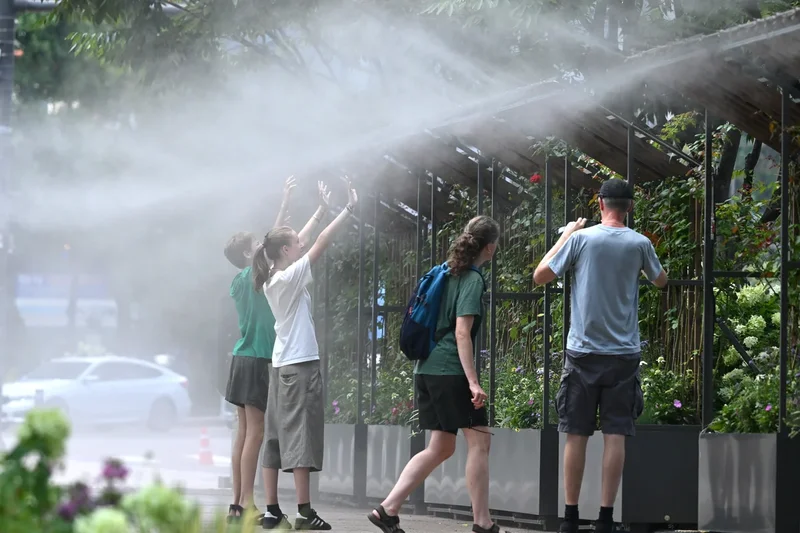
Seoul has opened more cooling shelters and begun handing out water and sun umbrellas, while Yangsan has expanded street spraying.
Reservoirs across South Gyeongsang are down to 40 per cent of capacity, with at least two, both in the city of Miryang, close to empty and no longer able to supply water to farms.
Forecasters said scattered showers on Tuesday could ease the heat in southern areas, though highs of about 37C were still expected and humidity could push the heat index higher after the rain.
Extreme heat has gripped nearly all of East Asia. Japan recorded its first "cruelly hot day" last month after temperatures climbed past 40C in three cities, weeks after the weather agency introduced the term to warn people about dangerous heat.
The designation of cruelly hot day, “kokushobi” in Japanese, was coined in April for any day recording a temperature of 40C.
Meanwhile, Typhoon Dolphin, the 13th named storm of the year, was about 1,520km east of Okinawa on Monday morning, moving west-north-west at 18kmph with maximum sustained winds of 169kmph.
It’s forecast to pass Okinawa on Friday. If it continues towards China, the typhoon will strengthen the easterly winds driving the heat. A northward turn towards Korea, however, may break the heatwave, but bring storm damage with it.