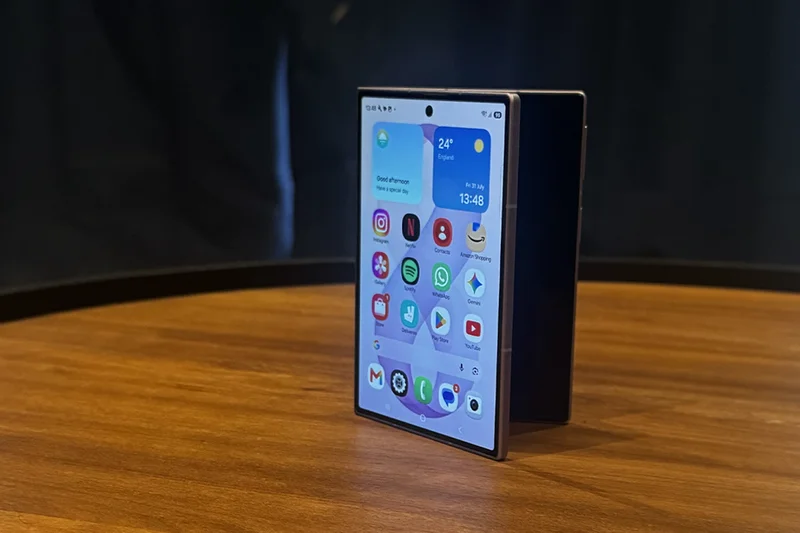
For ages, I thought no brand could pry a slab phone out of my dead, cold hands. Single-screen devices are just fine and good for what I want to do with a phone, which is scroll late into the night on TikTok, natter away in my fantasy football WhatsApp group chat and binge watch episodes of Lost. Why complicate things with something that folds?
But then I laid my hands on the Samsung Galaxy Z Fold 8. Predicted to be what the iPhone Ultra will look like, it's had me flirting with the thought of switching over to foldables for the first time.
Thanks to its shorter, wider proportions, it almost feels like I’m using a regular slab phone for endless doomscrolling, and then the iPad Mini-like inner display is the perfect size for streaming. It’s light, easy to hold and has been great for all kinds of content. I’ve spent the last week putting it to the test to see if the form factor could win me over.
Read more: The best Samsung Galaxy Z Fold 8 pre-order deals
Read more: Best Android phones, reviewed
- Why we love it- Wider, more usable cover display
- Premium, lightweight design
- Bright, vibrant AMOLED displays
-
Long battery life
-
Take note- Cameras disappoint for the price
- No wireless charging
- Odd speaker setup
Samsung Galaxy Z Fold 8: Design and display
The reason why the Z Fold 8 piqued my interest is primarily because of its design. Sure, it’s a shiny, new form factor, which is always fun, but shorter and wider just feels like the best size for a foldable anyway.
It boasts a 5.5in AMOLED cover display with a 10:16 aspect ratio. If it weren’t for the sharp corners, its size would almost feel retro, harking back to when we all loved smaller phones. Open it up and you get a 7.6in AMOLED display with an aspect ratio of 4:3. Both have a refresh rate of up to 120Hz for buttery smooth scrolling and gaming.
Yes, it is chunkier than a regular slab phone at 9.7mm when folded, but that’s not so thick that it becomes cumbersome. Because it’s shorter, it doesn’t feel like it’s going to drop out of my pocket, and it’s fairly lightweight at 201g. It’s super thin when unfolded though at just 4.5mm.
Personally, I still prefer rounded corners over Samsung’s squared-off design. They’re just more comfortable to hold, but there’s no denying the Fold 8 looks incredibly premium. I’ve been testing the understated lilac colourway, but it also comes in cream, graphite and (exclusive to Samsung) pistachio.
It does fit in my hand much more naturally than the tall and narrow Fold, and the screen is just big enough to do everything I’d usually do on a phone, from doomscrolling through Instagram to replying to WhatsApp messages.
In fact, I’ve been pretty happy using the cover display for the majority of the day. It’s much easier to use one-handed when shut. You don’t have to stretch to touch the top of the screen, and fat-thumbed folk will find it much easier to type on than the tall and skinny Z Fold 8 Ultra. I’ve never really had to unfold the device, just because I wanted to make it easier to use and type on.
Both displays now reach a peak brightness of 3,000 nits, so they’re easy to view outdoors. Samsung has also added an anti-reflective coating to the inner display. It’s a lot easier to see when you’re in direct sunlight, although the panels pick up a lot of fingerprints, and they can definitely be spotted.
The rest of the hardware feels every bit as premium as you'd expect from a £1,699 phone. Samsung has reinforced the flexible display using titanium layers, with an armour aluminium frame and Victus 2 Gorilla Glass on the rear, as well as Gorilla Glass Ceramic 3 on the cover display for extra durability. The major disappointment is its IP48 rating, meaning it isn’t fully dust resistant and I’d be really cautious using this on a sandy beach this summer.
The Z Fold 8 also boasts a new hinge, so it now almost clicks into place when you unfold it, opening up to a perfect 180 degrees. Super satisfying, though it does mean you can’t use it in Flex Mode anymore. In terms of the crease, it’s much less noticeable than on previous foldables, though you can still see it if you go looking.
If you do want to prop it up, though, I found that flipping the phone over and standing it on its edges like a teepee worked wonderfully. It’s a great looking phone.
Samsung Galaxy Z Fold 8: Content consumption
Samsung is pitching this as the company’s content consumption phone, so I’ve done a lot of, well, content-consuming, to really see how much better it is with wider, shorter proportions.
First, social media. I’ve loved scrolling through Instagram on this thing. The main feed and your own profile are wider, fitting the length of the cover screen. If you open it up, it’ll feel like scrolling through your feed on the web.
Switch over to Instagram reels though and, while you do get kind of ugly black bars on the left and right of reels when using the cover display, I don't actually mind it too much. The buttons have previously got in the way of videos, but now they're pushed off to the side in the letterboxed area, so they don't look as distracting (especially when someone's unhelpfully put captions so far down the page that they overlap with their post). Most TikToks are similar, videos stretch the entire length of the screen, with black bars on the side.
That said, TikTok videos and Instagram reels look a bit naff when opened up. Videos are a super narrow sliver in the centre, and even when you rotate it into a portrait orientation, you get black bars on all four edges.
That contrasts to my experience using YouTube on the inner display. There’s no black space at all when unfolded because the comments and related videos sit on the right-hand side – it’s all cohesive. Social media would look way better if comments also sat alongside reels and videos, rather than still being tucked away inside a drawer – that would utilise the bigger screen much better.
Long-form video is a different story. The 7.6in inner display is brilliant for YouTube and Netflix. There's far less letterboxing than on Samsung's taller Fold 8 Ultra, so you don't end up with hulking great black bars down the sides, and pinching to zoom doesn't crop away too much of the picture.
The screen is super bright and colourful, so it’s been great for streaming films and TV shows, from Love Island to The Backrooms to Lost.
YouTube also makes much better use of the larger screen than TikTok and Instagram, with comments and recommended videos sitting next to the video instead of being tucked away underneath, so the whole experience feels much more cohesive.
I just wish Instagram and TikTok did the same, because they'd make much better use of the Fold 8's bigger screen if comments sat alongside reels and videos instead of being hidden away in a drawer.
I’ve also enjoyed reading articles and ebooks on the inner display. The wider ratio feels better proportioned for this kind of thing – it often looked weird reading on a squarer inner display. It’s almost like having an ereader.
I’ve been playing Asphalt Legends on the Z Fold 8 and besides feeling so much more at home on the inner display, fitting edge-to-edge, it looks great too.
Besides social media not being best-optimised for the inner display, the only other gripe I have is the placement of the speakers. Because the Galaxy Z Fold 8 now opens into a landscape-oriented display, both stereo speakers end up firing from the left side of the screen when you're watching videos, so it doesn't feel as immersive. There's no real stereo separation when watching content out loud.
Samsung Galaxy Z Fold 8: Cameras
While I wouldn’t call the Galaxy Z Fold 8's cameras bad, they are the biggest compromise you'll make if you opt for the cheaper Fold instead of the Fold 8 Ultra.
Samsung has got rid of the telephoto lens entirely, so you just have a pair of 50MP rear cameras – one main and one ultrawide.
In good lighting and bright sunlight, the main camera takes great photos. Images are sharp, colourful and have that signature Samsung look, with vivid colours. The HDR ensures the sky looks bright and shadowy areas don't end up looking muddy.
The 50MP ultrawide is similarly good – there's very little drop in quality when you want to squeeze more into the frame, with colours still looking vibrant.
However, things aren’t so good when you get to the zoom. I think the 2x optical-quality zoom is perfectly serviceable, but the zoom gets progressively worse and less detailed when you move to 5x and 10x. I did find myself missing a dedicated telephoto camera for photographing subjects in the distance. There’s just not much clarity.
I also tested it at night to see how it would handle lamp-lit streets. Compared with the Fold 8 Ultra, the smaller sensor and narrower f/1.8 aperture mean it doesn't gather quite as much light, but it still puts in a respectable performance.
Colours look natural and HDR does a good job of keeping bright street lights under control, although the brightest lamps do produce a little blooming. Samsung's image processing also smooths away some of the finer detail to reduce noise, so brickwork, foliage and other textures lose sharpness in night-time photography.
Both the cover display and the right-hand side of the inner display have 10MP selfie cameras, but I'd ignore them. They’re fine for WhatsApp calls, but aren’t great quality for much else. Instead, use the rear cameras for all your selfies.
Open the camera, tap Selfie mode and the cover display becomes a live viewfinder, letting you frame yourself while taking advantage of the much higher-quality rear cameras.
Dual recording is also a really nice feature. It lets you record from both the selfie camera and the rear camera at the same time – which has been great for filming unboxing videos, with options for vertical splits and horizontal splits.
The new camera feature is My FanCam, which seems like it’s purpose-built for TikTok dancers. After recording a video in landscape, you can use My FanCam feature to track one single person and keep them centred in the shot. I also think it’ll be great for tracking a specific player at football matches.
With My FanCam, Galaxy AI automatically crops the video and tracks the person for you. You can then turn it into a vertical social-ready video or keep it horizontal, with aspect ratios ranging from 9:16, 1:1, 3:4, 2:3, 3:5, 4:5 and 5:7.
Sure, the cameras are good, but I still get better photos from my slab phone, which costs several hundred pounds less. The Fold 8's cameras are more than capable for general photography, but for £1,699 I'd expect a flagship camera system.
Samsung Galaxy Z Fold 8: Performance
The Galaxy Z Fold 8 is powered by Qualcomm's Snapdragon 8 Elite Gen 5 for Galaxy chipset and comes with 12GB of RAM (or 16GB if you splash out on the 1TB model).
I've thrown pretty much everything at it over the past week, from editing videos, gaming, multitasking with split windows and filming content, and on the whole, it’s been nimble and fast. Things open in a snap, and the 120Hz displays make it all look buttery smooth.
But one blemish on performance is heat. The Fold 8 gets very hot when you push it hard, and on a few occasions I noticed the display dimming in a bid to keep temperatures under control. I didn’t spot a huge amount of lag, but it can struggle.
The Z Fold 8 runs on Samsung’s One UI 9 and Samsung is also promising seven years of Android OS and security updates, which is about as good as it gets.
Samsung Galaxy Z Fold 8: Battery life
I love battery tech, and Samsung has made me very excited because it’s introduced a silicon-carbon battery to its smartphone. The newer battery chemistry squeezes more energy into a smaller space, which means despite being thinner than the Z Fold 7, the Fold 8 actually has a larger 4,800mAh battery.
Samsung says it's good for up to 26 hours of video playback, but that's obviously under ideal conditions. All throughout testing, I’ve managed to eke out a full day of battery on a single charge – and it often still has 20 per cent of juice in the tank when I head to bed.
You get 45W wired charging, which is a lot better than the 25W on the previous foldable, helping me charge up quicker, but disappointingly there's no wireless charging. An odd decision.
Key specifications
- Screen size:7.6in inner display, 5.5in cover display
- Screen type: 120Hz Dynamic AMOLED 2X
- Dimensions:123.9mm x 161.4mm x 4.5mm (unfolded)
- Weight:201g
- Storage:256GB, 512GB, 1TB
- RAM:12GB (256GB/512GB), 16GB (1TB)
- Rear cameras:50MP main, 50MP ultrawide
- Selfie camera:10MP (cover), 10MP (inner)
- Processor:Qualcomm Snapdragon 8 Elite Gen 5 for Samsung Galaxy
- Charging:4,800mAh battery (45W wired charging)
- Water resistance: IP48