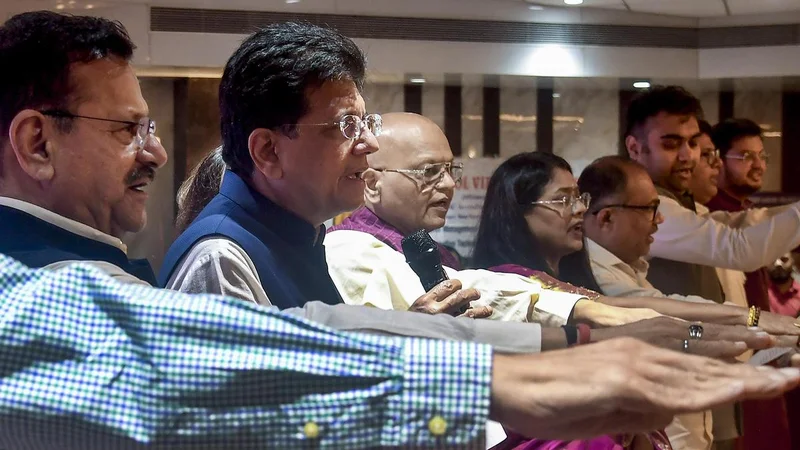
Prime Minister Narendra Modi has launched the “Nasha Mukt Yuva for Viksit Bharat Sankalp Abhiyan (Drug-Free Youth for Developed India Pledge Campaign)”, aimed at mobilising young people against substance abuse.
The campaign was launched on August 2, 2026, across more than 28,000 locations with the participation of over one crore young people. It has received support from more than 125 spiritual organisations, educational institutions, public bodies and industry associations.
The initiative will continue for 100 weeks, with activities centred around sports, art, culture, meditation, spirituality and community service.
Why is the campaign linked to the Viksit Bharat vision?
The government sees India’s young population as key to achieving this vision. After launching the campaign, Mr. Modi said India’s future depends on the energy and creativity of its youth.
Drug abuse can affect the health, productivity, and social stability of young people, weakening this demographic advantage.
“When this happens in families and society, the strength of the country is weakened as well. That is why hostile countries also conspire to lure our youth into drug addiction. Profiting from drug trafficking while weakening our country is part of their malicious agenda. Therefore, we must protect every young person from falling into the trap,” said Mr. Modi.
What is the government’s strategy against drug abuse?
The government’s approach rests on three broad pillars: demand reduction through awareness and prevention; supply reduction through “ruthless” enforcement; and harm reduction through rehabilitation.
The awareness campaign comes alongside a wider action plan rolled out by Union Home Minister Amit Shah. At the 10th Apex-Level Meeting of the Narco-Coordination Centre (NCORD) in June 2026, he released the Vision Document on Drug Control (2026–2029).
**ALSO WATCH ** Watch: PM Modi launches ‘Nasha Mukt Yuva’ campaign | 100-week drive for a drug-free India
The strategy follows a “Detect, Disrupt, and Destroy” approach, aimed at targeting the complete drug ecosystem, ranging from international suppliers, organised crime groups, local distribution networks, and financial networks supporting drug trafficking, to emerging digital methods of smuggling.
What measures has the Home Minister announced?
Mr. Shah has called for stronger Anti-Narcotics Task Forces (ANTFs) in every State and improved coordination between Central and State agencies. He has also emphasised better use of forensic science laboratories, timely filing of chargesheets, higher conviction rates, and regular outcome-based reviews.
What has been the enforcement record?
The government has cited increased seizures and arrests as evidence of stronger action under the Narcotic Drugs and Psychotropic Substances (NDPS) Act.
According to government data, between 2014 and 2026, 1.18 crore kg of drugs worth about ₹1.84 lakh crore were seized by various agencies across the country, and 42.47 lakh kg of drugs were destroyed. The agencies registered 8.75 lakh cases and arrested 10.97 lakh accused persons.
Major recent operations include the Narcotics Control Bureau’s (NCB) first-ever seizure of Captagon — about 227.7 kg — under Operation Ragepill in May 2026. The same month, as part of Operation White Strike, the agency seized about 349 kg of cocaine valued at nearly ₹1,745 crore in the Mumbai region.
What are the challenges ahead?
India faces major challenges because of its location near major drug-producing regions such as the Golden Crescent and Golden Triangle.
Traditional smuggling methods have become more complex with the use of new technologies. The government has identified emerging challenges including synthetic drugs, darknet-based trafficking, encrypted communication networks, cryptocurrency-linked transactions, drone-based smuggling, online marketplaces, and cross-border supply routes.
Another challenge is ensuring that effective enforcement efforts are complemented by adequate rehabilitation measures. Swift prosecution of offenders is important, but people affected by addiction also need sustained institutional support to recover and reintegrate into society.
Published - August 03, 2026 03:55 pm IST