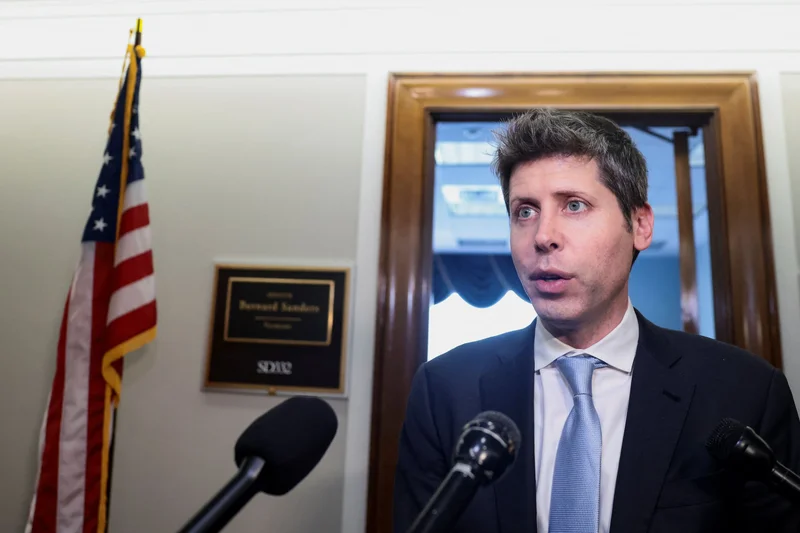
OpenAI is dominating the first visible wave of artificial intelligence spending inside Congress.
The maker of ChatGPT accounted for roughly $9 out of every $10 spent on identifiable AI tools by House offices, committees and institutional accounts during the year ending March 31, according to a CNBC analysis of House disbursement records.
The records offer only a partial view of Congress' AI adoption because they exclude free accounts, AI bundled into broader software contracts and most Senate use. Even so, they show at least a sixth of House member offices — and likely many more — are already using AI tools as lawmakers shape the industry's future.
CNBC identified at least $113,740 in spending on named AI vendors between April 1, 2025, and March 31, 2026, the most recent data available. ChatGPT accounted for $100,580 of that total across 798 transactions — about 88% of the dollars and 96% of the transactions reviewed. Anthropic's Claude, ChatGPT's closest chatbot rival, was a distant second, totaling $13,160 across 37 transactions.
The competition is about more than congressional office productivity. OpenAI, Anthropic, Google and Microsoft are racing for influence across Washington as lawmakers and federal agencies decide how AI should be purchased, used and regulated.
Congressional staff are using the tools to summarize legislation, draft memos, prepare hearing materials and respond to constituents — work that can shape how offices understand policy, communicate with voters and manage the flood of information arriving on Capitol Hill.
Rep. Julie Fedorchak, R-N.D., said her staff used to spend hours writing memos to prepare her for the dozen-plus meetings she would have in a day — time that ate into writing and advancing legislation.
Fedorchak said she and her staff used ChatGPT to develop a searchable database of legislation she has worked on and materials received from constituents and outside organizations. She said using AI to produce briefing memos from that information is "saving dozens and dozens of hours every week of staff time."
Other offices are also using AI to summarize reports and bills, draft social media posts, prepare constituent responses, analyze legislation, review hearing materials and sort through policy research, according to Marci Harris, CEO of POPVOX Foundation, a nonprofit that helps train members of Congress and staff on how to use AI.
"Staffers are famously overwhelmed, and actually AI is exacerbating that," Harris said, noting that lobbyists and constituents are also using AI to send longer, more frequent and more detailed material to congressional offices. Lawmakers are working with less staff than in years past, Brennan Center for Justice senior research fellow Maya Kornberg notes in her book "Stuck — How Money, Media and Violence Prevent Change in Congress."
Democratic member offices accounted for $54,165 in identified AI purchases, more than three times the $15,782 spent by Republican offices.
ChatGPT purchases appeared in 44 Democratic member offices and 27 Republican offices. Claude purchases appeared in five Democratic offices and one Republican office.
The numbers underscore an awkward political dynamic: Democrats are leading the visible spending on AI tools, even as many in the party have warned about the technology's risks to workers, privacy, civil rights, elections and corporate power.
The figures almost certainly understate Congress' total AI use.
CNBC's analysis is limited to purchases for which House disbursement records specifically name an AI vendor. It does not capture use of free versions of ChatGPT, Claude or other products, nor does it capture AI functions bundled into broader software contracts, including Microsoft Copilot.
Some offices also have a financial administrator purchase subscriptions and then reimburse that person. In those cases, the records show the reimbursement but not the specific tools purchased.
The analysis also excludes the Senate, whose public spending reports do not identify software vendors in the same way, making ChatGPT subscriptions impossible to trace. The Senate does not allow Claude for official use, according to chamber rules.
Harris said the House's Microsoft Copilot deployment may represent more official AI spending than the ChatGPT purchases visible in public records.
Some lawmakers also have internal protocols on how AI can and can't be used.
For Rep. James Walkinshaw, D-Va., AI helps with everything from research to social media posts and newsletters. But all facts must be independently verified, and decisions need to be made by a person.
"Our caseworkers in our district office can use AI to help organize casework requests, maybe expedite them, move things along faster," he told CNBC. "But when they're making decisions related to a constituent's case — are we going to advocate for our constituent with the Social Security Administration or with IRS? — that has to be a human decision, not an AI decision."
OpenAI and Anthropic did not respond to CNBC's request for comment.
OpenAI's apparent dominance traces back to Congress' first formal experiments with generative AI.
In 2023, the House Digital Service, an innovation arm inside the Chief Administrative Officer's office, launched an AI working group and distributed the first 40 ChatGPT Plus licenses to a bipartisan group of staff.
But Samantha Carter, the CAO's chief communications officer, said the House's approach "is deliberately not limited to a single vendor."
House officials issued more restrictive guidance around AI use in September 2024, limiting which tools staff could use for official work and warning against entering sensitive information. But by then, ChatGPT had already become the first AI product many offices knew by name.
"OpenAI was the firm that they heard about," Harris said. "In the early days, ChatGPT was almost synonymous with AI — the way Kleenex is with tissues or Band-Aid is with bandages."
OpenAI also built a training pipeline into Congress. The Congressional Management Foundation, a nonpartisan group that trains congressional offices on AI, has partnered with OpenAI on ChatGPT sessions for House and Senate senior staff, with OpenAI engineers helping lead part of the program.
Some offices, Fedorchak's included, have gotten personal training on products from OpenAI and Microsoft.
At the same time, AI companies are expanding their Washington lobbying operations as lawmakers and agencies debate how the technology should be bought, used and regulated.
OpenAI spent $1 million on federal lobbying in the first quarter of 2026, up 82.5% from the same period a year earlier, according to an analysis by Issue One, a nonprofit government watchdog, of federal lobbying disclosures. Anthropic spent nearly $1.6 million, more than tripling its spending from the first quarter of 2025.
Interest in OpenAI's rivals grew only after ChatGPT had already established a foothold in congressional offices, Harris said.
"After the whole Department of Defense-Anthropic blowup, we had people calling us saying, 'I want to use Claude. Tell me about Claude,'" Harris said.
In January, Anthropic refused to remove restrictions on using Claude for mass domestic surveillance and fully autonomous weapons. The dispute escalated in early March, when the Pentagon designated the company a supply-chain risk.
CNBC has not identified a comparable Anthropic-run partnership with a similar nonpartisan Hill training group.
Why AI model choice matters
Eric Petry of the Brennan Center said it is fair to question the government when it appears to favor one company's product over a competitor's.
"It may be the case that one product is better suited for the government applications, or maybe one product is better than the other," Petry said. "But if it's based on partisan preferences, or there's politics at play, then it becomes really concerning."
The same principle applies whether the government is awarding a major contract or individual offices are buying subscriptions, he said.
"We want to make sure that taxpayer dollars are being used to give the government the best tools available, and not to reward political favorites," Petry said.
Congressional offices and nonpartisan legislative agencies should be able to test multiple models, compare their strengths and weaknesses, and understand how they behave before lawmakers write rules for the industry, Harris said.
"It's going to be their job to regulate it, so they need to be able to get their hands on all of them and understand the way that they work," Harris said.