- Published
More than 150 public figures have signed a letter calling for the government to reverse a "foolish" decision and "find funding immediately to save Jodrell Bank".
About £2.8m has been pulled from the Cheshire observatory, leaving the University of Manchester needing to find alternative cash by 2028.
Signatories of the letter include astronaut Tim Peake, musicians Sir Brian May and Jarvis Cocker, Scotland's Astronomer Royal Prof Catherine Heymans, physicists Prof Jim Al-Khalili and Prof Brian Cox, and Judy Spence, the daughter of the site's founder Sir Bernard Lovell.
The UK Research and Innovation agency (UKRI) has said it had to focus on projects that delivered "the greatest long-term impact".
The observatory, a Unesco World Heritage Site, is dominated by the enormous Lovell Telescope, a structure that was voted Britain's greatest unsung landmark in 2006.
All scientific observations at Jodrell are expected to cease on the 1 April 2028 unless alternative funding can be found.
Twenty-eight jobs are at risk at the observatory, but its closure would also affect the work of nearly 3,000 scientists who use it in their research.
When the plan to cut funding was announced, Business Secretary Jonathan Reynolds said the UK's world class research was "absolutely central to creating a better future for the UK".
"I am committed to working with UKRI to ensure the UK remains able not only to sustain its world-leading research capabilities, but also to invest in the next generation of scientific facilities and infrastructure that will underpin discovery, innovation and growth in the years ahead," he said.
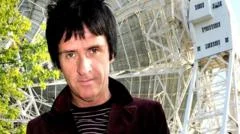
The open letter was signed by a number of figures who have played concerts or broadcast from the observatory, including guitarist Johnny Marr, electronica pioneer Ralf Hütter of Kraftwerk, the bands New Order, Elbow and Doves, comedian Dara à Briain and poet laureate Simon Armitage.
It stated Jodrell Bank was "an icon in UK cultural and scientific history", which was the "thriving, thumping heart of space observation, research and education in the UK".
"This beacon of science is more ambitious than ever, with exciting plans already under way that will ensure the UK's relevance and leadership in the rapidly evolving domain of space exploration and utilisation," it said.
It said that in being the headquarters for the new Square Kilometre Array Observatory, Jodrell Bank was "at the heart of the biggest astronomical project in the world" and could play an "essential role" in global safety in "tracking space debris, destructive solar flares, satellites and asteroids".
It said the site was also "the birthplace of future UK science pioneers", as it welcomed "more than 25,000 schoolchildren every year".
"This only begins to explain the value of Jodrell Bank," it added.
"If you were offered the opportunity to realise all of these huge national and global benefits, for an investment of just £2.8m a year, you'd be foolish not to seize it."
The UKRI, which has an annual budget of about £10bn, said it has had to cut the observatory's annual £2.8m budget because planned research costs for physics and the running of its labs had escalated.
The announcement was part of broader cuts to astronomy, nuclear and particle physics research over the next four years which will also impact on other projects.
The UK will no longer participate in research at the James Clark Maxwell Telescope in Hawaii and has cut funding for the UK's involvement in two instruments on the Extremely Large Telescope which is being built in Chile.
A number of upgrades to improve experiments at the Large Hadron Collider will also not be paid for by the agency.