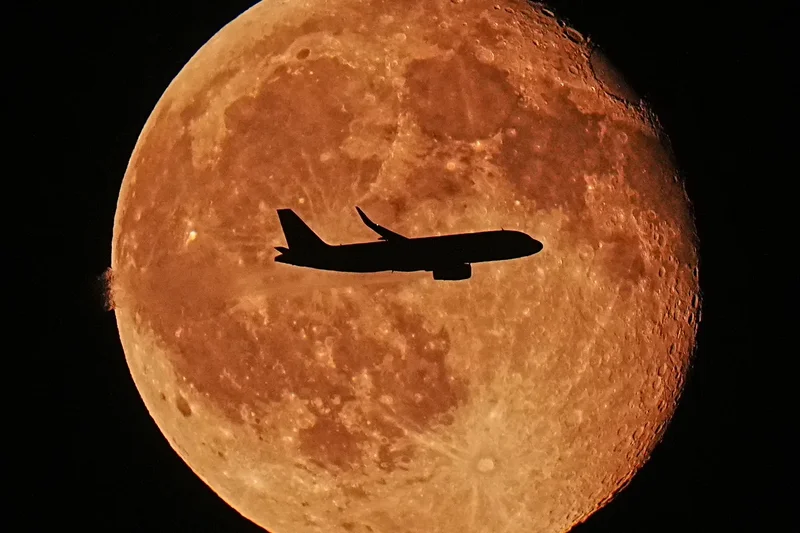
The spacecraft will hit the lunar surface on Wednesday, around 7.28am UK time, or 2.28am on the east coast. When it does, it will collide with the force of three tons of TNT, leaving behind a hole in the lunar surface and sending pieces of the Moon flying into the air.
Scientists are excited for the opportunities to study that dust and rubble, and see what it might tell us about the composition and nature of the Moon. But experts also warn that the collision is a reminder of the fact that we are filling the space above us with debris and spacecraft that are becoming increasingly dangerous.
The collision will happen near the Moon’s Einstein Creator, on its western edge. It will hit at a speed of about 5,400mph.
The crash will cause an explosive flash, which will not be visible with the naked eye but is expected to be seen with telescopes. It will also throw up a trail of dust and debris that should be visible from Earth, and is likely to stay around for tens of minutes because of the relative lack of gravity and wind to pull it around or blow it away.
After the collision is over, it will leave behind a crater roughly 27 metres across and 5 metres deep. That is not large enough to be seen by Earth, but can be examined with spacecraft.
The collision itself will also be watched by other spacecraft. Nasa’s Lunar Reconnaissance Orbiter and South Korea’s Danuri spacecraft – both currently in orbit around the Moon – will be able to gather before and after pictures from the collision, with the latter passing nearby the collision point just two minutes before it happens.
The piece of SpaceX rocket carried two lunar landers and scientific instruments to the Moon in January 2025. It was not intended to crash into the surface.
But it has been floating in space since, and SpaceX has been unable to stop it from colliding with the surface. It is about 12 metres long and weighs around 4,500 kilograms.
It is the second time that a dead rocket has crashed into the Moon by accident. A piece of a Chinese spacecraft left behind two craters on the lunar far side in 2022.
The Moon is regularly hit by meteoroids and other natural objects, and is not protected from them in the way the Earth is by its atmosphere. But those natural objects are unpredictable, and so this offers a rare opportunity for scientists to watch a strike closely.
That is likely to prove useful in the years to come, as Nasa and other space agencies aim to go back to the Moon and perhaps even live on it. Collisions such as these give scientists important data on how the lunar dust might behave, and how safe future astronauts might be from collisions – either with natural objects or space debris.