Love or hate the terminology, weâve recently seen a rise in something folks are calling âfriendslopââgenerally indie games intended to be played with friends that encourage communication, teamwork, and silliness. Games like Meccha Chameleon, Among Us, and Peak are prime examples, and have gained rapid popularity thanks both to being very well-designed, fun games, and also to their facilitation of positive human relationships. At a time when everyone is feeling increasingly isolated, these games encourage us to play together.
I guess, by this definition, Big Walk is another prime example of friendslop. But I just canât bring myself to use that term for it, especially with the somewhat messy connotations of the âslopâ suffix. Thereâs something about Big Walk that defies the âslopâness of the word: something clean and clear, something aggressively earnest and even loving. Whatever that something is, itâs been making me tear up every time I have thought back on moments in my own Big Walk. Itâs made me want to message the friends I walked with, excitedly beginning with âHey, remember when-?â
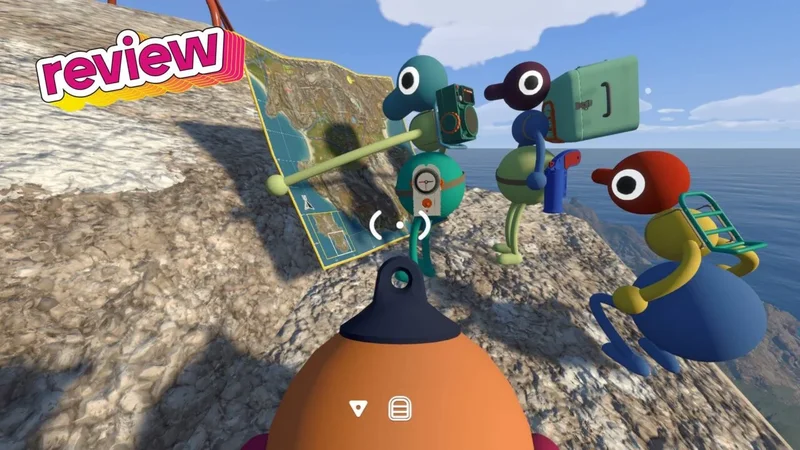
In Big Walk, you and your friends go on a big walk. Itâs set on an uninhabited island: you and your companions are the only ones there. There are lots of trees, a few mountains of varying heights, valleys, rivers, coastsâyou know, things you see on a hike. There are no signs or trail markers, no wildlife to be seen, though you can hear birds.
There are large, Fischer-Price-looking monuments spaced out across the landscape, brightly colored, built like giant toys. Normal stuff.
Inside almost all of them is a puzzle, always one that requires more than one person to solve and almost always one that requires thoughtful communication and teamwork. For instance, the very first puzzle we encountered in the tutorial area was a giant crane with a button on top, far out of our reach. To get to it, the six of us had to stack on top of one another, with the bottom person lining the tower up correctly and the top person hitting the button. Another very early one had one person push a button to light up and activate an objective across the valley, and the other person had to follow the light and run over to the correct spot. These were simple, early game puzzles, but everything grew increasingly complex from there.
The reward for solving most puzzles is a weird little nub that our group unfortunately immediately dubbed a ânipple.â You can call it what you like. The goal, very roughly, of Big Walk is to collect a lot of nipples (sorry, I wonât do it again).
In this regard, I guess I should describe Big Walk as a puzzle game primarily. It is certainly the puzzle game that finally made it click for me what it is that makes a really good puzzle game. Itâs not about puzzles being difficult, or easy enough, or especially intricate, or anything like that. A good puzzle game makes you, the player, feel like a genius. Big Walk does one even better. It puzzles are almost universally so well-paced and well-designed that it makes a group of people feel like a collective genius. It even celebrates that genius appropriately: I love that every time you finish a puzzle, thereâs a little party horn âhonk!â noise and a bunch of confetti is spit out at you. A mini-celebration, every time, with you and your friends jumping up and down and waving your arms and yelling into the mics because you got it, you did it!
Big Walk is also explicitly a cooperative game. By that I do not mean that it is a single-player game with optional co-op. I mean you must, must play it with at least one other friend, up to 11 others if you like, and ideally at least five or six if you want the richest experience possible. You donât need to play it with the same people every time: the start of each session lets the host choose between a game for 2 people, 3 people, and 4+, which adjusts some of the puzzles to ensure theyâre solvable by the number of folks available. I donât recommend having different people hop in and out of Big Walk (though you can), because it is very much an experience that builds on itself, and the knowledge you gain in one session will almost certainly be helpful in the next. But the ability to adjust is great if one of your friends canât make a play session on a given night.
And I do specify, you should play this with your friends. You can play it with strangersâI have no doubt there will be a wonderful little community established around connecting folks to play Big Walk together, and a lot of people will have a good time that way. But if you can, play it with people you know and love dearly. Get them to make time.
This is necessary not just mechanically, but also thematically, because Big Walk is fundamentally a game about communication, and finding ways to do it within different limitations. The little dudes you control can gesture: up, forward, and to the side. They can sit and crouch and jump. Different items you pick up throughout the hike can facilitate communication: there are lights you can turn on and off, cowbells to ring, flare guns, walkie-talkies, and so forth. You can only ever hold one thing in your hands at a time, though, and some items are rarer than others, so nothing is as simple as just handing out walkie-talkies and promising to stay in touch if you get lost.
Because you will get lost, even if you think you wonât, even if you swear up and down youâll stay together. Someone will see something neat and stray off into the trees. Your leader will run too far ahead. It gets dark at night and youâll lose track of people. A few of your dumbass friends will chase after the flare gun you kicked into the trees minutes before because you were sick of them firing it off every time it reloaded, and then youâll have to go find them again (following the flare from the gun, of course). You know how it is.
In this regard, Big Walk is as much a game about loneliness as it is about connection. While its highest highs have you trying not to inadvertently spit out your drink all over your keyboard from laughter, thereâs also a profundity in quiet moments in the dark, alone, unsure if your friends have a walkie-talkie with which to hear you calling, unable to find a light or a flare gun, trying to find your way back to where the fun is, where your friends are. Please play this game using the in-game proximity voice chat rather than a Discord call. The latter takes away a shocking amount of Big Walkâs impact.
Big Walk is at its best when you and your friends are very stupid. I can honestly say I havenât laughed as hard as I laughed playing Big Walk in months. It wasnât about anything video game-y happening at that moment, specifically. It was about what Big Walk facilitated: these wonderful, memorable, goofy moments with people I love. Fellow Kotaku writer Zack Zwiezen singing âLife Is a Highwayâ off-key into the walkie-talkie. Everyone picking each other up and chucking each other off the tops of tall towers. Discovering a [redacted] and instead of everyone enjoying the moment together, my friends immediately started trying to see how far they could kick a lawn chair. The moment we unlocked the [redacted] and everyone immediately rushed to [redacted], which we immediately and delightedly learned made the most annoying sound possible, which also meant everyone would be trying to make that sound again at every opportunity.
- Back-of-the-box quote "Please do not shoot the flare gun when we are trying to solve a sound-based puzzle"
- Developer House House
- Type of game Cooperative communication puzzle walking simulator
-
Liked The puzzles, the world, discovering and unlocking things, honking the train horn, my friends
-
Disliked Walking on uneven ground
- Platforms PC (played), PlayStation 5, Nintendo Switch 2
- Release date August 4, 2026
- Played About 20 hours. There are still puzzles remaining, and possibly another ending.
The thing is, I donât want to sit here and tell you about every single magical moment I had in Big Walk. I donât want to tell you about any of them! Because I so badly want you to go play this and experience every single one without knowing whatâs coming. So much of the joy of Big Walk is in the surprise: when youâre wandering lost through the woods at night, following the dim light of your friendâs flashlight, and suddenly come upon a towering blue spiral, or a giant jungle gym, or a tidy little house, or some other brightly colored monument rising out of the landscape. I want you to have every last moment of discovery, where your friends and you are on opposite sides of a wall that lets you see one another, but not hear, and suddenly it clicks with one of you how you can communicate necessary information. I want you to be surprised both by the thrill of solving puzzles, and also by the quiet joy of finding a place that exists for no particular reason at all other than to draw your groupâs eye and encourage them to take a beat and rest, together.
I have exactly one complaint about Big Walk: sometimes, the walking part is bad. Specifically, when youâre trying to go uphill or when you hit an area of rocky, uneven ground. You could say, âWell, Reb, this is simply part of going on a hike,â but it is not part of going on a hike to get your body wedged between two regular-sized rocks and become unable to move at all, or to be mysteriously unable to get on top of a knee-high boulder, or to be incapable of walking through a person-sized space while holding a whiteboard. These little bits were frustrating when they happened, which was multiple times per walk. They were also quickly forgotten about the second something new caught my interest.
In House Houseâs last game, Untitled Goose Game, I remember being thrilled by the ending, in which the goose steals a tiny bell from a tower and runs it back through all the areas itâs visited already, chased by angry townspeople, until it reaches a large pile of bells you saw at the beginning and drops it in. Itâs such a wonderful, full-circle moment, joyful and satisfying. I was hoping, based on the tidiness of that ending, that Big Walk would have a similarly good conclusion. I was not disappointed. In fact, I was elated. The ending of Big Walk, its final encounter (dare I call it a boss battle?!) and denouement, is fantastic and worth experiencing. I think I spent the final hour of Big Walk crying on and off from sheer elation as my friends and I worked our way through an utterly magnificent final puzzle gauntlet and saw what lay on the other side.
There is also a post-game something that we are making time to do next week. I cannot stop thinking about it and wondering what weâll discover. Iâm really happy there was something beyond the end of Big Walk, because Iâm so, so sad to leave it. I donât think I could ever play this game a second time. Itâs not âfriendslop.â Its magic is brilliant, and it also is single-use. Once you know the tricks, you canât be surprised by them again. But oh, the memory of being surprised that first and only time!
Everyone is busy, life is hard, and the world is falling apart. There is no better time to call up your friends, get everyone to give up one night a week for about a month or so, and use that time to go on a Big Walk together. I hope it makes you all as happy as it made us.