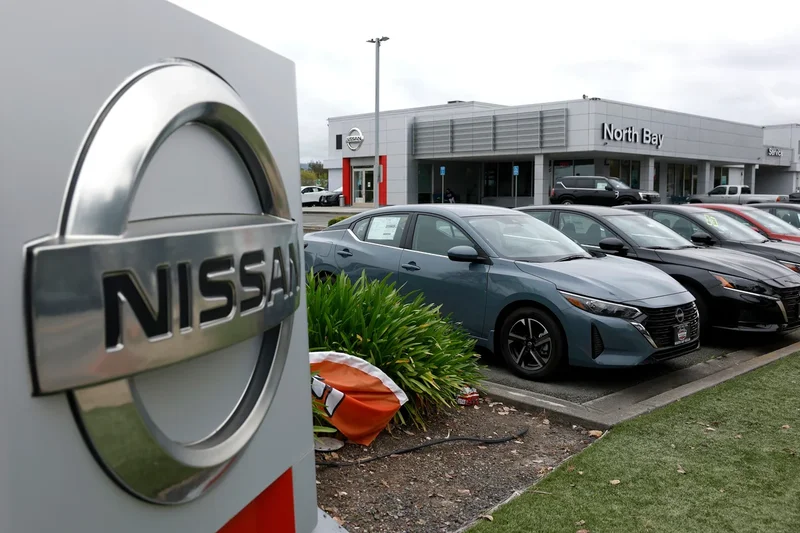
Nissan Motor Corp. has announced a return to profitability in the first fiscal quarter, driven by cost-cutting measures and improved sales performance in key markets.
The Yokohama-based automaker reported a net profit of 3.8 billion yen ($24 million) for the April to June period, a significant turnaround from the 115.8 billion yen loss recorded in the same quarter of 2025.
Quarterly sales climbed 9.5% to 2.96 trillion yen ($19 billion), up from 2.7 trillion yen a year prior.
This marks a crucial step for Nissan, which has faced two consecutive fiscal years in the red, accumulating billions in losses. The company's leadership has pledged to restore profitability by the end of the current fiscal year, concluding in March 2027.
Chief Executive Ivan Espinosa highlighted the growing momentum of cost reduction efforts. While acknowledging ongoing challenges in certain global markets, such as the Middle East, he noted strong sales growth in the U.S. and Japan.
"We are managing disruption where it exists, building momentum where we see opportunity," Espinosa said.
The company faces several headwinds, including the effective closure of the Strait of Hormuz due to the war in Iran, a vital route for Japan's exports to the Middle East. Sales in China have also been impacted by intense competition from domestic electric vehicle manufacturers. Nissan has revised its annual sales projection downward to 3.15 million vehicles, matching the previous year's figures and below an earlier forecast of 3.3 million units, primarily due to the Chinese market's difficulties.
Further disruptions include a partial stalling of production lines following the magnitude 7.1 earthquake in Kumamoto, southwestern Japan, last week. Espinosa confirmed no employees were harmed and no facilities, including those of Nissan’s partners, sustained damage. The disruption is expected to last until Wednesday, affecting 5,000 vehicles.
In the U.S., Japanese automakers continue to navigate tariffs imposed by President Donald Trump, which, despite negotiations, remain at 15% after being lowered from an initial 27.5%, still significantly higher than the previous 2.5% rate. Rising material costs also present an ongoing challenge.
Nissan, allied with France’s Renault SA and Japan’s Mitsubishi Motors Corp. and partnering with Honda Motor Co. on some technology and parts, maintained its full-year forecast for a 20 billion yen ($127 million) profit on 13 trillion yen ($83 billion) in sales in this fiscal year.
Espinosa affirmed the company’s strategic direction: "Our focus is unchanged: Creating value for customers, improving profitability and free cash flow and building a stronger, more resilient Nissan for the long term."
Following the announcement, made after the close of trading, Nissan shares dipped more than 3% in Tokyo.