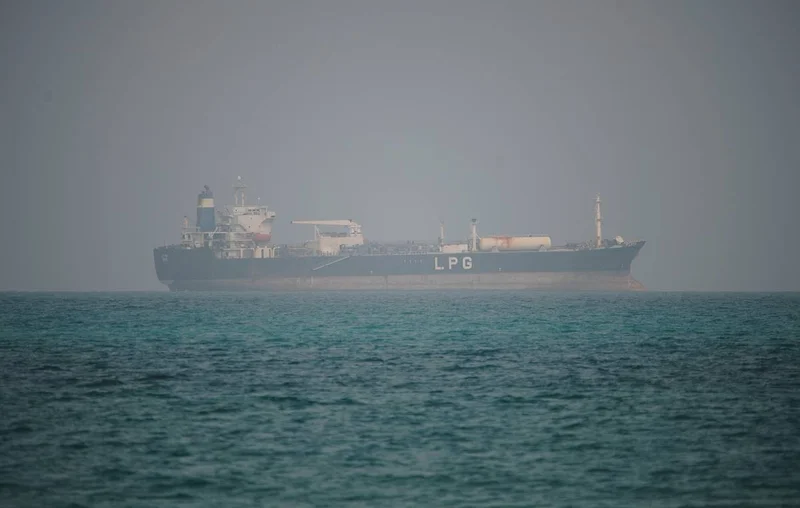
MOSCOW, July 22. /TASS/. Houthi threats against Saudi shipping are raising concerns over a new front in the Middle East conflict and risks to global energy supplies; UN divisions are hindering efforts to respond to the escalating Middle East conflict and shipping disruptions; and Japan is considering revising its Three Non-Nuclear Principles, drawing criticism from Russia and China. These stories topped Wednesday’s newspaper headlines across Russia.
Saudi Arabia-led Arab Coalition forces (which also include Bahrain, Kuwait, Jordan, and Senegal) have threatened to use force against the Iran-backed Houthi movement in Yemen if it begins attacking civilian vessels in the Red Sea. The warning was issued by coalition spokesman Saudi Major General Turki Al-Maliki on X in response to the Houthis’ announcement on July 20 of a maritime blockade targeting Saudi Arabia. The move could potentially open a new front in the region and disrupt global energy supplies beyond the Persian Gulf, Vedomosti writes. The Houthis declared the Bab el-Mandeb Strait closed to Saudi vessels, citing what they described as Riyadh’s "unjust blockade of Yemen." Saudi Arabia rejected the accusation.
According to Nikolay Sukhov, Senior Research Fellow at the Center for Middle Eastern Studies of the Institute of World Economy and International Relations, the Houthis’ declaration does not amount to a full-scale naval and air blockade of Saudi Arabia. In his view, it should instead be interpreted as a declaration of a campaign of coercive pressure against maritime and air transport linked to the kingdom. "In practice, the Houthis do not possess naval forces capable of maintaining a continuous cordon around Saudi ports. Their ‘blockade’ will be enforced through threats directed at shipowners," the Middle East expert said.
The Houthis have retained significant military capabilities even after the 12-day war in June 2025, Senior Research Fellow at the Center for Analysis of Strategies and Technologies Yury Lyamin told Vedomosti. According to him, following the end of the prolonged conflict with the United States and Israel, Tehran unofficially continued supplying Yemen with new missiles and other weapons. In addition, Iranian specialists spent many years helping the Houthis build up their domestic defense industry and achieved considerable success in doing so, the expert added.
As in the past, the Houthis could employ anti-ship and ballistic missiles, drones, and uncrewed surface vessels, Sukhov said. While Saudi Arabia is capable of protecting its main ports and parts of its shipping routes, it cannot completely eliminate external threats. "Even isolated strikes on infrastructure would force Riyadh to spend substantial resources on air defense and escorting commercial vessels. Economically, the most sensitive impact would be disruptions to shipments from Yanbu to Asia. Rerouting vessels around Africa would increase freight costs and create temporary supply disruptions for Asian refiners," the expert noted.
The United Nations is increasingly losing its ability to influence developments in the Middle East conflict. Deep divisions among the permanent members of the UN Security Council continue to prevent the adoption of coordinated decisions even as the regional situation deteriorates rapidly. The Houthis have announced a blockade of Saudi Arabia and threatened to attack vessels in the Bab el-Mandeb Strait, raising the risk of a new global energy crisis. Against this backdrop, Russia and China have decided not to bring their draft resolution on Iran and the Strait of Hormuz to a vote in the Security Council for the time being. As Russian Deputy Foreign Minister Alexander Alimov told Izvestia, Moscow is disappointed by the Security Council’s inability to adopt a balanced approach to the conflict.
"The Security Council’s consideration of the situation surrounding Iran over the past several months has demonstrated that it is unable to adopt a balanced decision that would help move the conflict toward a political and diplomatic resolution. Unfortunately, some of its members are prepared to support any anti-Iranian initiatives, while appeals for peace and negotiations hold no interest for them," the Russian deputy foreign minister explained.
While debates continue at the United Nations, the situation in the Strait of Hormuz is deteriorating rapidly. According to Reuters, citing vessel-tracking platform Kpler, only four cargo vessels passed through the strait over the past 24 hours, compared with seven the previous day. For the first time in a long time, no large crude oil supertankers and no liquefied natural gas (LNG) carriers used the route.
"So long as the Americans continue their atrocities, not a single drop of oil or gas will be exported from this region," the Islamic Revolutionary Guard Corps (IRGC) said earlier.
According to Grigory Lukyanov, Research Fellow at the Center for Arab and Islamic Studies of the Institute of Oriental Studies of the Russian Academy of Sciences, countries in the region currently lack an effective collective security mechanism capable of ensuring the safety of this strategic maritime corridor.
As a result, UN diplomacy is failing to keep pace with the rapidly evolving conflict. The organization has fallen victim to the bystander effect - watching a fire burn while unable to do anything about it. Meanwhile, developments surrounding the Strait of Hormuz and now the Bab el-Mandeb Strait show that the consequences of the conflict could once again deal a severe blow to economies around the world.
The United States will impose a 50% tariff on certain Canadian goods beginning August 19, according to three proclamations issued by President Donald Trump and published on the White House website overnight on July 21. The proclamations argue that Canada, through "discrimination and unfair practices," harms the US economy and commerce, particularly American producers of dairy products, alcoholic beverages, and automobiles. At the same time, they emphasize that Ottawa does not apply similar measures to comparable products from other countries. Experts interviewed by Vedomosti believe Trump’s proposed tariffs are intended mainly to strengthen his negotiating and domestic political leverage while testing new legal mechanisms for future trade pressure against larger partners such as China and the European Union.
According to calculations by the Office of the United States Trade Representative (USTR) under Jamieson Greer, the new tariffs would affect $20 bln worth of Canadian goods, equivalent to nearly 5% of Canada’s total exports to the United States. According to the USTR website, total US-Canada trade reached $909.1 bln in 2024. Based on those figures, the tariffs would affect approximately 2% of Canadian exports to the United States.
The threat of new tariffs is primarily a source of leverage for Trump in ongoing trade negotiations with Canada, political analyst and US expert Malek Dudakov told Vedomosti. At the same time, he noted that the actual tariff pressure would affect only a small minority of Canadian goods crossing the US border because nearly all Canadian products remain protected under the United States-Mexico-Canada Agreement (USMCA), which remains in force.
Trump is also using economic pressure on Canada to strengthen his domestic political position, according to Pavel Koshkin, Senior Research Fellow at the Institute for US and Canadian Studies of the Russian Academy of Sciences. He added that the administration is testing alternative tariff tools after the US Supreme Court barred the use of a 1977 law that had allowed the president to quickly impose tariffs at virtually any level. According to Koshkin, these alternative mechanisms could later be applied against more significant US trading partners such as China and the European Union.
Japan’s defense minister has called for holding a dialogue on the country’s approach to nuclear weapons, arguing that a broad debate should begin on moving away from the country’s Three Non-Nuclear Principles. The proposal has raised serious concerns in Russia, China, and among opposition forces within Japan, Izvestia writes.
Since the 1960s, Tokyo has adhered to the Three Non-Nuclear Principles: not possessing nuclear weapons, not producing them, and not permitting their deployment on Japanese territory. According to Japanese media, a departure from these principles could be formally incorporated into doctrine by the end of this year through revisions to the National Security Strategy, the National Defense Strategy, and the Defense Buildup Program.
The developments have caused concern in both Russia and China. The Russian Foreign Ministry has repeatedly stated that it views the possibility of Japan fielding a nuclear arsenal negatively.
Earlier, Russian Deputy Foreign Minister Andrey Rudenko said that the militarization of the island nation could only worsen the security situation in Northeast Asia and lead to corresponding countermeasures by countries that perceive such militarization as a threat.
Chinese Foreign Ministry spokesman Lin Jian expressed a similar position, describing the Japanese defense minister’s initiative as highly provocative and dangerous. In his view, it undermines Japan’s non-nuclear principles and threatens the post-World War II international order.
Lyu Chao, expert at the Liaoning Academy of Social Sciences, previously said that Defense Minister Shinjiro Koizumi’s statement "represents another step in a dangerous trend that creates serious risks for neighboring countries and global security."
In Lyu’s opinion, a nuclear-armed Japan would also pose significant risks to the United States itself.
"This development should serve as a warning to Japan’s neighboring countries, the international community, and some Western countries led by the United States that Japanese militarism has not disappeared," the political analyst said.
Zhang Debing, Director and Professor of the Center for Korean Peninsula Studies at the Shanghai University of International Business and Economics, believes that "if Washington allows Japan to break its nuclear taboos and grants its right-wing forces greater freedom in shaping security policy, the United States could eventually lose control over Japan’s military adventurism."
China remains the world’s leading supplier of rare earth elements (REEs). According to estimates by the International Energy Agency (IEA), a full implementation of China’s export restrictions on rare earth metals could jeopardize global production of finished goods worth $6.5 trillion annually. The IEA has proposed creating a strategic stockpile of 11 critical minerals, estimating that maintaining it would cost nearly $1 bln per year, while establishing the reserve would require approximately $10 bln. Experts interviewed by Nezavisimaya Gazeta believe that if countries increase investment in rare earth projects, China’s share of global rare earth mining could be reduced to 45% by 2035.
On Wednesday, July 22, new US tariffs on a broad range of Brazilian goods are due to take effect. However, rare earth materials will be exempt from the additional 25% tariff. The White House is also introducing additional 50% tariffs on goods from Canada, although these measures likewise exclude critical minerals imported from Canada.
These decisions come after China significantly tightened export controls on rare earth metals and processing technologies. In late June 2026, China imposed export restrictions on 10 US companies, including rare earth producers MP Materials and USA Rare Earth. The list also included defense industry manufacturers.
Creating alternatives to Chinese rare earth supplies is possible but will require substantial financial measures, Antonina Levashenko, Head of the Laboratory for the Analysis of International Best Practices at the Gaidar Institute, told Nezavisimaya Gazeta.
"If a number of rare earth projects in other regions can rapidly increase production through additional investment, then by 2035 China’s share of global rare earth mining could be reduced from 60% to 45%, primarily through projects in Australia, the United States, Brazil, Laos, Tanzania, and India. Its share of processing could also decline from 85% to 70% through projects in Malaysia, the United States, Australia, Vietnam, Japan, the United Kingdom, France, and Estonia, helping to offset China’s export restrictions, which, according to the OECD, account for nearly half (45%) of global rare earth exports," she said.
In the expert’s view, one effective initiative to reduce losses for Russia’s strategically important industries resulting from China’s restrictions on rare earth supplies would be to establish dedicated funds or joint financing programs for mining projects, including rare earth projects, through international partnerships, such as within the Commonwealth of Independent States (CIS) or with ASEAN member states.
"In addition, Russia itself needs to introduce measures to develop its domestic rare earth industry to ensure self-sufficiency in strategically important sectors. According to Rosnedra, Russia ranked fourth in the world in terms of rare earth resources in 2024, but it remains weak in processing and lags behind other countries in supporting companies operating in the sector," Levashenko noted.
TASS is not responsible for the material quoted in these press reviews