Scientists reveal the hidden force driving the universeâs hottest fluid
A hidden surge of acceleration may be reshaping the hottest matter ever made.
- Date:
- August 3, 2026
- Source:
- Nuclear Science and Techniques
- Summary:
- When atomic nuclei smash together at nearly the speed of light, they create the hottest fluid in the universe, but scientists may have overlooked one of its most important forces. New simulations reveal that extreme acceleration builds up along the edges of quark-gluon plasma, helping drive its explosive expansion. This acceleration may do far more than move the fluid, potentially changing its temperature-like behavior, influencing particle spins, and even reshaping how matter transitions between fundamental states.
- Share:
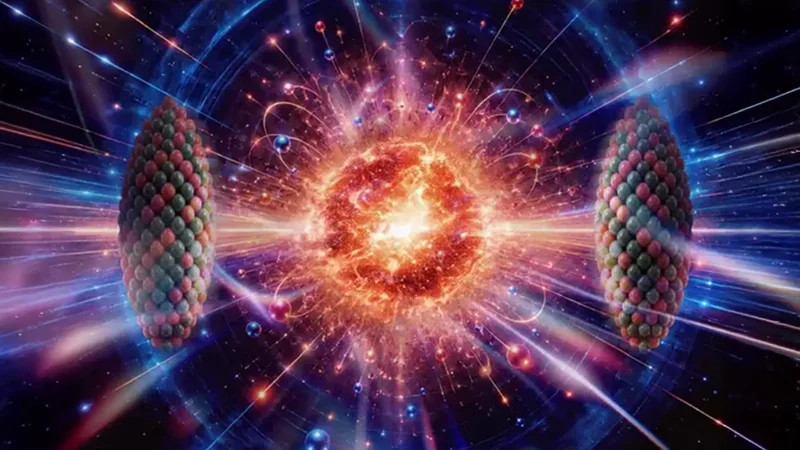
When atomic nuclei crash into one another at nearly the speed of light, they briefly produce quark-gluon plasma, an extraordinarily hot state of matter in which quarks and gluons can move freely. This exotic material behaves like an almost perfect fluid and offers scientists a way to study conditions similar to those that existed shortly after the Big Bang.
Researchers have devoted considerable attention to the plasma's intense swirling motion and powerful electromagnetic fields. Its acceleration, however, has received far less scrutiny, even though it directly contributes to the fireball's rapid expansion. In hydrodynamics, acceleration is considered just as fundamental as vorticity, much as electric and magnetic fields are treated as equally important parts of electromagnetism.
Mapping Acceleration Across Collision Energies
A research team led by Fudan University physicists Yu-Gang Ma and Xu-Guang Huang set out to map how acceleration forms and changes inside quark-gluon plasma.
The researchers combined two widely used particle transport models, AMPT and UrQMD, with a Gaussian smearing method. This technique transformed individual particle distributions into continuous energy, momentum, and velocity fields, allowing the team to examine the plasma as an evolving fluid.
Using this approach, they tracked acceleration across collision energies ranging from 3.5 GeV to 2.76 TeV.
"Acceleration is not merely a kinematic detail -- it may act as a thermodynamic control parameter of QCD matter," explains Professor Huang.
Extreme Acceleration at the Fireball's Edge
The simulations showed that peak proper acceleration can reach several hundred MeV at both low and high collision energies. The strongest transverse acceleration consistently points outward and appears near the outer boundary of the fireball.
This edge becomes an acceleration hotspot because pressure falls rapidly there while enthalpy density remains low. According to the relativistic Euler equation, those two conditions reinforce each other and greatly increase the acceleration.
The plasma behaves differently depending on the energy of the collision. At lower energies, nuclear stopping initially slows the matter down, producing deceleration of up to about 500 MeV. At ultrarelativistic energies, the nuclei pass through each other so quickly that they pull the newly created plasma into brief, intense acceleration pulses.
Because the most powerful acceleration remains concentrated along the boundary, the overall effect changes only slightly depending on whether the nuclei collide directly or strike each other at an angle.
A Possible New Control for Extreme Matter
Acceleration may influence more than the plasma's motion. Through the Unruh effect, an accelerating observer would perceive empty space as a thermal environment. An acceleration of several hundred MeV could therefore resemble temperatures close to the QCD transition temperature.
That possibility suggests acceleration could add a new "acceleration axis" to the phase structure of QCD matter. It may affect both the chiral transition and the transition associated with quark confinement.
Acceleration could also generate previously unexplored transport effects and influence the alignment of particle spins. These effects would complement those produced by vorticity and may help researchers investigate unresolved spin behavior observed at RHIC and the LHC.
Searching for Measurable Collider Signals
The researchers now plan to include more realistic hydrodynamic evolution in their calculations. They also hope to identify experimental signals that could reveal the influence of acceleration, including patterns in hyperon spin polarization.
By connecting non-inertial quantum effects with measurable particle behavior, the work opens a new direction for studying matter governed by the strong interaction.
"Just as temperature and density define the phase diagram of matter, acceleration may open a new axis of that diagram," stated Professor Huang. "By mapping this hidden dimension of the quark-gluon plasma, we hope to turn non-inertial quantum effects into signatures that experiments can actually measure."
Story Source:
Materials provided by Nuclear Science and Techniques. Note: Content may be edited for style and length.
Journal Reference:
- Song-Ze Zhong, Xian-Gai Deng, Xu-Guang Huang, Yu-Gang Ma. Fluid acceleration in heavy-ion collisions.Nuclear Science and Techniques, 2026; 37 (10) DOI: 10.1007/s41365-026-02044-8
Cite This Page:
ScienceDaily. Retrieved August 3, 2026 from www.sciencedaily.com