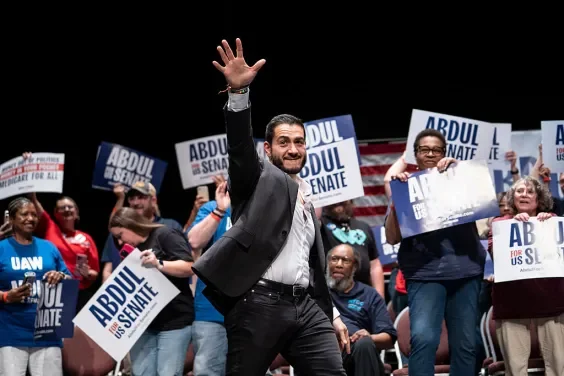
DETROIT — It’s 2:00 p.m. on a Tuesday, just one week from election day, and Abdul El-Sayed’s Detroit office is standing room only. The front and back of the room are packed with volunteers eager to hear the senate-hopeful speak before they go out and canvass the nearby neighborhoods. Many of them are still coming off the high of what they saw as a stellar performance from El-Sayed in the candidate debate that aired the night before.
“He was so good, so good,” Lisa, a woman from Grosse Pointe Woods, tells me. While she has previously canvassed for El-Sayed, today she’s brought backup: her son, a college student at Michigan State University who is volunteering for the campaign for the first time.
El-Sayed’s campaign has knocked 190,000 doors since he launched his run for Michigan’s U.S. senate seat, and in these final days before the election, they’re hoping to drive those numbers up. Every meaningful conversation they’re able to have with an undecided voter could make all the difference come Aug. 4. In the Michigan Democratic senate primary, El-Sayed, a Bernie Sanders-backed progressive with a background in public health, is facing off against Rep. Haley Stevens, a moderate congresswoman who has picked up the support of Governor Gretchen Whitmer. The money in this race is decidedly not on El-Sayed’s side. Super PACs have spent more than $60 million to support Stevens, with over $30 million of that coming in from the American Israel Public Affair Committee.
Although El-Sayed may not boast the advertising might of the Stevens campaign, what he does have might be even better. Through a strong network of field organizers that span from southeast Michigan to the Upper Peninsula, the campaign is fighting money with manpower—roughly 10,000 volunteers, if you want to put a number to it. Regionally, they’re led by campaign staffers, many of them college-aged or recent graduates, who are tapped into their local communities and ready to throw down everything for El-Sayed. This race may be a tipping point in the Democratic party’s ideological direction, and his staffers are determined to come out on top.
When I first arrived at the office, which is located in a commercial strip on the side of a busy road, I noticed that it was charmingly situated next to a comic book store. Just a week or so earlier, the Islamophobic right-wing activist Jake Lang had attempted to crash another canvass launch at this office. El-Sayed and his guest of the day—Minnesota Attorney General Keith Ellison—had led a “USA” chant as security escorted Lang off the premises.
Today’s canvass launch doesn’t have anywhere near that level of drama, although there is an impressive press corps present to document the event. The New York Times is here, and so is The Times of London, equipped with a camera crew. At one point, a local news channel enters unannounced with an anchor. This time around, El-Sayed is accompanied by Florida’s Gen-Z congressman Maxwell Frost, who gives a rousing speech to the crowd of canvassers. Donavan McKinney, a DSA-backed candidate running to oust an unpopular incumbent in Detroit’s congressional district, also delivers a pitch.
“If it hasn’t been clear that this is a race between the money and the many, I hope it was clear yesterday,” El-Sayed tells the crowd, referring to the debate that happened the night before. Stevens had inelegantly tried to dodge questions about the super PAC money behind her campaign.
“This is probably gonna go down as the most expensive Democratic primary in the history of the country,” McKinney says. “But guess what? What I believe more than anything, organized people beat organized money every single time.”
This isn’t the first time that eye-watering amounts of outside money have poured in to support Stevens during a primary. In 2022, redistricting led to an incumbent-on-incumbent battle between Stevens and then-congressman Andy Levin, a Jewish progressive who hailed from one of Michigan’s most noted political dynasties. At the time, Levin was my congressman, and it was a fact I was proud of. He was a champion for renewable energy projects and a strong ally to environmental groups and climate activists. As a fellow for his campaign, I would soon learn that he had drawn the attention of AIPAC. During his time in office, Levin, who identifies as a Zionist, had been critical of Israel, especially after he visited the West Bank in 2019. In a January 2022 email calling on voters and donors to back Stevens, a former AIPAC president said that the race was “a rare opportunity to defeat arguably the most corrosive member of Congress to the US-Israel relationship.”
Through its newly-formed super PAC, the United Democracy Project, AIPAC funneled $4.2 million into the race to back Stevens. Their ads did not mention Israel. Instead, AIPAC focused on boosting name recognition for Stevens through nonstop ads. Combined with a few million dollars from EMILY’s List, which backs women candidates who are pro-choice, airwaves and mailboxes got flooded with pro-Stevens messaging. In the end, Levin lost by a double-digit margin. Levin’s defeat, coming two years after Bernie Sanders’s energized base and organized ground game weren’t enough to overcome Joe Biden in the Democratic presidential primary, served as a reminder that “organized people beat organized money” isn’t always as true as it sounds. Levin’s field team ran circles around Stevens’s, but it didn’t feel like it made a difference in the end.
Since then, AIPAC has only thrown more and more money into races across the country, typically in Democratic primaries. In 2024, they successfully ousted Jamaal Bowman and Cori Bush, both members of the progressive Squad. But as of late, AIPAC has begun to stumble, especially as their name recognition has increased among the general public. Many voters have begun to associate AIPAC with dark money in politics and the increasingly unpopular policy of unconditional aid to Israel.
This Michigan Democratic senate primary is much like Stevens’s 2022 race, but on steroids. She’s facing off against another Sanders-backed progressive who staunchly supports Medicare For All, and she’s doing so with the monetary might of AIPAC behind her. Just last week, AIPAC committed another $5 million toward Stevens. But if the newest polls on the race are to be believed (the majority that have dropped in the last week have El-Sayed up by double digits), Stevens might not emerge victorious this time. The many might beat the money, in part because growing frustrations against the Democratic party are driving people to consider a charismatic candidate who speaks to all their issues with the status quo, and proposes an alternative. For El-Sayed, that alternative comes in the form of a three-line slogan: “Money out of Politics, Money in Your Pocket, and Medicare For All.”
At the first campaign event I attended, a small town hall in a church basement in metro Detroit, the call and response for his slogan was a little quieter, the 100 or so members of the audience just learning the lines. Then, at his Detroit Opera House rally with Bernie Sanders and Alexandria Ocasio-Cortez on July 18, a crowd of well over 1,000 had chanted loud and proud. At his Detroit Office, with his most dedicated supporters gearing up to canvass, it’s clear they know the lines, too.
For those following the Michigan Democratic senate primary from out of state, it can be hard to tell whether the enthusiastic support for El-Sayed translates beyond the online bubbles of Twitter or Facebook. How grounded, actually, is his campaign? The answer is that El-Sayed and his team are, by large margins, hosting the most events and boasting the most volunteers of any candidate in this race.
Just three weeks ago, on July 13, the Stevens campaign was advertising zero in-person events (and only three virtual phonebanks) on Mobilize, a platform Democratic candidates often use to register volunteers and attendees. In contrast, El-Sayed’s campaign had around 86 listed events that same week.
When El-Sayed began his senate run in spring 2025, his campaign made a trip to the Upper Peninsula of Michigan fairly early on. It would be nearly half a year later until Stevens made her first visit up north. In the first year of his campaign, El-Sayed made it a priority to hold town halls throughout the entire state, and it’s an investment that may pay off. While southeast Michigan is the most populated area of the state, 50 percent of the electorate lives everywhere else.
Mason Pressler, a 20-year-old school board member from Bay City, Mich., began hearing rumblings of an El-Sayed senate run in early 2025. By the summer, El-Sayed began showing up in Bay City to campaign. Pressler, an early endorser of El-Sayed, noted how his campaign had done early outreach in communities that don’t always get the most attention from Democrats at the state or national level.
I catch him on the phone while he’s driving to a campaign event in Flint, Mich. Pressler began working for the campaign as a field organizer in May, although he has been a loud and enthusiastic supporter of El-Sayed for much longer. He explained to me that the campaign had been calling endorsers and looking for individuals who knew their regional communities well. To date, the campaign has roughly 12 regional field organizers across the state, bolstered by two dozen or so paid campaign fellows who assist in knocking doors and running in-person events.
“When their strategy is organizing and tapping into these pre-existing progressive networks, rather than blanketing the airwaves with millions of dollars in TV ads, I think that that strategic investment has really paid off for the campaign broadly,” Pressler says.
In conversations with voters all across Bay City, he tells me that his most interesting discovery is that the majority of elderly voters he has spoken to have already submitted their absentee ballots for Abdul.
“They're excited about his message. A lot of the older people tend to think that he energizes young people,” Pressler explains.
Milo, a college junior, has been a field organizer for the Upper Peninsula this summer, and he tells me that in rural areas, there is a real appetite for a populist candidate backing Medicare for All and opposing data centers—and El-Sayed’s message resonates there.
“I expect him to do very well up there in the election next week, because people hear his message, and they really aren’t thinking about who can cater to the center that exists in some political world that nobody’s really living with anymore,” Milo tells me. At the Tuesday canvass launch, he delivers instructions to the volunteers, and it’s clear that El-Sayed’s message resonates with Milo, too.
As Rep. Frost, a former field director, tells me, El-Sayed’s field team is delivering some of the best pitches he’s ever heard. “I’ve seen a lot of organizers give field pitches that are not coming from the heart. These organizers are invested in this campaign.” And those good pitches can make all the difference between a motivated canvasser who takes the extra step to try to convince a voter, and one that leaves literature on a doorstep and calls it a day.
Calla, a recent graduate from the University of Michigan, is one of his Washtenaw-area fellows, and like El-Sayed, she had planned to become a doctor before she realized how broken the system was.
“There were so many systemic issues that just being a good doctor wouldn’t fix,” she says while we’re sitting outside a canvass launch in Ann Arbor. “I realized that politics was a realm you have to get into if you want to tackle these issues like Medicaid funding.”
Hana, a Metro-Detroit fellow for the campaign and a rising senior at Michigan State University, tells me that her brother has a chronic illness that has massively driven up the cost of their family’s insurance.
“Medicare for All is really important to my family, because there’s no reason anyone should be paying a full wage for insurance,” she says.
Everardo, a Detroit-native and a current University of Southern California student tells me that he has been following El-Sayed’s campaign since it launched last spring. While Everardo previously interned for Senator Gary Peters, the outgoing establishment Democrat who has backed Stevens as his successor, he was drawn to El-Sayed’s campaign particularly after the candidate called for ICE to be abolished.
For Everardo, that call is personal. His brother-in-law was arrested and deported by ICE early into the second Trump administration, and he has seen firsthand how much it has affected his sister.
“My nephew was born six months before [the arrest], which was obviously really harsh on her,” he tells me. “And my nephew, he doesn’t really know his dad … I see my sister and how much she has struggled emotionally and physically, and it’s just not fair.”
In these weeks leading up to the election, Everardo has been focused on reaching community members in Southwest Detroit, where there’s a large concentration of Hispanic voters. It’s also an area that has been particularly hit hard by ICE raids. When he’s out knocking doors, Everardo wants Hispanic voters to know where El-Sayed stands on immigration and ICE, and how he would help their community. Like the other staff members I speak to, Everardo emphasizes positivity, so he doesn’t speak to me at all about where Stevens stands on the issue of ICE—she’s not interested in abolishing it, and is more focused on reform.
Both Everardo and Hana emphasize El-Sayed’s opposition to the genocide in Gaza as one of the reasons they’re proud to work for him.
Pressler tells me that the consultant class misunderstands where the average Michigan Democrat stands on Israel-Palestine. “People from outside of Michigan, and people who are in the D.C. beltway, the think tank space, they all tend to think that not many voters care about this, that it’s confined to Arab and Muslim Americans. It’s confined to young student activists on college campuses. And, you know, ‘It’s gonna be a detriment that Abdul talks about it so much,’” Pressler says, “... But what I’ve seen is that for most Democratic voters, it’s the sticking point. It’s the issue that matters. It’s the reason why. It might not be 100 percent of the reason, but it’s the tipping point to supporting Abdul.”
On Wednesday, I get my chance to see what it’s like to be a field organizer for El-Sayed. Frost and Georgia state representative Ruwa Romman are here to hype up around three dozen canvassers in the middle of the workday. The topic of the day is the increasing attacks on El-Sayed from the Stevens camp.
“You’re seeing the flood of corporate money coming into this election. I’m sure you’ve seen the ads. I’m sure you’ve seen the mailers and all that,” Rep. Frost tells the crowd. “The reason they're doing this is not because they think they’re gonna win. They’re doing it because they think they’re gonna lose. Your enemy, your opposition will fight the hardest, will throw the most swings when their back is against the wall.”
For well over a month, AIPAC’s UDP has been running ads about how El-Sayed is disrespectful to women, a claim that his campaign has characterized as misleading and that statewide publications have debunked. There’s also been a fair amount of Islamophobia directed at El-Sayed, including from an endorser of Stevens, and bizarre attacks reducing him to a “podcaster” and a “celebrity.”
“What we’re hearing at the doors is people are actually extremely, extremely receptive to Abdul. Not only that, but for some of them, they’ve seen the attack ads, but it hasn’t been enough to convince them to vote for Haley. What’s happening is it’s convincing them to stay home,” Romman explains to the crowd. “Because that's the problem with negative campaigning. It convinces us to let our power go. And what you guys are doing is you are going to those doors and you’re reminding them not only of their power, but you are pushing back on some of the lies being used to make it seem as if people are actually apathetic.”
Claire, a field organizer who covers Washtenaw County, is one of the staffers running this canvass launch. She tells me that she recognizes about half of the volunteers present today. Some of them, sitting in the back row of the room, are among the most dedicated volunteers and have knocked over 2,000 doors for El-Sayed.
“A lot of times in campaigns, people come up to these canvass events to see some people speak and then they dip and they don’t canvass,” Frost tells me. That, however, hasn’t been his impression of the events he’s done for El-Sayed. “Every rally I’ve been to with him, everyone’s staying to canvass. People are here to work, which means they feel invested in the message and the campaign.”
Romman and Frost, too, are knocking doors in Ann Arbor today. When I ask Frost if he’ll introduce himself as a congressman, he just smiles. “I feel like unless they know who I am off the bat, I’d rather just be Maxwell.”
Claire has another event to run in the evening, but in the time between this canvass launch and the next, she’ll go knock on 50 or so doors. We drive a few minutes to a neighborhood nearby, and she splits a stack of door hangers with another campaign staffer. While Claire covers Washtenaw County, she’s also in charge of field operations in Jackson County, and several cities in southern Michigan. As I walk with her from door to door, she tells me about why she decided to support and work for El-Sayed.
In the winter, she heard El-Sayed speak for the first time at a protest in Romulus, Mich., where locals and politicians were rallying against a proposed ICE facility. While some other senate hopefuls were there, it felt clear to Claire that compared to the rest of them, El-Sayed was “a real fighter,” the kind of person that people are excited to vote for.
No one answers at the first few doors we approach—not all that unexpected, considering that many people are still at work—but eventually we get some contacts. The first man tells us that he’s voting for El-Sayed. The next household says that they just moved and are unsure if they can still vote, so Claire gives them some information about registering in the area. We get another voter who tells us she already voted for El-Sayed. Then, at the next door, we meet the kind of voter that most canvassers tell me is their favorite kind—the undecided voter.
When the woman opens the door, she tells us that she’s still reading up on the news.
“Are you feeling him?” Claire asks, referring to El-Sayed. "Kind of," the woman responds. She likes some of his ideas, but do we think he can win when reaches the general election? In response, Claire suggests that much of Stevens’s outside support might dry up in the general—they’re more interested in defeating El-Sayed in the primary than they are in lifting Stevens all the way to the senate. And El-Sayed’s appeal transcends party lines. The newest polls say independents are really swinging for him.
At the remaining doors Claire approaches, nearly every voter we encounter says they’re voting for El-Sayed or have already voted for him. The only Stevens voter we meet—an early voter—tells us that he’s already regretting his choice. “He’s a great speaker,” he says. “The other one, not so much.” The voter tells Claire that he’s worried that El-Sayed’s appeal doesn’t extend outside of southeast Michigan, and she tells him that that likely isn’t the case. The crowds that came out to see him in Grand Rapids were even larger than the one in Detroit. The odds say he’s going to take northern and western Michigan. He tells us that his wife has yet to vote, and that we should leave a flyer behind.
“People like Abdul,” Claire tells me as we’re wrapping up. “People need the things that he’s fighting for. And that’s why we have so many volunteers and so many people out in the field because people are passionate about it.” In a moment, she’ll hop in her car and head out to meet with more volunteers. At this point, it seems like she and every other full-time staffer I meet is working upwards of 12 hours a day. But that’s the nature of a campaign job like this, and it only gets more intense the more you care about the campaign.
It’s a kind of dedication that no amount of money can buy. As young as they may be, some of El-Sayed’s staffers have been on this train since 2017. Roxie Richner, his official spokesperson, is only two years out of college, but interned for El-Sayed’s gubernatorial race when she was still in high school. Another one of his press aides also worked for his campaign back then. And in Detroit, I meet Sonique, a local mental health advocate who put the nonprofit she runs on hold in order to help El-Sayed as a field organizer. For a while, Sonique had considered herself retired from campaigns.
“Abdul was literally the only person who could pull me out of political retirement,” she tells me. She met him back in 2017, and has always appreciated his background as a public servant. Right now, Sonique is working 12 hours a day, seven days a week, in her hometown of Detroit where she’s hoping to flip more voters to El-Sayed. On Monday, she drove for hours around the city, visiting every early voting site to place a yard sign for El-Sayed.
But every voter she’s able to flip at the doors makes the job worth it. “I would not want to be anywhere else,” Sonique tells me. “I cried like a baby when I got the job offer.”
I ask Sonique what she’ll do if she wakes up to a world on August 5th where El-Sayed has won the democratic primary. She tells me if that is the case, she’d consider taking a short break. “I might take half the day off to just sleep,” Sonique says. “And then I’m gonna wake up, and hit the ground running again.”