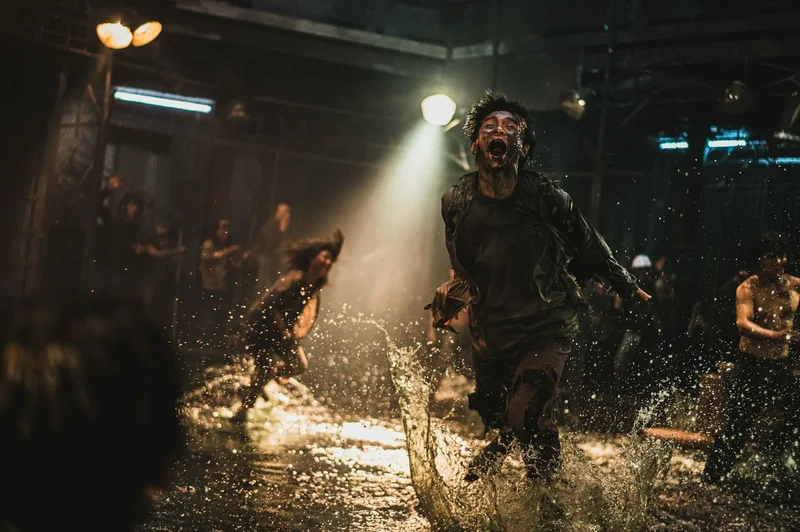
Yeon Sang-ho still remembers what was going through his head as he prepared to make Korea's first commercial zombie movie. "I remember when we were first planning in pre-production, I was like, 'I want you to be able to cry when you watch this film,'" Yeon tells Polygon.
The result was Train to Busan, a breakout hit for South Korean cinema that became a global sensation and probably made a lot of people cry with its grounded, gritty portrayal of a zombie outbreak onboard a train headed south from Seoul to Busan.
A decade after its 2016 premiere, Train to Busan is pulling back into theaters on Aug. 14, and to mark the occasion, Polygon hopped on a zoom with Yeon to discuss how he made a zombie movie for audiences who weren't familiar with the genre, why the sequel didn't achieve the same success, and whether he ever plans to complete the trilogy.
The biggest challenge facing Train to Busan early on was that there was no built-in audience for zombie horror in Korea. Yeon knew the genre had potential, but he wasn't taking any chances. After directing a pair of animated features earlier in the 2010s, this was his chance for a live-action blockbuster, so he made sure to throw in anything he could think of to win over skeptical audiences.
"We just did not have a very solid built-in zombie genre fan base," Yeon says. "So I had to actively incorporate other elements, other than the typical traits that you see in a zombie film. Train to Busan is also an action film. It's a drama film. It is a true combination of several genres and dramatic elements."
Conversely, the decision to combine multiple genres in Train to Busan didn't just make it a hit in Korea. It gave the film global reach. Yeon attributes this to the fact that he made a zombie movie that feels different from what was being released in America at the time.
Admittedly, 2016 was otherwise a lowpoint for the genre; the biggest zombie movie to come out of Hollywood that year was Pride and Prejudice and Zombies. Still, Yeon credits this choice with turning Train to Busan into an international phenomenon.
"That really set this film apart," he says. "I think that's been a very decisive factor in the film resonating with international audiences."
Four years after Train to Busan's release, Yeon followed it up with a sequel titled Peninsula. The highly anticipated movie jumped forward several years to imagine a future where South Korea had been completely overtaken by zombies and cordoned off from the rest of the world (not unlike the premise of 2025's 28 Years Later). In the film, a group of Koreans living in diaspora return to Busan on a mission to retrieve an abandoned truck full of money. What they find is a post-apocalyptic hellscape where the surviving humans and the Mad Max-style world they've constructed is scarier than the roving mobs of zombies.
According to Yeon, that's exactly the problem with Peninsula, which did fine at the box office but got poor reviews. The zombies he'd created specifically for Train to Busan just didn't work in a different setting:
"In Train to Busan, the zombies are working in a very limited space, like a train car. So one of the things we thought about is, because trains in Korea go through a lot of tunnels, there's a lot of contrast between light and dark. So we came up with the concept of the weakness of the zombie being a sensitivity to light. In that sense, the zombies in Train to Busan are catered to that specific film, and the suspense comes from being in that claustrophobic space. On the other hand, in Peninsula we bring the same traits of those zombies, but now they're no longer in a limited space. They're sort of out there in the world. And because of that, the suspense you got from the train lost its power in Peninsula. The zombies effectively become powerless, and the movie became more about exploring the human nature that comes from a post-apocalyptic world."
Yeon's solution after Peninsula was to start from scratch with a brand new breed of zombies in his latest movie, Colony, which releases Aug. 28 in the U.S. But while Yeon is already thinking about sequels and other ways to expand this latest franchise, he hasn't completely abandoned the zombies that launched his career a decade ago.
"We'll see if I'm gonna make another movie to complete a Train to Busan trilogy," he says. "We'll see about that."
Train to Busan returns to theaters on Aug. 14.