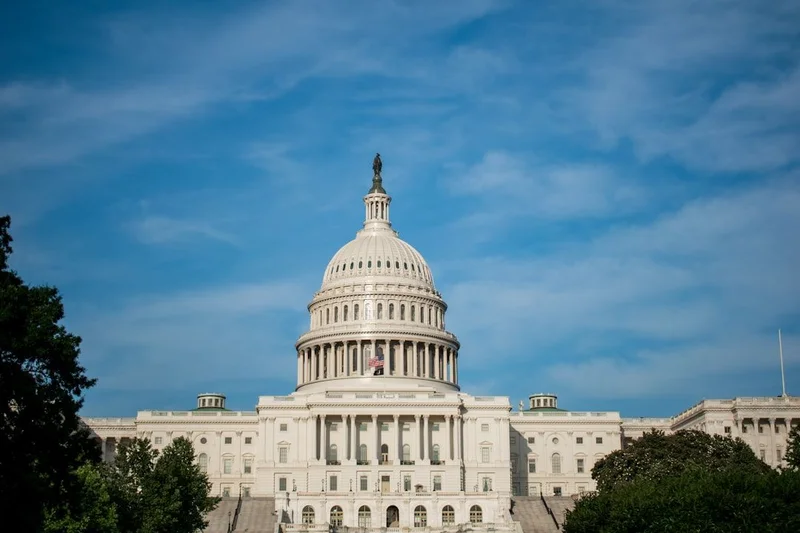
The 616-page bill bars federal officials and their spouses from issuing or sponsoring tokens, expressly lets them keep investing, routes enforcement through the DOJ, and sunsets at noon on January 20, 2029. Three design choices that add up to a conflict-of-interest rule engineered not to bind much.
The waiting is over, at least for the text. On July 22, Senate Republicans released a 616-page version of the Digital Asset Market Clarity Act (the merged product of the Banking and Agriculture Committee bills) and teed it up for a possible floor vote as soon as next week. After a year in which the ethics provision was the reason nothing moved, we can finally read what a landable version looks like. The answer, on the terms reported by The Block, which obtained the text: an ethics section parked at the very end of the bill that is narrow in what it prohibits, temporary in how long it lasts, and discretionary in who enforces it. Each of those is a load-bearing choice. Together they tell you how little this provision is meant to constrain the officeholder who prompted it.
What the text actually says
Per The Block's reading, the ethics section bars a public official or employee, and their spouse, from issuing or sponsoring digital assets, while expressly preserving their ability to invest in them. Enforcement sits with the Department of Justice, not state attorneys general. And the whole section carries a sunset: it has, in the bill's words, "no force and effect on and after noon on January 20, 2029." These specifics are fresh and come from the outlet that obtained the text; the 616-page bill hasn't yet been parsed line-by-line in public, so treat the plumbing as reported rather than as settled statutory analysis. But the shape is clear enough to assess.
One thing to credit up front: extending the bar to spouses is a real expansion, and it answers a demand Sen. Kirsten Gillibrand made months ago when she pushed to cover officials and their spouses. The personnel scope widened. It's the conduct scope, and the duration, where the provision gives most of it back.
Issue and sponsor but invest freely
Start with the verbs, because in a conflict statute the verbs are the whole game. Barring an official from issuing or sponsoring a digital asset reaches the act of launching or lending your name to a new token. It does not reach holding one, trading one, or collecting a revenue stream from one already launched — and the text, as described, says so directly by carving investing out as permitted conduct.
Apply that to the facts that generated this fight. The $TRUMP memecoin was issued in January 2025; the roughly $635 million in memecoin royalties in Trump's July disclosure flows from a licensing arrangement tied to an asset that already exists. World Liberty Financial is likewise already up and running. A prospective ban on issuing or sponsoring, paired with an explicit blessing of investing, leaves existing positions and their income streams untouched. It requires no divestment. It does not unwind a single royalty. It stops the president and his family from launching the next token for the remainder of this term — which is a real limit, but not the one Democrats spent a year demanding. Their ask, embodied in the Van Hollen amendment that died 11–13 in committee, was a bar on holding and profiting. The text answers a narrower question than the one on the table.
This is also why the White House could sign off. Its stated position all along was that any rule apply "across the board" and not single out one officeholder, and that existing ethics law already restrains issuance. Earlier drafts leaned on exactly that framing, even invoking a Section 208 deeming mechanism — notable because 18 U.S.C. § 208, the criminal conflict-of-interest statute, categorically exempts the president and vice president. A provision built to route around § 208's exemption cannot suddenly bind the person § 208 was written to exclude.
The sunset is the tell
Now the date. Noon on January 20, 2029 is not an arbitrary cutoff. Under the Twentieth Amendment, that is the precise minute the next presidential term begins. The ethics section, in other words, is drafted to expire at the exact moment this administration ends. Whatever constraint it imposes runs for roughly two and a half years and then evaporates by operation of its own text, requiring a future Congress to reauthorize it before it could bind any future officeholder.
For a bill whose entire selling point is durability (the argument that only a statute, not the SEC and CFTC's reversible March interpretive guidance, can survive a change of administration), an ethics rider with a built-in expiration date is a striking contradiction. The market-structure framework is forever; the conflict rule attached to it is a term limit. Read charitably, from the Republican side, the sunset is what made a concession possible at all: a temporary rule is easier for a reluctant president to accept. Read from the Democratic side, a conflict-of-interest provision that covers only the presidency that provoked it and then self-destructs is close to symbolic. Both readings point the same direction on the votes.
DOJ, again, is the enforcer
The enforcement structure survived intact from earlier this week, and so did the objection to it. Housing enforcement solely in the Justice Department means enforcement subject to prosecutorial discretion, with no private right of action and no state attorney general to act when Main Justice declines. Congress has repeatedly given state AGs concurrent authority over federal financial law (Dodd-Frank's Section 1042 is the cleanest example) precisely to prevent a single gatekeeper from nullifying a statute by inaction. The CLARITY text does the opposite.
That is what Sen. Angela Alsobrooks, a lead Democratic negotiator, was reacting to when she called DOJ-only enforcement an "unserious" offer she couldn't support, while leaving room to keep working "from that floor." Her skepticism is sharpened by who currently runs the department: Todd Blanche, Trump's former personal defense lawyer, now acting attorney general and the president's nominee for the permanent job. Ask covered officials to trust that this DOJ will investigate this president over conduct that, thanks to the investing carve-out, is mostly permitted anyway, and the provision starts to look like enforcement theater.
The developer safe harbor rides along
Buried in the 616 pages is Section 604, the Blockchain Regulatory Certainty Act, which codifies that non-custodial developers, node operators, and validators who never take custody of user funds are not money transmitters under federal law and carry no Bank Secrecy Act obligations. This is the provision much of the industry cares about most, because DOJ has argued in pending litigation that publishing non-custodial DeFi code can amount to unlicensed money transmission. Blockchain Association's Summer Mersinger has signaled she expects BRCA to survive in the final text, and The Digital Chamber's Cody Carbone called the release a "meaningful step."
It also carries its own opposition, distinct from the ethics fight. The National District Attorneys Association and the National Sheriffs' Association — and, per The Block, some Catholic leaders — warn that the safe harbor could hamper trafficking and money-laundering investigations. Sens. Mark Warner and Catherine Cortez Masto have tied their votes to law enforcement's sign-off. That's a second Democratic constraint operating in parallel with ethics, and it doesn't clear just because the text dropped.
Does this get to 60?
The arithmetic hasn't softened. Cloture takes 60; Republicans hold 52 after Sen. Lindsey Graham's death, with Hawley and Paul expected to defect on substance, leaving at least seven Democrats to find. The committee produced two crossovers, Gallego and Alsobrooks, both conditional, and Alsobrooks is currently a public "no" on the enforcement language. No Democrat has endorsed the released text.
My read: this text is more likely a forcing mechanism than a finished deal. It converts a year of abstract argument into concrete language Democrats now have to accept or reject on the record, but as drafted, the scope carve-out, the sunset, and DOJ-only enforcement each give a wavering Democrat a clean reason to withhold a vote, and together they're hard to wave away as technicalities. The realistic paths remain narrow: negotiators bolt on a concurrent enforcer or strip the sunset to move a few moderates, or the bill slides past the recess into a calendar that belongs to the midterms.
What to watch
- The actual sunset and carve-out language.Confirm the noon-January-20-2029 date and the investing carve-out against the enrolled text, and watch whether either changes on the floor. They are the provision's two softest points.
- Whether the sunset or enforcement gets amended.A floor amendment adding state-AG or inspector-general enforcement, or deleting the sunset, is the clearest signal a real bipartisan deal is forming.
- The gettable Democrats.Gillibrand, Warner, Cortez Masto, Coons, Warnock. Warner and Cortez Masto are also gated on the Section 604 law-enforcement fight, so they're double-locked.
- A filed cloture motion.Until Majority Leader Thune files, "vote next week" is a plan, not a schedule.
- The August 7 recess.Two cloture sequences eat most of two weeks. Miss the window and this resets to the fall at best.
Author’s Note: This piece is analysis and commentary, not legal advice, and reflects a fast-moving situation as of July 22, 2026. Nothing here creates an attorney-client relationship or should be relied upon as a legal opinion. The 616-page text was released hours before publication; descriptions of the ethics section's scope, sunset, and enforcement are drawn from the reporting of the outlet that obtained the bill and are treated as provisional pending line-by-line review of the enrolled text.