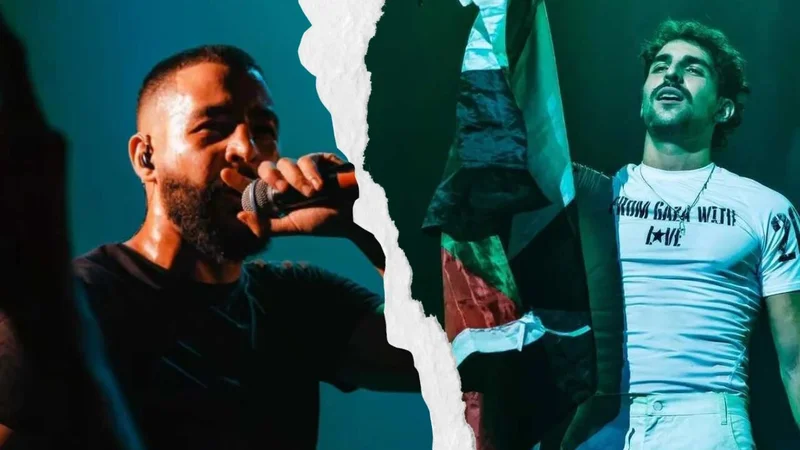
Shabjdeed's Saint Levant diss track: Who gets to represent Palestine?
When Palestinian rapper Shabjdeed released "SLV" on Saturday, a blistering diss track aimed at fellow artist Saint Levant, listeners initially treated it as the start of another celebrity feud.
But within hours, the conversation moved beyond bars and rivalry. Palestinians across social media found themselves debating something much larger: whether or not Palestinian identity has become a brand and suffering gives an artist greater legitimacy, and what audiences expect from cultural figures representing a people living through war and occupation.
Saint Levant vs. Shabjdeed is the Arab version of Drake vs. Kendrick Lamar
— your fav jordanian 🇯🇴 (@jordanianitgirl) August 2, 2026
The timing only intensified the discussion. Both artists are scheduled to perform separate concerts in Amman, Jordan, on 13 August, prompting speculation online that the diss may have been partly influenced by competing shows. Neither artist has publicly linked the track to the concerts.
In just under two minutes, Shabjdeed takes aim at Saint Levant's carefully built public image. He opens by acknowledging, "Sometimes I respect your ability to get things done," before quickly turning to criticism: "I'll teach you a lesson through this diss track."
Much of the song questions Saint Levant's public persona. "Why is your name like that?" he repeatedly asks, joking that, given his frequent references to women and romantic relationships in his music, perhaps he should be called "Saint Women".
Later, he accuses him of "mixing Palestine with every bit of bootlicking, with European horniness" and reducing Palestinian symbolism to aesthetics, rapping about "a bunch of watermelon on my thighs, just so you know how much I love my country".
The lyrics echoed criticisms that have followed Saint Levant throughout his rise to fame.
Born in Jerusalem to a Palestinian-Serbian father and French-Algerian mother, Saint Levant spent part of his childhood in Gaza before moving between Jordan and the US to study. His music blends English, Arabic and French and often explores love, nostalgia and diaspora, paired with highly polished aesthetics.
On the other hand, Shabjdeed emerged from Palestine’s underground rap scene after growing up in Kafr Aqab, and is now based in Ramallah. His work draws on life in the occupied West Bank, local slang and the realities of Israeli occupation, checkpoints and restricted movement, offering a perspective rooted inside Palestine itself.
This contrast lies at the centre of the debate. For some listeners, Shabjdeed articulated frustrations they had long felt.
"Shabjdeed my love!! Thanks for finally speaking up," one supporter wrote.
One user said they were “not surprised by the backlash” against Saint Levant, arguing they had “never been convinced by (his) activism” because it felt “very different from the image he presented before”.
Some argued Saint Levant's multilingualism, international background and collaboration with a luxury fashion house have made him easier to market to western audiences than artists working from inside occupied Palestine.
One Instagram user wrote: “The industry rewards voices that are easiest to package: multilingual, aesthetically polished, commercially attractive, and culturally familiar to the West,” adding that when one artist becomes “the face of Palestine internationally”, other Palestinian experiences risk disappearing from view.
Saint Levant had not publicly responded to the track or commented on Shabjdeed's criticisms at the time of publication.
But many social media users have pushed back against the backlash, saying Palestinian art should not be limited to themes of resistance and suffering.
Everyone hating on saint levant after shabjdeed released a diss track on him .. just know I was here first https://t.co/W6WrEmWL8I
— oma (@omalettte) August 2, 2026
For them, the question was not whether Saint Levant was "Palestinian enough", but how Palestinian identity is packaged and consumed internationally.
'Diversity is a sign of strength'
Responding to an argument that Palestinians should be "allowed to make love songs", one user stated that the question was not whether Palestinians should make such music: "Palestinians are allowed to sing, write and think anything they want. That's not the issue at all. What Shabjdeed called out Saint Levant on is way deeper than an event or love songs."
Others warned against reducing Palestinian identity to a single narrative.
"The Palestinian diaspora is vastly diverse," one commenter wrote. "Palestinians from Syria absorbed the resilience and soul of the Syrian camps, while those in Lebanon, Jordan, Europe and the US each carry unique backgrounds shaped by where they lived."
They added that "diversity is a sign of strength and cultural richness, not a weakness," arguing that Palestinian representation "isn't exclusive to one genre, one tone, or one rigid frame."
And not everyone supported Shabjdeed's approach.
Some criticised lyrics as misogynistic, particularly his references to women and Saint Levant's female collaborators.
Some argued the diss itself was unnecessary, saying, "Great artists should be remembered for what they create, not who they attack" - while others defended the track as part of rap culture.
The debate also sparked questions over whether Palestinians should even be focusing on a song amid Israel's ongoing genocide in Gaza.
Journalist Faten Elwan shared footage showing an unborn baby recovered from rubble after an Israeli strike, writing: "I hope you will spread this exactly as you spread the stupidity of Shabjdeed and Marwan."
Her comments drew criticism of their own. Some argued that discussing culture while documenting the devastation in Gaza were not mutually exclusive, and that Palestinians should not have to speak only about death to be considered legitimate voices.
Perhaps that is why SLV has resonated beyond hip-hop. The track has become a wider debate over class, diaspora, authenticity, and visibility.
At its core is a question that extends far beyond rap: who gets to represent Palestine?
Middle East Eye has reached out to Saint Levant and Shabjdeed.