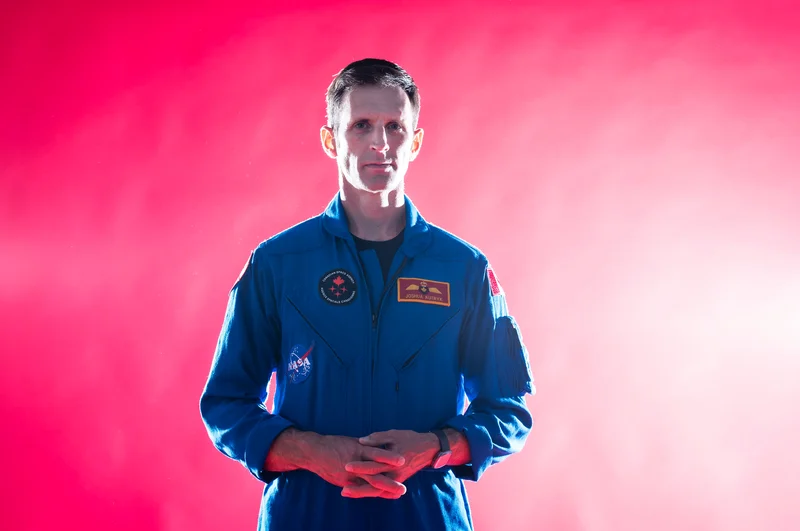
For the second time this year, a Canadian astronaut is heading to space.
It’s been four months since Jeremy Hansen and his U.S. crewmates captured the world’s attention when they rocketed around the moon and back in just over nine days.
Now, Joshua Kutryk, a 44-year-old native of Fort Saskatchewan, Alta., is stepping into the spotlight as he prepares for a six-month stint on the International Space Station.
He is heading to the ISS alongside U.S. astronauts Jessica Watkins and Luke Delaney and Russian cosmonaut Sergey Teteryatnikov. The quartet is scheduled to lift off from the Kennedy Space Center in Florida as early as Sept. 12.
The assignment marks the first trip to orbit for Col. Kutryk and the first long-duration space mission for a Canadian in more than seven years.
During his time aboard the orbiting laboratory, Col. Kutryk will conduct science experiments on topics as diverse as disease modelling using stem cell-derived human tissue, blood flow disorders and crop production in space.
A former test pilot and instructor with the Royal Canadian Air Force, Col. Kutryk was selected to be an astronaut by the Canadian Space Agency in 2017.
While his journey to the launch pad has not been quite as long as Homer’s Odyssey, it has included at least one unplanned detour.
In 2023, Col. Kutryk was chosen for a future flight to the station on a Boeing Starliner. But the next year, problems with that spacecraft during its first crewed test flight turned a planned eight-day mission for two U.S. astronauts into an unplanned nine-month stay on the station.
That put Col. Kutryk’s ride on hold. But in April, NASA announced he and his crewmates would be travelling to the station aboard a SpaceX Dragon capsule. (For Col. Kutryk and his wife Heather, the timing of the flight means that he is on track to be in space during the birth of their third child.)
Recently, Col. Kutryk spoke with The Globe and Mail about what he hopes to achieve on the trip.
**What has it been like to train with SpaceX, particularly on such a short timeline to launch? **
It is a very different paradigm in some ways from missions gone by. [Canadian Space Agency] astronauts previously flew on [Russia’s] Soyuz spacecraft, and before that, the space shuttle. This time we don’t train so much at NASA when it comes to the launch vehicle. We do all that training at SpaceX in Hawthorne, CA. But at the same time, their approach to this complicated problem of how you launch and recover humans from outer space is similar to what we might have seen previously.
Because you first trained for a flight with the Boeing Starliner, do you feel you gained an extra layer of expertise?
That’s how I look at it. I’m one of only a few astronauts, and the only one from Canada, trained to fly that vehicle. I got to participate in the piloting of that vehicle. I was a flight controller for the first crewed launch. I feel, in some ways, that I’ve almost gotten two space flights out of this mission.
Yours is the only the fourth long-duration mission for a Canadian on the space station. How will you spend your time?
The six months are highly programmed. In the broadest sense, [our focus] is on two main things. The first is to keep the space station in running order. That could mean fixing a computer circuit board. That could mean putting a space suit on and going outside to replace a pump module. You have to be able to do all of that.
The second part is the science. The space station is a place where we can do complicated science that we’re unable to do on Earth. Some of that science is related to spaceflight and what we have to do to be able to take our next steps, which involves going to the moon. But a lot of the science relates to problems here on Earth, including aging and disease. A majority of my time will be spent on that, performing experiments for researchers from around the world, many from Canada.
How do you plan to make use of your personal time on the space station?
I am a huge road cycling fan. The good news about the space station is that there’s a bike there. I also like to read. I’ll have my Kindle app so I can basically access any book I want. Of course, we also have the ability to call people on Earth. I’ll try to devote a lot of time to communicating with my family, friends and people who are invested in this mission.
What is it important about this mission from a Canadian perspective?
I think pragmatically, practically, this is an important mission to enable future steps in outer space. The space station missions that we’re doing now are quite complex in their own right, but they’re all designed to be building blocks for what we’re going to have to do at an even more extreme level with the Artemis program. The space station is a test bed for technologies that will be used in the next leap, as we work toward a sustained human presence on the surface of the moon.
For six months we’ll have a Canadian in orbit passing overhead every 90 minutes. It’s a very vivid sign – a beacon in space, literally, that shows Canadians what we can do as a country.
Jeremy Hansen’s flight on Artemis II put Canada’s role as a partner in full view. What’s your sense of Canadians’ interest level in the space program at this point?
My sense is that interest in human space exploration, interest in what we can do to support life here on Earth – interest in all of that has been dramatically accelerated because of Artemis II.
It shows what the future can look like if we go out and try to do some of these really difficult missions together. People were inspired to look at the future optimistically, to dream about what we can do as a species. We’re riding that wave right of increased excitement for space, and we hope it continues because it’s important, especially for Canada.
This interview has been edited and condensed.