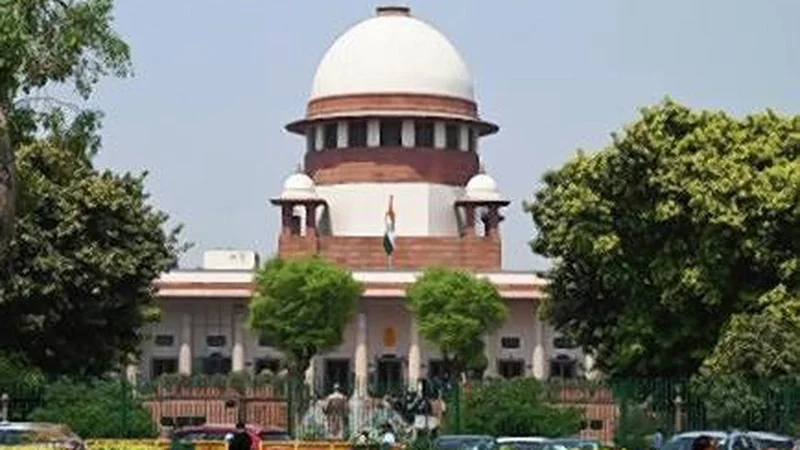
The Supreme Court on Monday (August 3, 2026) summoned the Arunachal Pradesh Chief Secretary and Principal Secretary (Home) after the Central Bureau of Investigation (CBI) alleged that the State government had failed to cooperate with its probe into allegations that Chief Minister Pema Khandu had favoured firms linked to his family members in the award of government contracts over the past decade.
A Bench of Justices Vikram Nath and Sandeep Mehta was examining a status report filed by the Central agency pursuant to the court’s earlier directions when it was informed that the Arunachal Pradesh Government had not cooperated in providing records sought by the CBI during its preliminary enquiry.
Taking note of the agency’s report, the Bench directed both senior officials to appear before it on August 24, 2026, and explain the State government’s alleged failure to comply with the court’s earlier directions.
“We deem it appropriate to issue notice to the Chief Secretary, State of Arunachal Pradesh, and the Principal Secretary (Home), Government of Arunachal Pradesh, making it returnable on August 24, 2026. Both the aforesaid officers shall remain present before this court along with their response to the aforementioned report of the CBI, and also explain as to why there is non-cooperation and non-compliance with the directions issued by this court,” the Bench said.
The order was passed in a public interest litigation filed by the Save Mon Region Federation and Voluntary Arunachal Sena, alleging that several high value contracts for development works in Tawang district were awarded to firms linked to the Chief Minister and his family members. The petitioners have alleged favouritism in the award of these contracts and sought an independent investigation into the matter.
Earlier, the top court had directed the State government to produce records relating to all contracts awarded across Arunachal Pradesh to the firms named in the petition.
On Monday (August 3), Justice Mehta questioned Additional Solicitor General K.M. Nataraj, appearing for the CBI, on the progress of the preliminary enquiry and asked whether the agency was giving a “long rope” to the Chief Minister despite having collected sufficient material.
Mr. Nataraj informed the Bench that the State government had not been cooperating with the inquiry and was yet to furnish all the documents sought by the agency. “The government is yet to furnish all the requisite documents... We will initiate steps in the proper manner. Let the State government cooperate,” he submitted.
Advocate Prashant Bhushan, appearing for the petitioners, urged the court to direct the CBI to register a First Information Report (FIR), contending that the agency’s preliminary enquiry had already revealed prima facie material indicating irregularities in the award of government contracts.
“Normally, a preliminary enquiry is only for the purpose of deciding whether an FIR should be registered or not... Coercive steps have to be taken,” Mr. Bhushan submitted.
Justice Mehta also referred to the discrepancies recorded in the CBI’s status report and questioned why an FIR had not yet been registered despite the material already gathered by the agency.
“In your report, it says all discrepancies. None of the procurement manuals has been followed... Oral work orders, no approval records, nothing. Why do you need anything more? You are just giving a long rope,” Justice Mehta remarked.
Mr. Nataraj clarified that the agency would take appropriate action once all the requisite records had been furnished by the State government. Taking note of the submission and the CBI’s allegation of non-cooperation, the Bench directed the top State officials to remain personally present before the court on the next date of hearing on August 24, 2026.
Earlier, the top court had directed the CBI to conduct a preliminary enquiry into the allegations concerning the award of public works in Arunachal Pradesh between January 1, 2015 and December 31, 2025. The agency was asked to examine why open tenders were allegedly not invited for certain works, whether the absence of competitive bidding affected transparency in the award of contracts, and the flow of funds and payments made under them.
The court had also permitted the agency to examine the beneficial ownership of firms allegedly linked to Mr. Khandu, and the movement of funds through such entities.
The petitioners had also relied on observations made by the Comptroller and Auditor General in earlier proceedings before the apex court, pointing to alleged departures from the General Financial Rules, 2017; the Manual for Procurement of Consultancy and Other Services; and the Manual for Procurement of Works in the award of contracts. The procurement framework, they pointed out, prescribes safeguards concerning the integrity of the bidding process, conflicts of interest, confidentiality, independence, and transparency at different stages of procurement.
The State government, however, has relied on a law enacted in 2015 that permits awarding contracts for work costing up to ₹50 lakh through a “work order” where no special technical know-how is required. It has maintained that the practice was followed with the objective of generating employment opportunities for local villagers and contractors.
Published - August 03, 2026 11:58 pm IST