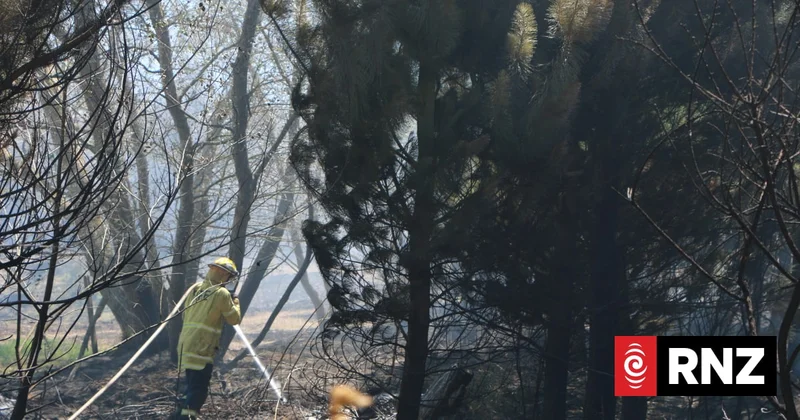
Forest fire-fighters are struggling to identify the biggest wildfire risks, blaming "incomplete, inconsistent and inadequate" official information about where and how blazes break out.
Some key data about the use of land hit by fires was pulled out of by Fire and Emergency NZ's (FENZ) annual wildfire reports several years ago.
FENZ says the data is not its own and is not reliable enough - but wants to reinstate the data once it is.
But according to a survey from the Forest Owners Association and Farm Forestry Association, the ongoing data gap is making it harder to gauge the impacts on forests, the biggest risks, or trends in how fires behaved.
"You can't actually determine where fires are igniting, the area of a particular land use that's burnt each year, and can't really get to the root cause of what's driving a lot of the wildfires that are occurring," said the associations' joint fire committee chair Sean McBride.
The survey said this was making it harder to plan how to prevent or fight wildfires as a whole.
'New normal'
As fires ravage parts of Europe and North America, the European Commission has warned the continent's firefighting response - where countries share aircraft, gear and personnel - is struggling to keep up.
It had to make further and deeper changes in future, it said.
"What we are advocating is an integrated management approach."
The European Forest Institute called it the "new normal" that policies remained "dangerously unprepared" for.
"Climate change is only part of the picture. We must also examine how those landscapes are managed and the policies shaping them. There is no single European land-use story," it said.
Wildfire management in New Zealand is controversial - the rural sector has regularly sounded the alarm about a downgrade of firefighting resources and data since the 2017 merger of urban and rural fire services into FENZ.
The new survey said the model over-relied on rural volunteer brigades. The brigades' union told RNZ that its crews had plenty of capability to fight scrub and grassland fires and did so - but did not for forests, and resources had to come from the forestry sector in co-ordination with FENZ.
Actual damage from wildfires has risen about a quarter in the past five years compared to past decades.
But spending on fire protection by large commercial forest owners - while still more than $8m a year - had dropped by over a quarter since 2022, and their trained and experienced crews had been losing people.
This year volunteer fire brigades were particularly worried because the country was in an El Niño period that is expected to be stronger than usual. The transition from a La Niña to an El Niño was a "major climate driver" in the fires season three years ago.
'Insufficient data collection and quality'
The industry survey suggested FENZ was in the data hotseat but the agency has rejected that.
Before 2021, the agency's wildfire reports recorded what land was used for where the fire started, but this was dropped.
"This limitation is further underscored by the Bioeconomy Science Institute's inability (due to insufficient FENZ data collection and data quality) to publish a detailed breakdown of area burned by fuel type since the 2021/22 reporting year," said the survey.
But FENZ told RNZ this was out of its hands.
"We do not claim our data is complete, and we are open about the limitations."
One limit was around how much forest land was hit by fires, it said.
That relied on national data about land cover - and FENZ said it neither produced nor maintained that data.
"We removed that breakdown from recent summary reporting because the source data was not current or complete enough for us to report against with confidence," it said.
"We... will reinstate commercial forestry and wider land cover reporting once the source data is reliable enough to stand behind."
McBride said they had asked about the missing data, but FENZ had not been clear about it. "We've asked the... question" but not got a "succinct answer".
They were having talks with FENZ about wildfire and forest fire resources, including the data gap.
The survey presented a stocktake of firefighting resources and expertise held by the major forest companies that it said FENZ could use as a "a blueprint for rebuilding national rural-fire leadership capability".
"It highlights a critical capability asset that is unevenly distributed across the country and currently under-utilised."
'Broad and growing'
FENZ's annual wildfire reports are usually more than 50 pages long and have breakdowns of fires per district, as well as the source of the fire, such as cigarettes, fireworks or powerlines.
It told RNZ it captured a "broad and growing" body of wildfire information that it used "every day to reduce risk" and determine responses.
It recorded every wildfire it went to and held 20 years of data about responses.
It was developing several wildfire risk models, ran a national fire danger and fire weather system, and took drone imagery of actual fires to learn from them, it said.
However, its annual report last year also mentioned data accuracy problems. This was related to unpermitted rural burnoffs, which can be a major cause of wildfires.
Wildfire numbers fluctuate wildly but the trend is up. The five-year average is 4300 fires a year, burning 7000ha, versus the 35-year average of 3400 fires, burning 5600ha.
Especially bad fire seasons hit in 1998 and in 2019, when the February Nelson Pigeon Valley wildfire was described as the most destructive plantation fire in the past 60 years.
Before the 2017 merger of urban and rural fire services into FENZ, the National Rural Fire Authority was held to a dozen measurable goals.
"The forestry sector holds severe concerns about the lack of meaningful FENZ key performance indicators for fire management in the forest and rural landscape," said a 2023 report.
There is a global push to standardise fire management frameworks as the toll from wildfires rises.
Wildfires by the numbers
WILDFIRES BY THE NUMBERS
Source: FENZ Scion wildfire reports
- 2019-20- 5700 fires nation-wide, 10,400ha burned; Land use impacts - 7 percent on forestry land, 55 percent on conservation land, 15 percent on meat or wool farms.
- 2020-21- 4500 fires, 13,000ha. 12 percent on forestry land, 27 percent on conservation, 43 percent on meat or wool farms. This report mentioned forestry 37 times.
- 2021-22- 4400 fires, 4800ha. No land use impacts given. Forestry mentioned three times.
- 2022-23- 2400 fires, 1900 ha. No land use impacts given. Forestry mentioned two times.
- 2023-24- 4200 fires, 4100ha. No land use figures.
- Source: FENZ Scion wildfire reports