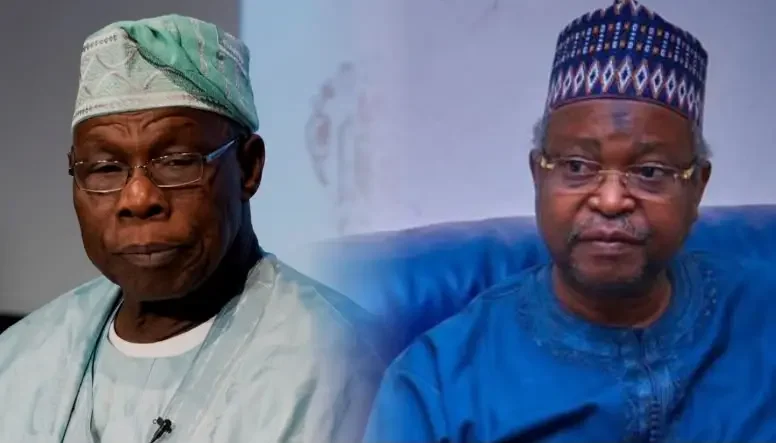
Former Chief Whip of the House of Representatives, Abubakar Bwari, has challenged former President Olusegun Obasanjo’s recent claims against the late former Speaker, Ghali Na’Abba, insisting that the former president’s account of events surrounding impeachment moves during the Fourth Republic is inaccurate and unfair to the deceased lawmaker.
Mr Bwari, who served as chief whip between 1999 and 2007, made the remarks in a lengthy statement on Monday titled, “Setting the Record Straight: A Gentle Correction to Obasanjo’s Claims on Ghali Na’Abba.”
The statement comes days after Mr Obasanjo, in a public letter responding to former Ogun State Governor Segun Osoba’s article, “How Obasanjo Deceived Us in 2003,” alleged that former Vice President Atiku Abubakar offered the late speaker N5 million to initiate impeachment proceedings against him during his presidency.
Mr Bwari described the allegation as “unfair and inaccurate,” arguing that it contradicts both the constitutional process for impeachment and the realities of the political events that unfolded between the executive and the National Assembly during the early years of Nigeria’s Fourth Republic.
| | |
|---|
The former chief whip said he was uniquely positioned to know what transpired because he was part of the House leadership throughout the period.
“As the chief whip of the House of Representatives during that foundational era, I did not merely observe these events; I lived them. I was at the nerve centre of our daily deliberations,” he said.
He questioned the logic behind Mr Obasanjo’s claim that N5 million could have been sufficient to induce an impeachment plot.
According to him, removing a president required a constitutionally prescribed process involving a two-thirds majority in both chambers of the National Assembly, making the alleged amount implausible.
“Is Baba suggesting that the presidency of the Federal Republic of Nigeria was worth so little?” Mr Bwari asked.
“It requires a constitutional two-thirds majority of the entire House, followed by a rigorous, concurrent process in the Senate.”
He further argued that Mr Na’Abba was “far too principled” and too committed to democratic ideals to participate in what he described as a transactional attempt to remove a sitting president.
Mr Bwari also disputed Mr Obasanjo’s claim that Atiku encouraged impeachment efforts.
Instead, he said the vice president regularly acted as Mr Obasanjo’s emissary whenever tensions escalated between the executive and the legislature.
“We viewed him not as an ally in any impeachment drive, but as President Obasanjo’s chief envoy and defender.
“Whenever the friction between the executive and the legislature reached a boiling point, it was Atiku who frequently appeared at our doorsteps, speaking passionately on OBJ’s behalf to douse the flames,” he said.
He said portraying Atiku as the architect of an impeachment plot contradicted the political reality at the time.
Contrary to Mr Obasanjo’s suggestion that he was unperturbed by the impeachment threats, Mr Bwari maintained that lawmakers were determined to commence impeachment proceedings against the president.
According to him, the House had compiled “dozens of impeachable offences” and was prepared to proceed until sustained mediation efforts de-escalated the crisis.
He recalled that several eminent Nigerians intervened to prevent a constitutional confrontation between the executive and legislature.
Among those he listed were former President Shehu Shagari, former Head of State Yakubu Gowon, former Vice President Alex Ekwueme, elder statesman Anthony Enahoro, retired army brigadier Abba Kyari, the late Ooni of Ife, Oba Okunade Sijuwade, the late Emir of Kano, Ado Bayero, as well as a delegation of governors led by Segun Osoba.
Mr Bwari also claimed that Mr Obasanjo’s then Chief of Staff, Abdullahi Mohammed, alongside other presidential emissaries, held several meetings with the House leadership in search of a political settlement.
“We engaged in those late-night dialogues with the utmost seriousness because we respected the presidency, even as we fiercely guarded the independence of the legislature,” he said.
Mr Bwari insisted that Mr Na’Abba’s disagreements with the presidency were never driven by personal animosity or financial inducement.
Rather, he said the late speaker’s actions stemmed from a commitment to protecting the legislature’s constitutional independence.
“Ghali Na’Abba’s battles with the executive were never personal, nor were they transactional. He was driven by an unyielding devotion to the doctrine of the separation of powers,” he said.
He added that several lawmakers who resisted executive influence eventually paid political prices, with many, including Mr Na’Abba, losing opportunities to return to the National Assembly.
The former chief whip also questioned why the allegation surfaced only after Mr Na’Abba’s death.
“The alleged bribe story is said to have occurred sometime between 2003 and 2007. Yet, for the best part of two decades, while Ghali was alive… this accusation was never brought to light,” he said.
“For former President Obasanjo to introduce it now, when the ‘lion’ has passed on and cannot offer his characteristic rebuttal, feels deeply unfair.”
Despite his criticism, Mr Bwari described Mr Obasanjo as an elder statesman deserving of respect and said that his (Bwari) intervention was motivated solely by a desire to preserve what he called the “sanctity of memory” surrounding the late Speaker.
Background
The latest exchange stems from an escalating war of words triggered by Mr Osoba’s article, How Obasanjo Deceived Us in 2003, in which he accused the former president of reneging on political agreements during the build-up to the 2003 elections.
Responding in a public letter, Mr Obasanjo denied deceiving Mr Osoba and used the opportunity to revisit several political events from his presidency.
Among the claims in the letter was an allegation that former Vice President Atiku Abubakar attempted to use the late Speaker, Mr Na’Abba, to orchestrate his impeachment by allegedly offering him N5 million.
Mr Obasanjo also suggested that he remained calm during the impeachment threats because he believed they would not succeed.
The allegation immediately drew a response from Atiku, who dismissed it as false and politically motivated.
The former vice president described the accusation as another attempt to rewrite history and suggested it formed part of an emerging political narrative ahead of the 2027 general elections.
The impeachment crisis referenced by both men dates back to the early years of the Fourth Republic, when relations between Mr Obasanjo and the House of Representatives under Speaker Na’Abba deteriorated over allegations of executive interference, budget implementation, constitutional violations and disputes over the separation of powers.
In August 2002, the House issued Mr Obasanjo an impeachment notice citing multiple allegations of constitutional breaches and executive misconduct.
The move triggered nationwide political tension and prompted intensive mediation by prominent statesmen, traditional rulers and political leaders.
Following weeks of negotiations and commitments by the presidency to address lawmakers’ concerns, the impeachment process was eventually suspended, averting what would have become Nigeria’s first impeachment proceedings against a democratically elected president under the Fourth Republic.
Mr Na’Abba, who served as Speaker from 1999 to 2003, was widely regarded as one of the strongest advocates for legislative independence, often clashing with the executive over constitutional powers before his death in December 2023.