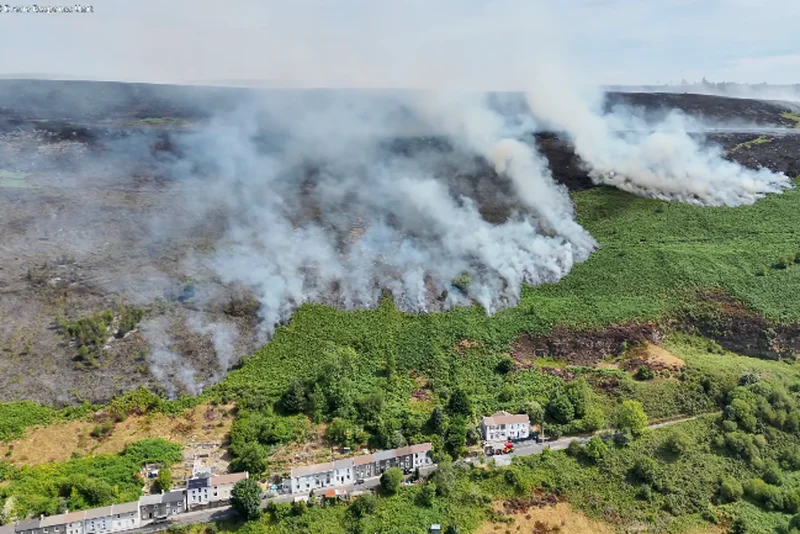
A major incident has been declared in south Wales as firefighters battle a vast wildfire that has ravaged 150 hectares of land in the Rhondda valley.
Crews have been at the scene in Llanwonno, near Ferndale, since Saturday afternoon, grappling with the blaze across forest, scrubland, and vegetation.
South Wales Fire and Rescue Service (SWFRS) confirmed the significant scale of the fire, noting that the steep terrain has made efforts to bring it under control particularly challenging.
Drone footage has captured stark images of blackened ground and thick smoke billowing high above the valley, illustrating the intensity of the inferno.
While residents of Blaenllechau and Ferndale have not been ordered to evacuate, a rest centre has been established at Rhondda Fach Leisure Centre in Tylorstown.
This facility is available for those who choose not to remain in their homes due to concerns over poor air quality caused by the smoke.
Those who wish to remain at home have been told to keep their windows and doors closed if they are affected by the smoke.
People have also been urged to avoid the area where possible and to follow advice from emergency services.
A no-fly zone has been put in place for the next week at the site of the wildfire.
The fire service anticipates that the incident will persist for several more days, with crews expected to remain on site overnight on Monday to conduct controlled burns as part of their strategy to manage the extensive wildfire.
A spokesperson for SWFRS said: “We have declared it a major incident as it requires a greater demand on our resource and as such more co-ordination.
“There are currently 20 fire engines at the scene, supported by two specialist wildfire teams, senior officers, a high-volume pumping unit and drone capability.”
The wildfire comes as provisional statistics from the Met Office showed Wales had its driest July in records dating back to 1836, amid a summer of extreme weather that has seen the whole country plunged into drought.
It comes amid a summer of extreme heat and dry weather across the country, which has seen four back-to-back heatwaves and left all of Wales and half of England plunged into drought.