"Only players who are women are eligible to play in the WNBA."
Sounds simple, right?
That’s the exact language included in the recently signed collective bargaining agreement between the WNBA and the Women’s National Basketball Players Association.
But there’s one problem: The CBA doesn’t actually define "woman."
That should be easy to resolve, and OutKick/Fox News Digital attempted to do just that. In essence, we asked both the league and the players association: What is a woman?
We did not hear back from either.
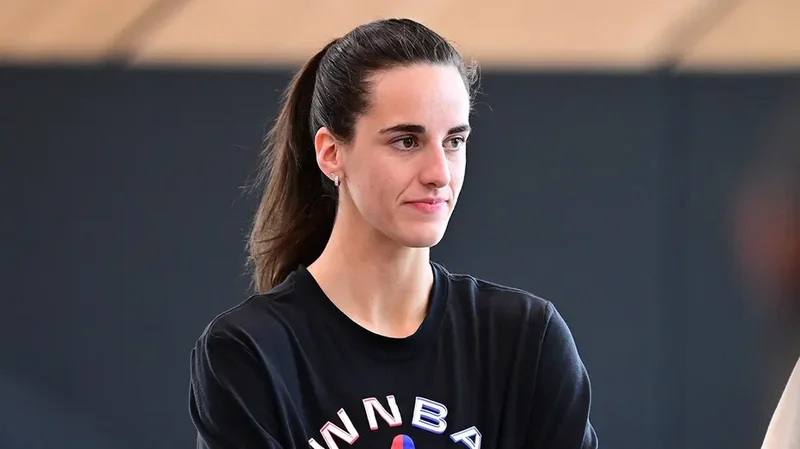
The question became particularly relevant after Indiana Fever star Caitlin Clark was asked Sunday about the controversy surrounding teammate Sophie Cunningham’s comments that girls and women should not have to compete against biological men.
"I think it’s for leagues and governing bodies to work with their athletes to find solutions," Clark said following Indiana’s 108-100 loss to the Minnesota Lynx. "Our focus is on basketball. That’s what we talk about and how we can get wins and obviously we didn’t do that tonight. So, we need to find an area to improve in that way."
Clark, the biggest star in women's sports, identified who she believes is responsible for resolving the issue: the leagues and governing bodies that operate women’s sports.
So, OutKick/Fox News Digital asked the WNBA and the WNBPA to do exactly what Clark suggested and explain the league’s eligibility standard.
Article XIII, Section 1(a) of the 409-page CBA states: "Only players who are women are eligible to play in the WNBA."
The document does not define "woman" or "women." The terms "transgender" and "gender identity" do not appear in the agreement.
The CBA contains detailed definitions for dozens of terms, including "rookie," "veteran," "player contract," "team," "regular season" and "WNBA competitions."
But it does not define the word that determines who is eligible to play in the league.
OutKick/Fox News Digital contacted the WNBA and asked five questions:
- How does the WNBA define "women" for purposes of Article XIII, Section 1(a)?
- Would a player who was born male but identifies as a woman be eligible to play in the WNBA under that provision?
- Does the WNBA have a written policy, league rule or other guidance governing the eligibility of transgender players outside the CBA? If so, please provide it and explain the applicable criteria.
- Who determines whether a prospective or current player satisfies Article XIII, Section 1(a), and what standard would be used to make that determination?
- In light of Clark’s comments, does the league plan to work with players and the WNBPA to clarify this eligibility standard publicly?
The WNBA did not respond by Monday's 3 p.m. ET deadline.
OutKick/Fox News Digital also contacted the WNBPA and asked five similar questions:
- How does the WNBPA interpret the term "women" for purposes of Article XIII, Section 1(a)?
- Was the eligibility of transgender athletes discussed during collective bargaining, and did the WNBPA and WNBA agree to any definition or standard beyond the language appearing in the CBA?
- Does the WNBPA believe that a player who was born male but identifies as a woman is eligible to play in the WNBA under Article XIII?
- Is the WNBPA aware of, or a party to, any separate written policy, league rule or guidance governing transgender-player eligibility outside the CBA? If so, please provide it.
- Has the WNBPA consulted its membership—or does it plan to consult its membership—about how the eligibility provision should be defined and applied?
The WNBPA also did not respond by Monday's 3 p.m. ET deadline.
That leaves the WNBA in a strange position.
Its governing labor agreement declares that only women may play in the league, but neither the agreement nor the two organizations that negotiated it will explain what that requirement means.
The league has not publicly said whether eligibility is determined by biological sex, gender identity or some other standard. It has not identified who would make that decision, what criteria would be applied or whether a separate transgender-player policy exists outside the CBA.
The agreement also provides no stated process for enforcing the requirement. It does not establish an eligibility-verification procedure, identify what records or information a player must provide, expressly authorize sex or hormone testing for that purpose or explain how the league would resolve a challenge to a player’s eligibility.
Although the CBA requires players to undergo physical examinations and drug testing, those provisions address health, fitness and prohibited substances—not whether a player qualifies as a "woman" under Article XIII. Without a definition or a verification process, it is unclear how the WNBA could determine whether its own eligibility rule had been violated.
Sophie Cunningham made her position clear.
Caitlin Clark said the league and its athletes should find a solution.
The WNBA and its players' association, at least for now, won’t even define the issue.
The WNBA has a rule.
It just won’t say what the rule means.