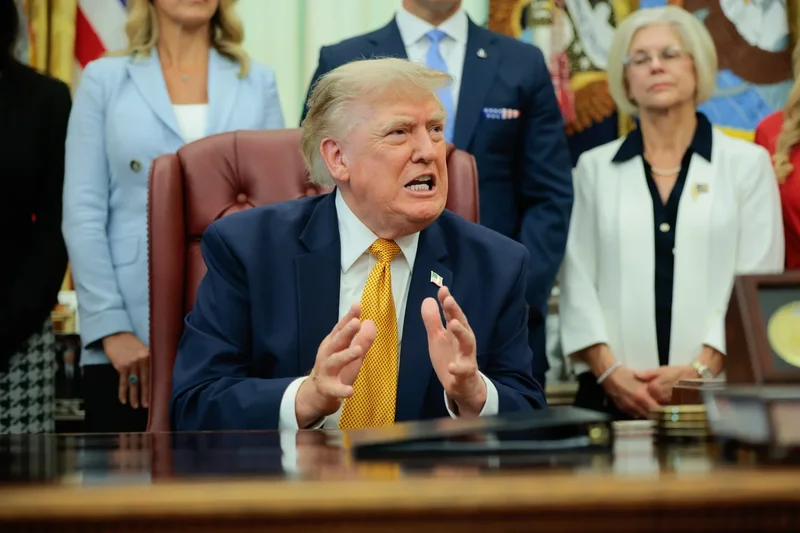
Donald Trump sounded much like an angry, jilted lover ranting on social media on Monday morning as he complained about Iranian officials denying that talks were underway with the United States for another ceasefire agreement.
The president would later address the situation at a White House event and was still fixated on the incongruent statements from Iran’s government as he said talks continued, facilitated and supported by Qatar, Saudi Arabia and the UAE.
On Truth Social, he unleashed on Iran for making him look foolish.
“Iranian Leadership is unbelievably duplicitous! They ask for a meeting, some would say ‘beg,’ talks begin, with more scheduled in the immediate future, and they say, openly and proudly, that they’re not having any discussions, that nothing is being talked about, and they’re only dealing with ‘Oman,’” Trump griped.
“They then go on to give their usual blather in saying, the Strait of Hormuz will be operated powerfully by them, when it is already completely controlled by the United States Navy and our ‘Blockade’ or, as some say, ‘The United States Wall of Steel!’”
Then Trump complained about how Iran was still claiming that its forces would control the Strait of Hormuz and exact tolls from ships passing through the waterway. Hours later at the White House, he appeared to still be fuming about statements from Iran as he appeared before reporters during an executive order signing and subjected them to a dizzying rant about how Iran was describing the talks.
“It's an amazing thing, we have a little problem with Iran,” Trump told reporters. “Because, we have many talks — and we'll say we have [talks], or we don't have [talks] — and we're straight about it. But they deny [it]. But they're not denying it now. They just put out a statement, not denying it.”
And he went on: “For some reason, they, when they're talking, they don't like saying that they're talking. So I say: we're in talks. Big deal. We're in talks. And they'll sometimes deny it, even though they spend hours and hours together talking.”
Meanwhile, the White House is holding off on yet-another supposedly massive wave of attacks that Iran couldn’t possibly withstand. In response, the president was asked by a reporter why this time should be any different than all of the other last chances he has offered and dire threats he has leveled, or why the outcome of the strikes the U.S. is supposedly planning against Iranian energy infrastructure targets would do anything more than escalate the conflict with still no end in sight.
“I don’t know,” came the president’s honest reply, before claiming he’d “decapitate” Iran.
Will that inspire confidence in his supporters and wayward independent voters that an end to the war is on the way? Or that the White House had an overarching strategy for any of this?
Polling shows voters do not currently believe either of those prospects to be the case. Most Americans now believe the war will last several months or even “years”, according to stark new polling numbers from CBS. Only two in ten Americans support hostilities continuing at all, according to an Associated Press/NORC poll.
Trump isn’t the only one talking like this. His U.N. ambassador and former DNI, Mike Waltz, is now refusing to say when he thinks the war will end, either: "I'm not going to put some kind of timeline on it.”
Last month, the president attended a dignified transfer of four U.S. service members killed in an Iranian attack on a U.S. airbase. He claimed afterwards, without any proof, that the slain soldiers “said very strongly” that “we can’t let Iran have a nuclear weapon”. Waltz also wouldn’t say if Americans should brace for further announcements of U.S. casualties.
And even so, progress on dealing with Iran’s supposed nuclear stockpile has been nonexistent for months as the administration has struggled even to keep the Strait of Hormuz open for safe shipping routes. On July 16, the president declared that the Strait of Hormuz was “safe” and “pristine”. Exactly ten days later an oil tanker struck a mine in the strait, and blew up.
A key Democratic senator on the Armed Services committee called on the president to switch up his strategy and advisers, arguing that the White House’s current course would lead nowhere positive and suggesting that his top negotiators, Jared Kushner and Steve Witkoff, were dangerously out of their depth.
"I would suggest to him, though, that the solution is not to do the same thing that he's been doing — not to have his real estate buddy and his son-in-law in charge of a negotiation,” said Kelly.
Instead, he said, Trump should “put some people in here that know how to do this, how to talk to the Iranians, and put a coalition together, bring our allies back together.”
At least for now, the White House is showing no signs of charting any course other than full steam ahead. At least for now.