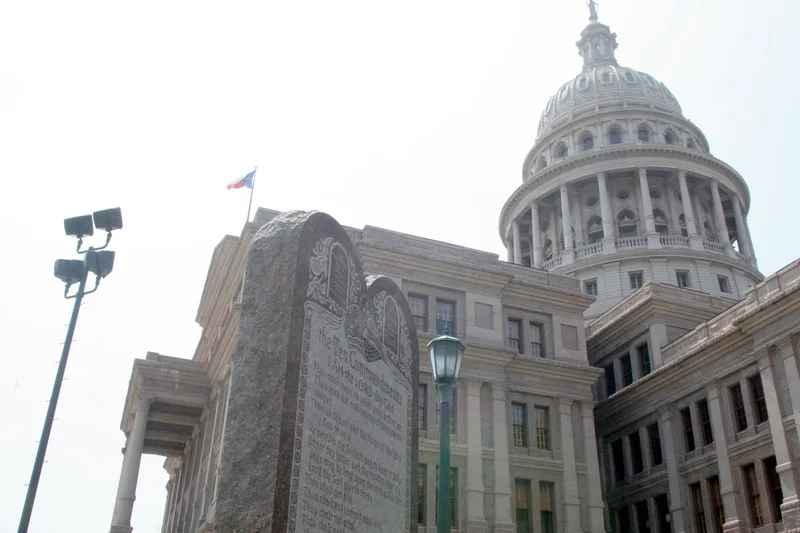
Three Houston mothers have filed a lawsuit seeking to block a Texas law that mandates displays of the Ten Commandments in public school classrooms.
The suit, filed Thursday in Harris County, targets Senate Bill 10, a state law requiring all public elementary and secondary schools to display donated posters of the King James Version of the Ten Commandments. Under the law, the posters must be framed or durable, measure at least 16 by 20 inches and be clearly visible inside every classroom.
Unlike previous legal challenges that relied on the First Amendment’s separation of church and state under federal law, the current action bases its arguments directly on Texas law, as reported by The Texas Tribune.
The plaintiffs — Audrey Nath, Sanjam Kaur Sohal and Emily Roth — have requested a temporary restraining order to stop the enforcement of the requirement before the new school year begins in mid-August. Their children attend schools in the Cypress-Fairbanks ISD, Houston ISD and Spring Branch ISD.
The lawsuit argues that the mandatory displays violate the Texas Religious Freedom Restoration Act, a 1999 law that prevents government agencies from placing a substantial burden on a person’s free exercise of religion. The suit also cites Texas Proposition 15, a voter-approved constitutional amendment known as the “Parental Rights Amendment,” which guarantees parents the right to direct the upbringing, care and control of their children.
“I’m not a lawyer, but what’s interesting about this is instead of addressing federal law, this addresses state law that’s on the books in Texas about our religious freedom," Nath told KHOU11. “I’m hopeful that we have this avenue of this state law to show this is not what freedom of religion looks like in Texas.”
Nath added that the legal action is also intended to set an example for her two children.
“I think it’s important to show my kids to speak up for what’s right,” she told KHOU11, noting her concerns over how students might process the displays. “It’s just a matter of I don’t want kids to be excluded or feel excluded or bullied because of what their relationship is with that piece of scripture.”
The plaintiffs represent diverse religious backgrounds. Sohal is Sikh, Roth is raising her children without a formal religion and Nath comes from a multi-religious background and is teaching her children across several faith traditions, including Jainism, Hinduism, Judaism and Quakerism.
Roth noted in a statement reported by The Texas Tribune that the posters ignore theological differences and convey a message of exclusion to students.
“It teaches students, and their teachers, that exclusion is acceptable, maybe even preferred,” Roth said. “That is not a lesson I want my children learning from the state of Texas.”
Different religious traditions — including Protestant, Catholic and Jewish faiths — use varying translations and numberings of the Ten Commandments, a point highlighted by the plaintiffs’ legal team.
Federal courts previously weighed in on Senate Bill 10 following an earlier lawsuit filed in July 2025 by 16 families across 11 school districts. In August 2025, U.S. District Judge Fred Biery issued a temporary injunction blocking the law in those specific districts, ruling that mandatory displays likely violated the First Amendment by coercing students into religious veneration.
However, the 5th U.S. Circuit Court of Appeals later overturned that block, allowing enforcement of the law to proceed after ruling that the statute did not violate the U.S. Constitution.
Texas Attorney General Ken Paxton has consistently defended the statute, maintaining that the Ten Commandments represent a foundational element of American history and legal tradition. Lawyers for the attorney general’s office have argued that passive visual displays do not constitute religious coercion because students are not required to read or study them.
The filing comes less than two months after the Texas Board of Education voted to approve a new curriculum that incorporates biblical teachings into public school instruction.