A whistleblower tried twice to warn Australia’s medical regulator about false claims made by a defibrillator maker, but officials took no action.
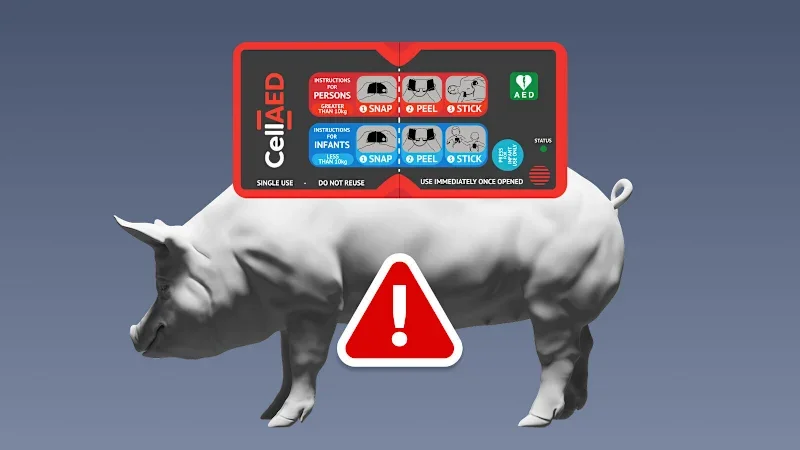
It can also be revealed that the CellAED defibrillator had been tested only on two pigs when its Australian manufacturer, Rapid Response Revival, applied for approval. Yet far from restarting their hearts, the device electrocuted both animals.
The developments heap fresh pressure on the Therapeutic Goods Administration (TGA), after this masthead’s Medical Malfunctions investigation revealed weak laws were allowing medical devices such as the CellAED to be sold with no human evidence showing they worked or were safe.
The Medical Malfunctions investigation used automated website scrapers to crack open the TGA’s database and extract about 81,000 publicly available reports detailing adverse-event reports submitted to the regulator since 2012.
Medical Malfunctions has already highlighted issues with the operation and regulation of devices such as glucose monitors and insulin pumps used by hundreds of thousands of Australians, spinal pain pumps and heart surgery machines.
A former executive at Rapid Response Revival alerted the TGA twice – in 2019 and 2021 – that the CellAED manufacturer was deceiving Australians and potential investors.
“This company continues to raise funds through deceptive means – providing false information about their product and company’s capabilities, readiness to manufacture, timelines and actual orders and regulatory approvals,” said the 2021 complaint, obtained by this masthead.
The senior executive, who wanted to remain anonymous for legal reasons, said he never received a response from the regulator.
The man, who has extensive experience working for some of the world’s largest medical device manufacturers, was recruited to Rapid Response Revival by an executive search firm. But he said that within two days he realised something wasn’t right.
“It seemed like a lot of smoke and mirrors,” he recalled of his short stint at the company in 2019.
“I could see this device had the potential to cause real harm. A patient experiencing cardiac arrest needs a working AED that has gone through rigorous regulatory processes. I knew that without proper standards, this product was going to cost someone their life.”
CellAED is a case study for many of the problems with Australia’s regulation of medical devices.
With no clinical evidence to prove it could save lives, the device bypassed Australian scrutiny by obtaining approval from a private German device evaluator. This for-profit company eventually approved the device – allowing it to be automatically approved for sale in Australia in September 2021.
More than 23,000 units have been sold or donated, including to ambulance services in Victoria and Canberra.
When the whistleblower asked for clinical evidence supporting the device, he claims founder Donovan Casey showed him a video of a pig being shocked by a CellAED.
“When they discharged the energy during the test, the pig jumped off the table,” he said.
“It absolutely didn’t restart the pig’s heart, all it did was show it delivered energy.”
He said the company originally tried to obtain TGA registration but was told by the watchdog in a pre-application discussion that they needed “human data”.
The whistleblower said after this discussion, the company flipped strategy and decided to seek registration overseas.
His account is backed up by a leaked company photograph of scrawlings on a whiteboard which read: “Our current clinical evaluation report would not be sufficient for the TGA to approve the device”.
The whistleblower described CellAED as a “carbon copy of Theranos” – a reference to the fraudulent health start-up founded by American Elizabeth Holmes, which spurred a popular podcast and television miniseries.
A 2019 clinical evaluation report, submitted to the private German company that eventually approved the CellAED for sale, highlights the lack of evidence supporting the device.
Medical devices can be approved on the back of clinical trials showing they are safe and effective.
Alternatively, manufacturers can use ‘equivalence’: claiming their device is the same as an already-approved device. The defibrillator generates just 85 joules, well below the 200 joules recommended by Australian defibrillation guidelines.
The 2019 evaluation report claimed the CellAED was equivalent to the FRED Easyport, which delivers shocks with 150 joules of energy.
The only actual data presented was from tests on two female pigs. The test was run while the pigs’ hearts were beating normally; it confirmed the device could electrocute a pig, but did not show it could restart their heart.
“To date, no human clinical studies have been performed,” the report noted.
The report presented a 2008 Bulgarian study as further evidence the device worked. But that study was also conducted using much higher energy levels than the CellAED could deliver.
This masthead provided the 2019 report to Australian Resuscitation Council deputy chair Michael Parr to review.
Based on the report, “a reviewer cannot tell if the device actually works”, he said. “The device did not demonstrate efficacy or true equivalence.”
Internal emails leaked to this masthead shed further light on the lack of clinical evidence supporting the device.
“There is no experience in RRR with medical devices compliance and regulatory requirements,” one email from a Rapid Response Revival executive reads.
Another email states that regulatory experts hired by the company had found the clinical data was “seriously lacking (non-existent).”
University of Sydney health law expert Dr Christopher Rudge criticised the TGA for failing to act on the whistleblower’s complaint.
“The TGA appears to respond to concerns almost at random,” Rudge said. “As the public authority responsible for the timely supply of safe and effective medical devices, it should be just as timely in responding to concerns about those already on the market.”
Rudge also expressed concerns over medical device companies exploiting regulatory loopholes to bypass Australia’s “front-door” registration requirements, often by securing approvals overseas.
He said CellAED’s early interactions with regulators should have served as a warning sign, long before the company secured registration in Australia via the legal but less onerous European “back door”.
A TGA spokesman said individuals who raise allegations of non-compliance will not necessarily be advised of any outcomes arising from the information they provide.
He said Rapid Response Revival met with the TGA before submitting their application for the CellAED, which is part of the normal regulatory process.
“Those discussions focused on regulatory requirements and did not review the evidence for the device and therefore no concerns about the clinical evidence were identified during those discussions,” he said.
The spokesman said when assessing the application, the watchdog sought and reviewed additional information, including the manufacturer’s instructions for use, product labelling, information demonstrating compliance with the electromedical safety standard and information relating to shock delivery performance.
In June 2025, CellAED’s manufacturer appointed administrators.
The administrators issued a critical recall of the device due to the company going into liquidation and being unable to offer critical support and maintenance.
The company has $20 in the bank and owes creditors up to $18 million.
An early investor in the CellAED, who contacted this masthead following its recent coverage of the device, said he lost around $250,000 that he ploughed into the company.
He said investors were kept in the dark about the lack of clinical evidence supporting the device and he has no chance of recouping his money.
“It sounded life-changing,” he said of the pocket-sized defibrillator. “The concept was great, but the delivery didn’t work.”
Britain’s national standards body and health regulator became so concerned by the CellAED’s lack of clinical evidence that the standards body withdrew the device’s certification.
But despite being aware of the UK’s concerns since 2023, the TGA allowed the CellAED to remain licensed for sale until February this year, when Rapid Response Revival cancelled the device’s registration.
Donovan Casey was contacted for comment.
The Examine newsletter explains and analyses science with a rigorous focus on the evidence. Sign up to get it each week.