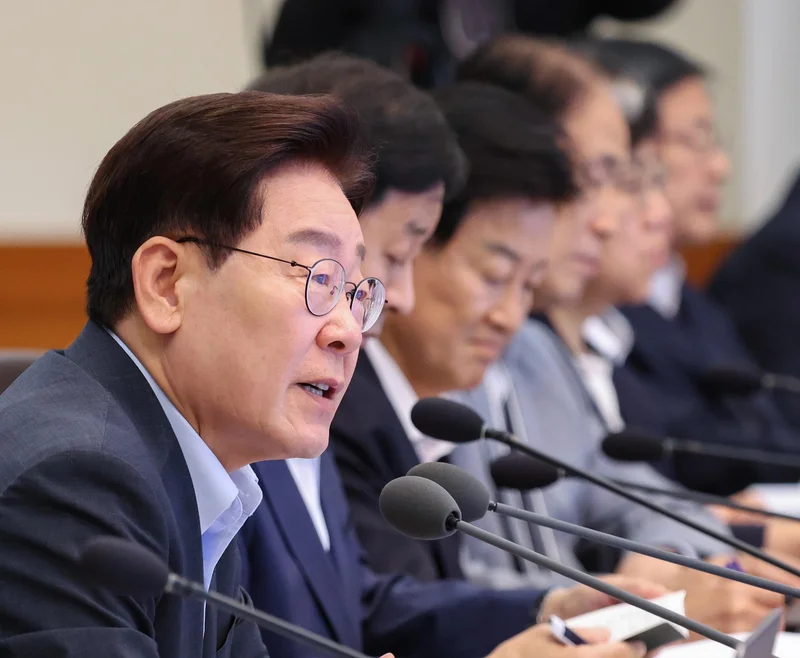
President Lee Jae Myung hinted, Tuesday, that he was ruling out exercising his veto against a disputed bill that removes prosecutors' supplementary investigative powers, amid concerns that it could result in investigative gaps and weaken protections for crime victims.
Speaking at a Cabinet meeting at Cheong Wa Dae, Lee said the bill, although controversial, did not present constitutional or legal defects serious enough to justify rejecting legislation passed by the National Assembly.
He was referring to the bill on prosecution reform, which the majority-wielding Democratic Party of Korea (DPK) passed on Friday amid protest from the main opposition People Power Party (PPP) and public discontent that intensified following allegations of police misconduct in a murder case involving a son of a police officer.
The bill is aimed at stripping the prosecution of its direct investigative powers, under the broader goal of separating its decades-long powers to both investigate and press charges.
The main point of contention was whether prosecutors should keep supplementary investigative powers, as a limited tool used to verify evidence and address shortcomings in police investigations.
Under the bill, prosecutors will retain only the authority to indict and may only request judicial police officers to conduct supplementary investigations.
"Although there are many controversies and differing opinions, it is difficult to conclude that this bill is so seriously flawed, whether because it is unconstitutional, impossible to implement, harmful to the national interest or an infringement on the executive branch's authority,” the president said. "It does not warrant rejecting the National Assembly's legislative authority."
Lee argued that a presidential veto should not be used simply because the executive disagrees with legislation, but only when a bill fundamentally violates the constitutional order or the legislature's authority.
The president accused prosecutors of abusing their broad investigative authority for decades, saying some had used supplementary investigations to cover up cases or conduct sweeping and targeted investigations against predetermined individuals.
"The separation of investigation and indictment is the first step toward normalizing an abnormal criminal justice system," Lee said, adding that all state institutions exercising public authority should remain subject to public oversight.