On a chilly morning in December 1989, Romanian President Nicolae Ceaușescu stepped onto the balcony of the Communist Party headquarters in Bucharest to deliver a speech. The crowd was full with people holding up carrying massive pictures of the version of him, and of his wife Elena.
Ceaușescu was very particular about how he looked on photographs – a team made sure wrinkles were removed and any photo looked perfectly staged. The widely circulated large posters of him had him in his 40s, people in Romania marveled at how his official posters refused to age. Like an unfortunate analogy for South Indian movie stardom, the crowd waving posters of the yesteryear blockbuster, facing an arthritic live version.
At first, the event seemed to be going alright. There were the usual celebratory chants, revolutionary slogans being waved on large red banners, the perfected dictatorship-style choreographed clapping lining the speech. Then something unexpected happened. Someone booed, then another person booed, and another. Within seconds the entire crowd burst into aggressive heckling.
The leader, so used to complete obedience and speeches peppered with the chant “Ceaușescu și poporul” (Ceaușescu and the people) was suddenly caught on camera with an expression his pre-Photoshop airbrushed images hadn’t prepared people for. He looked stunned and helpless, repeatedly asking the crowd to calm down.
His wife, similarly used to her de facto role as the second in command, had no luck trying to get people to quiet down. A row of cronies standing alongside on the balcony seemed likewise shocked, as a feared leader seemed to suddenly fail to instill dread in the people.
The national broadcaster’s television cameras covering the speech quickly turned the lens away from the jeering crowds and up towards the sky.
Ceaușescu had wielded near-complete power over the state and its institutions. The majority of the country’s population had known no leader other than him. There were massive banners and large cutouts of him in city squares, even photos in schools and factories. There were regular television missives from him, typically with him facing the camera directly, often taking only pre-selected questions.
He never did direct, unscripted engagements with journalists. All mainstream media was carefully managed, information that the people got from the government were presented as coming from Comrade Ceaușescu – factories existed because of him, agricultural successes came from his guidance, technological achievements were from his genius.
The common term of reference for this Eastern Bloc Vishwaguru was “Geniul Carpaților” – The Genius of the Carpathians.
The region was in disarray, but unlike Poland or Czechoslovakia there was no functional opposition in Romania. There was no problem with organised and disaffected regional minorities like in Yugoslavia. The state security apparatus, the Securitate, was extremely effective and feared. The standard process was to quickly prosecute and quell any dissenters as enemies of the state. Anyone of institutional significance – the army, bureaucracy, judiciary – had been vetted for loyalty to Ceaușescu and the party.
And yet, within a day of that catastrophic speech, he was reduced to a deposed prisoner.
The downfall of Ceaușescu was among the most unexpected and rapid falls from power in the history of modern politics. While the shock of booing was a massive trigger, the turning point moment of his downfall was when the television cameras turned away from the crowd and up towards the sky. That moment broadcast fear.
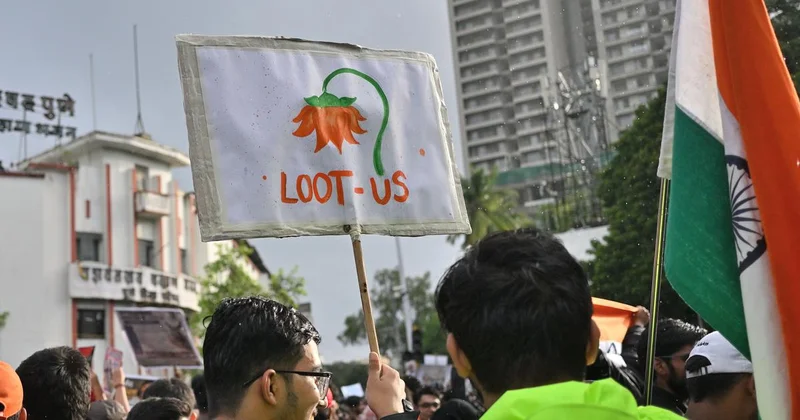
The past fortnight, the streets of the capital in India saw chants of protestors describing Prime Minister Narendra Modi as a coward who hid from the press, people openly asking for his resignation. But even with pliant television, turning the camera from the crowd to the sky was no longer possible. Not only was the fear of the genius leader and his apparatus struck down, even the unwritten rules of liberal civility were out of the window.
Full-frontal verbal assaults that were typically inflicted on the Opposition by the ruling party were now being dished out by protestors taking aim at everything that was sacred to the leader and establishment’s image, things that had been built up over years of branding.
For his 56-inch chest, protesters asked that he “tighten his bra”, for his picture-perfect photoshoots, protesters asked that he spruce up the lipstick, his chaiwala claims, once a marker of his connection to the ground reality of India, became a fodder for a flood of quickly assembled, handheld posters.
In a country where even “liking” the wrong social media message had been grounds for arrest, it felt like all bets were off as the internet eagerly awaited the next hilarious meme. The strong arm of the khaki vardi had seemingly ceased to scare students who stayed upright against swinging sticks of the Delhi Police, as they were also immune to the potential threats of sanskari lynch-happy mobs. This was a true fight or flight moment.
The information environment and the shock event
It could have gone the Tiananmen Square way. The lathis could have turned into armoured cars. But there was a problem. The more aggressive the media control, the more even the smallest bit of dissent could kill all semblance of narrative control. Crowds can be cleared out, but the memes were out. The information environment had been changed.
Insulting the prime minister had suddenly become cool and, as the Bharatiya Janata Party knew very well when it stuck the pejorative “Pappu” Rahul Gandhi, it takes years to roll back the butt of a joke. Within a few days, Modi had bent to the will of the student agitators, accepting all their demands for and conveying his acquiescence on the media platform they decided to use most aggressively to attack him – Instagram.
Regimes that thrive on the belief that they have permanently convinced their people that resistance is futile do not deal well with shocks. In most cases, the information environment is critical in determining if the boiling point will cause an explosion. In the run-up to the events that defined the French Revolution in 1789, for instance, there was discontent brewing and a range of other problems with the flailing finances of Louis XVI’s regime.
But the days leading up to the shock event, the storming of the Bastille by common people in Paris, saw a flood of insecurities surface and detonate. The information environment at the time included newspapers and official royal missives, but these had little impact on the crowds. Instead, it was cafe gossip, tales from travelers, and unverified pamphlets that got around a lot faster.
A range of stories with dubious sources suddenly hit a nerve – the aristocracy was plotting a famine against common people, banquets at the palace were mocking the movement, foreign mercenaries were being organised to attack common Parisians, the king was sending troops to dissolve the national assembly, and of course, Queen Marie Antoinette was asking the people with no access to bread to eat cake instead. The rest is a history podcast.
A few decades later, it was Japan’s turn to lose an information war in what was a far stranger situation than the Paris uprising. For centuries, Japan had a remarkably stable Shogunate, and while the forced entry of Western trade had shaken it up, the relationship between the people and the state remained solidly hierarchical, with feudal lords and the Samurai class on top, and the rural peasantry largely living on subsistence.
In 1867, Japan had a movement, named after the slogan that came to define it, Ee Ja Nai Ka movement, which did not feature wholesale assault on the leadership or security forces, but featured a lot of people behaving wildly in groups and breaking social norms of good behaviour. For some context, the worst lawlessness to come out of the movement was some looting of alcohol – levels of bad behavior that would probably not be worth talking about anyplace other than Japan.
Throughout 1867, especially in the belt between Kyoto and Osaka, common people, mostly peasants, stormed the streets screaming “Ee Ja Nai Ka”, literally meaning “What the hell?” or “Why not?”
The immediate driver was rumours that there were sacred talismans falling from the sky and that they were a sign of change. But the deeper meaning was a “to hell with it” take in which people suddenly started to believe that anything could happen, that the old rules no longer applied, and well, one may as well party.
People who forget that protests can often feel like a carnival were reminded in Delhi that not everyone is out calling for armed insurrection against the regime – many protesters are quite simply having a nihilistic moment in which they plan to share the frenzy of the mob as a simple, even enjoyable act of resistance.
In this form, people went into carnivalesque frenzies across Japan’s towns, abandoning work in the fields, running out in wild costumes and spontaneously dancing on the streets, setting up ad-hoc costume parades, all of which would be considered anywhere between inappropriate and unhinged.
The dancing and parades had clear political undertones – cross dressing, as well as the young dressing as old to undermine gender and hierarchy codes, with the chant of “Ee Ja Nai Ka” used as a refrain for “Old Rules Don’t Matter” rather than the literal translation.
Attempts by merchants and the feudal establishment to stop these and bring workers back to the fields failed. At the time, Japan had a highly organised and strictly hierarchical system of feudal lords, with a range of institutionalised systems in place to stop rebellion. One was called gonin-gumi. It was a small set of households, typically five, ordered like a neighborhood association, in which each household was responsible for the behavior of others.
But it was not like a shiny happy self-help group: it was a means of keeping strict order, acting like a spy agency similar to Ceaușescu neighborhood-level surveillance through the Romanian Securitate. It enabled tax collection through the constant threat of collective punishment. The authorities put out several decrees banning the dancing, and tried at first to ignore these events. Eventually, they tried to repress the events, or threaten punishments.
Word about these talismans and various forms of divine intervention, all of which were taken as signs for people to run wild, came from unverifiable sources such as travelling merchants, entertainers, or pilgrims. On the other hand, formal sources such as missives from local officials or from the Shogunate were expressly ignored.
The two events were very distinct in that the French Revolution crescendoed very quickly, while the Ee Ja Nai Ka was a distributed, disorganised slow burn. Although these shock events were effectively rebellions in that they acted against orders, the French Revolution had clear protagonists and antagonists whereas Ee Ja Nai Ka was more of a catharsis.
Neither event had a well-defined leadership, nor a locus of control with clear instructions or goals. Both led to change, although not immediate. Both events led to concessions for the participants in the events and they were overwhelmingly not prosecuted.
It did not end well for the masters of either society. The protests did not immediately depose them – the Shogun remained in power for several months after, while the much-weakened French king continued to rule for three years. But it eventually also ended badly for the close quarter groups of the leadership. As the Shogunate ended, so did the superior place of the Samurai, the class that aligned most closely with the Shogunate. It went from being on top of the social hierarchy to poverty and scraping the bottom. For the aristocracy in France, there was the guillotine.
In recent years, there have been many more examples of shock events in places where the crowd looked like it may pull something off, but the tide turned.
Tiananmen Square protests in Beijing occurred in 1989, the same time as a series of other protests around the end of the Soviet Union were taking place. China quickly understood that controlling the media was a key element here and started its response by first clearing all journalists out, expelling most foreign journalists from the country. It then responded with overwhelming military force and massive repression of the protestors, undertaking mass executions just over two weeks after the protests.
Iran probably holds place of pride for having had a series of major situations of political unrest and protests (1999, 2009, 2019, 2022, 2025), and in almost all of them, the reaction of the state has been extremely swift and brutal, first using lethal force at the sites of protests, and then carrying out public executions of selected people they wanted to make examples of.
But both China and Iran avoided executing high-profile student leaders both to avoid martyrdom and because students are younger and less prone to the fear of authority compared to family people or labour leaders.
Russia (2012) and Turkey (2013) did not have the same exhibition of state violence through executions of even ordinary protestors, but were nonetheless effective at dismantling the protest movements. Both used targeted strategies to undermine protests. Russia used pre-emptive arrests, institutional undermining of potential protestors or powerful supporters of protestors, assassinations and lengthy prison sentences in dead end prisons.
Turkey on the other hand is probably the closest example for what may work in India. Turkey did not see the same expansion of military into the cities, but a much bolder role played by their leader, Recep Tayyip Erdoğan. Erdoğan came out in the open and spoke directly in rallies in both Ankara and Istanbul, framing the protests not as democratic critique, but as an existential threat to the religious and conservative aspirational classes.
As with Modi, Erdoğan has a core, ideologically-driven following, and his direct show of courage by coming out when a public event could have gone badly wrong, strongly galvanised his base. The media in Turkey avoided covering the protests, and even before 2013, Erdoğan had a massive presence on social media and an ability to present a counter-narrative through his political base. At the same time, he used massive non-lethal force on protesters, specifically chemical water cannons and tear gas to disperse protestors.
Civil society was significantly weakened after the protests, even doctors who treated the wounded were targeted through a judicial system that Erdoğan has functionally captured. The trials of the accused in the 2013 protests lasted for years, underlining for protestors that the state may come after them at any point.
In each of these cases, the regimes have made clear that they mean business, and continue to mean business. As the protesters in Hong Kong would find out three decades later, not all regimes blink. Strongmen come out of these stronger.
When the underdogs win
There were events that did change things – Tahrir Square in Cairo in 2011, Courthouse Square in Libya’s Benghazi in 2011, the Independence Square protests in Kyiv in Ukraine in 2013, the Kasbah Square in Tunis in 2011 all saw strongmen fall. More recently, both Dhaka and Kathmandu saw the same.
A good authoritarian builds as large a core support group, such that they are inherently invested in the status quo. The French and Japanese cases were classic situations of small groups of disconnected elites who were insufficient in pushing back when things got serious, in modern times, the authoritarian leaders in Romania, Tunisia and Egypt had the same problem, few enough people thought it would be a death knell for them if the leader vanished that it was easier replacing them.
For leaders who do have enough of an internal group – whether religious, ethnolinguistic, or organisational, that would be highly imperiled without them, the path to political survival can be easier and the biggest threat is external. Which is why China started its pushback against Tiananmen by removing the foreign press.
In almost all the cases where the shock event managed to change the political leadership, college students and young people were critical in driving the events and consequences.
Most of the shock events had a key public space where the drama unfolded, but also a number of other commonalities. These included a core group of protestors, grievances that have no space to be debated openly, a key individual whose leadership or death triggers events, a second layer of aggrieved people who join the fray, and last, a controlled media environment that either leaves the event discredited or fundamentally changes after it.
In the French and Japanese cases, the protests broke the media outreach of the official missive through sheer gossip, but every successive shock event since has seen some or other crash in the media system. Ceaușescu’s downfall – including his trial and execution – were broadcast by the television system he himself built and controlled. Authoritarian regimes invest in controlling some subset of dominant media, but in the overconfidence of constantly hearing no bad news on the media they control, they often pay scant attention to the evolving media environment.
In Russia in 1917, it was labour papers and pamphlets, in Iran in 1979 it was cassette tapes, in the Philippines in 1986 it was Catholic Radio channels, in Hong Kong in 2019 it was Air Drop.
Since the mid-2000s, social media directly played a role in either the work of converting peoples’ minds or of allowing protestors to organise. But before we give social media some liberating power, it is important to remember that the last two decades have seen several authoritarians master the networks and narratives on social media.
Modi and the BJP learnt from the Arab Spring media moment very well. Rather than reject social media, they actively engaged it and captured it not only institutionally, by bending the platform companies to do their bidding, but also did so organically by capturing the networks through influencers and by flooding platforms with their supporters. They made one critical mistake: in 2020, they banned TikTok.
The reasons for banning TikTok did not matter, the consequences did. The thing with TikTok is that its algorithm fundamentally changed the rules of how social media works. Instead of something going viral because of the person who said it, TikTok’s algorithm made things reach audiences because they were interesting.
TikTok actually understood how long people stayed on content, how quickly audiences liked or disliked something irrespective of who sent it or who amplified it. Almost immediately they started eating into the markets of other social media platforms. Had India stayed on TikTok, the Modi government may have done a much better job over the last few years of understanding what people really want to consume, outside of what is fed to them.
US platforms quickly realised that they could not beat TikTok if they continued to do what they did, and instead changed their algorithms to be more like TikTok. When we think about why Abhijeet Dipke was able to roll out the Cockroach Janata Party so quickly and why the students continued to engage in protest despite the clear danger to them, thank TikTok. It fundamentally changed how social media decides what is saleable.
Dipke sold because what he started to talk about had natural appeal among people. This should have been a warning to a party that thinks any noise can be drowned out by loud screams of anti-national.
The US had fears about TikTok and its Chinese ownership impacting the understanding of data from American citizens. It also became a platform where criticism of Israel started to get buoyancy online in ways that it did not in the other US-owned social media platforms. It became increasingly clear that TikTok would be a place where people would say what was not easy to say on mainstream media. That in turn, it would be a place where political narratives get built and solidified.
So instead of banning TikTok, the US decided to force its sale to an American company.
Modi and the BJP cornered Twitter and Facebook, but the playbook of social media flooding that works so well on Twitter, fails almost entirely on TikTok, and ergo, on the new Instagram. It does not help if actor Salman Khan amplifies your message. Instead, the only action it gains on social media is confirmation that Khan is a blustering clown, a naked emperor of little more than his unspecified corner in Bandra.
For now, the Indian students have won. The win though may not translate to electoral value as quickly because institutional capture matters. But fairly large and diverse electoral systems have eaten dirt of late. If you think Nepal and Bangladesh are not warning enough, you can always look at the fact that a film star who made a handful of public campaign appearances is now the chief minister of Tamil Nadu, having handily eaten up two massive legacy parties with lakhs of boots on the ground.
The worst-case scenario for the students would be some equivalent of the Chinese “Hundred Flowers Campaign”, which pretended to open up the space for dissent but in reality became a means to bring into the open those with opinions opposed to the state – most of whom were quickly quashed.
But we know that Modi is no Erdoğan. He has not demonstrated the gumption of coming out in the open and confronting the students and their narrative. We know that India is no Iran or China, and that Delhi is no Srinagar or Imphal.
The problem with the Indian state is that it has never beaten up on any constituency without first othering and marginalising it. The student protestors were not Kashmiri, North Easterner, Adivasi or Muslim. To take on them needs a different kind of gumption, and Modi must either prepare to turn into Putin or Xi, or at least Sheikh Hasina of 2013. And even China and Iran were careful about not going after the students.
As for the best case-scenario, well that has already been achieved.
It may already be too late for Modi, but he may still decide either to act decisively and unleash prolonged judicial harassment of those who spoke against him. If not, that mythical trip through the Himalayas that Modi keeps posting pictures of may be closer than we think.
Authoritarianism survives on two key factors – the choreographed demonstration of loyalty by those close to the key leader and daily acts of compliance by everyone else. The Emperor’s New Clothes is such a sustaining tale because it is so true to the reality of sycophancy.
The defining image of Ceaușescu was the bewildered expression on his face as he saw people booing him. The Indian prime minister did well not to come out and address the crowds. The clumsy Instagram video he shot got its fair share of trolling online, but at least it was not with the ignominy of having someone from the crowd start chanting for him to fix his bra. I doubt I could say that a month ago.
Joyojeet Pal is a Professor of Information at the University of Michigan.
We welcome your comments at letters@scroll.in.