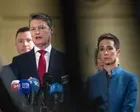
It’s been exactly one week since Ben Carroll became Victorian premier, promising to differentiate himself from his predecessors Jacinta Allan and Daniel Andrews. With his new cabinet sworn in at Government House on Tuesday morning, Victorians are beginning to see what that actually looks like.
This was far more than tinkering at the edges. Four months out from an election, Carroll has made cuts and completely overhauled portfolios, and in turn, the priorities of his government.
“This is a strong, focused, united team that is taking our government in a new direction. A government that will fight every day for working people. A government that will fix things,” he told reporters.
The most striking feature of the new cabinet is which portfolios Carroll chose to abolish. Gone are the standalone transport infrastructure and Suburban Rail Loop portfolios that symbolised Allan and Andrews government’s focus. Carroll also scrapped the cost of living and the men and boys portfolios, the latter a national-first role established only four months ago by Allan to address the influence of the manosphere.
Carroll argues ministers responsible for health, roads and public transport should oversee infrastructure within their own portfolios, that “every” portfolio should be focused on easing cost-of-living pressures and his deputy, Gabrielle Williams, will take on responsibilities for gender equality. He also says removing the standalone SRL portfolio does not necessarily signal the project’s demise – though he continues to dodge questions around a review into the costly project.
“This is a sign that we’re going to do things better, more efficiently and more effectively,” Carroll says.
Carroll has also slimmed the cabinet, confirming on Monday that the two vacancies created by the resignations of Allan supporters Lily D’Ambrosio and Harriet Shing will remain unfilled. He said on Monday it was a “simple measure” that showed he was treating taxpayers’ dollars with respect: the basic salary payable to an MP is $219,391 per annum, while ministers receive an extra $184,407 and $19,628 in expense allowances.
Most Labor MPs agree its a politically smart move. But fiscally, the savings are modest. With Victoria’s debt forecast to approach $200bn over the forward estimates, the roughly $400,000 saved annually in ministerial salary allowances barely makes a dent.
The move also quietly strengthens Carroll’s position inside cabinet. A smaller cabinet reduces the influence of the Socialist Left faction while increasing the proportion of ministers aligned with the new premier.
Personnel decisions reinforce the same theme.
The biggest is Colin Brooks’ elevation to treasurer. Brooks is said to have built a reputation among business groups as industry and advanced manufacturing minister for being pragmatic and willing to engage with industry.
He also inherits industrial relations, placing him at the centre of ongoing pay disputes – including with school teachers and public hospital doctors.
Williams becomes the new education minister, who said she would contact the teachers’ union “as soon as I’m away from these microphones” in an effort to avert a third strike later this month. As deputy, she was able to chose her own portfolios.
Paul Edbrooke is another clear winner. Elevated to cabinet only in April, he now takes on the high-profile police, emergency services and crime prevention portfolios.
It’s telling both Edbrooke – a former firefighter – and Brooks – a qualified electrician who says he “grew up in a small business household”- emphasised their careers outside politics during Tuesday’s media appearance. As Labor seeks to reconnect with working-class voters considering backing One Nation, it will need more plain-speaking politicians front and centre. And Edbrooke’s addition of multicultural affairs also gives him responsibility to counter Pauline Hanson’s and One Nation rhetoric.
There were also losers. Several ministers associated with Allan lost influence. Steve Dimopoulos retains sport but loses major events and jobs. Paul Hamer gains roads but relinquishes corrections, youth justice and local government.
Symes – who was Victoria’s first female treasurer and was also seen as close to Allan – gained energy and environment – portfolios that will place her at the forefront of Victoria’s renewable energy transition and the politically fraught rollout of new transmission lines across regional communities.
Sonya Kilkenny is the only senior minister loyal to Allan who retained her major portfolios, after signing a deal last week to secure her positions as planning minister and attorney general in exchange for stepping down as a leadership candidate against Carroll.
Former police minister, Anthony Carbines, among Carroll’s closest allies, shifts into a new space, becoming the inaugural Minister for Al and Digital Economy, as well as medical research, trade and investment and economic development. Other ministers who also broke ranks to support a leadership change were also rewarded, including Ingrid Stitt who takes on health and Enver Erdogan, who adds finance, government services, and keeps casino, gaming and liquor regulation.
Cabinet met on Tuesday afternoon, where the terms of reference for Carroll’s promised royal commission in the construction industry was expected to be discussed. What they look like will be the new premier’s first test.
After that, voters will be looking for more than rhetoric. They’ll want evidence that the change Carroll promises is real.
°Benita Kolovos is Guardian Australia’s Victorian state correspondent