Neither Biswapati Sarkar nor Sameer Saxena, the creators of the Prime Video series Adarsh Baal Vidyalala, studied in a government school. But Sarkar and Saxena both had family members who taught in government-run educational institutions – a connection that helped them build the riotous world explored across the show’s seven episodes, they told Scroll.
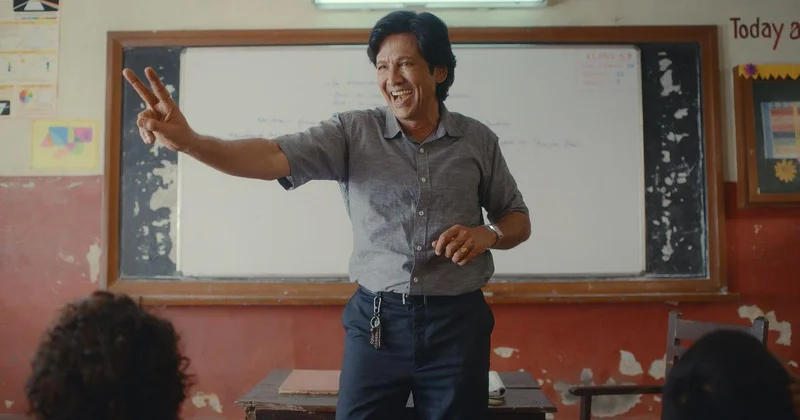
Directed by Himank Gaur, the Hindi series follows the misadventures of Adarsh Baal Vidyalala’s principal Gyaneshwar as he tries to turn around his run-down school’s reputation. Gyaneshwar hopes that by achieving better results in the tenth standard examination, he will be selected for a training programme in the United Kingdom. With everything lax in his school, starting with himself, it’s a tall order, as events prove.
The series deploys satire to explore the problems facing government-aided schools, from poor facilities and anarchic students to political interference and restless parents.
The cast includes Kay Kay Menon as Gyaneshwar, Archana Puran Singh as Gyaneshwar’s bete noire and Naveen Kasturia as an earnest counsellor. Prasanna Bisht plays an idealistic new recruit; Abhimanyu Singh’s teacher loves corporal punishment as much as correct Hindi grammar. Deven Bhojani portrays a politician who meddles in the school’s functioning.
The show’s producer Posham Pictures, which counts Biswapati Sarkar and Sameer Saxena among its four partners, is on a roll. Having already produced the series Kaala Paani, Maamla Legal Hai and the direct-to-Netflix film Jaadugar, the company recently sealed a production deal with Yash Raj Films to jointly make films that will be released in theatres.
Saxena will direct the first of these, titled Mupapa and starring Ayushmann Khurrana. The film is scheduled for a February 19, 2027, release.
Sarkar and Saxena spoke to Scroll about the ideas that went into Adarsh Baal Vidyalala and the power of humour as a coping mechanism to deal with the absurdities of India. Here are edited excerpts from the interview.
What have the responses to Adarsh Baal Vidyalala been like?
Biswapati Sarkar: Every day, I wake up to messages on my WhatsApp, on my Instagram. They range from ‘very hilarious’ to ‘extremely heart-warming’. A lot of people are saying that they started watching the show because of the humour and they unexpectedly got emotional towards the end. That was the intention.
What inspired the series?
Biswapati Sarkar: An old friend of mine used to work with government schools and would tell me about his experiences. I thought that this could be a show. When we pitched it to Amazon, they responded very well.
Sameer Saxena: Also, we wanted to make something light and humorous, because there is a lot of content with action and violence all around. Another reason the show has worked so well is because people needed something like this, which they can watch with their families.
How did you develop the idea beyond its one-liner?
Biswapati Sarkar: One of the tenets of the show is the school management committee. This was something that I was unaware of until my friend told me about it.
The school management committee consists of teachers and parents, who meet regularly to discuss issues: how to manage budgets, how politics is entwined in the working of a school, the things teachers have to go through to get across to the kids. Many kids are the first ever in their families to go to school. What have they been through, and what are their hopes and aspirations?
One of the things that we keep discussing is the great Indian dream, which is that if you study hard and you work harder, you’ll have a great life. All the big positions that we look up to go through the gates of a school. That was one thing that we wanted to cover.
Sameer Saxena: We may have seen schools and colleges in films and series, but this world of a government school has never been shown before. It was interesting to bring that out.
What is the show saying about the state of education in India?
Sameer Saxena: The show clearly highlights the problems in teaching, the way things are conducted in schools. We’re not trying to suggest solutions, but are pointing to alternative ways of dealing with issues.
Biswapati Sarkar: We’re also celebrating teaching and teachers. I don’t think that happens enough.
Whenever we see teachers from government schools in the media, we usually see the ones who are making mistakes. But during our research, we met so many good teachers, with so many refreshing insights. Could we make a show where we could see teachers trying their best and either succeeding or not succeeding? Could we tell their stories honestly?
Several of the casting decisions are unusual, starting with Kay Kay Menon as the principal.
Biswapati Sarkar: We have always wanted to work with KK sir. But we were very sure that we didn’t want to offer him something that was run of the mill.
KK sir usually plays powerful characters in big positions. Here is this guy who’s very innocent, very lively, and not a great role model for kids. Of course, we later realise that he has all these other qualities, as well as a sense of responsibility.
It was also great to see him smile. He looks good when he smiles.
Sameer Saxena: We went in for slightly offbeat casting to make the world a bit fresh. You see Archana Puran Singh not doing a typical comedy. You see Abhimanyu Singh in a role that’s very different from his image. They are fantastic actors, but they unfortunately get typecast.
The child actors are hugely entertaining too – and anarchic.
Biswapati Sarkar: Kids will say anything, they have no filters. When we were meeting teachers, they told us stories that we couldn’t even put into the show.
The children were great fun to work with. We were prepared for a lot of stress, but they were professional and had memorised their lines. We didn’t even have notes for most of them. They were absolutely prolific at what they were doing.
What would you change in subsequent seasons?
Biswapati Sarkar: We would like to be faster, funnier, a little more edgier. But also more of the same.
Why does humour, particularly satire, work so well in highlighting some of the most serious problems affecting Indian society?
Biswapati Sarkar: This kind of humour comes organically to Indians. Given the kind of lives we lead, we have to develop a sense of humour if we want to get through. We have to make fun of problems because we know that if we don’t find a lighter way to look at them, it will be very hard for us.
Growing up, Jaspal Bhatti was a huge influence on all of us – the way he used to create satire around ordinary things. That’s what we’ve tried to do.
Truth can be stranger than fiction. The things that happen in our country are so bizarre at times that even if we go a tad ridiculous, it’s still in conjunction with reality.
In the show, the satire is the base, to which are added character-related humour or situational humour. The crux is good people trying to do good things and facing the consequences because of their actions.
Posham Pa Pictures is the first outside company to collaborate with the legacy studio Yash Raj Films. How did that happen?
Sameer Saxena: The credit goes to Yash Raj. They wanted to tell stories differently and were looking for fresher voices, which is how this collaboration happened. It only highlights their belief in us, in the kind of stories that we have told so far. They want us to tell more such stories on bigger screens.
So far, the collaboration has been fantastic, with complete freedom. That’s a great way for any studio to move forward, to reinvent and look for new voices. We are very excited about the partnership.
Also read:
We welcome your comments at letters@scroll.in.