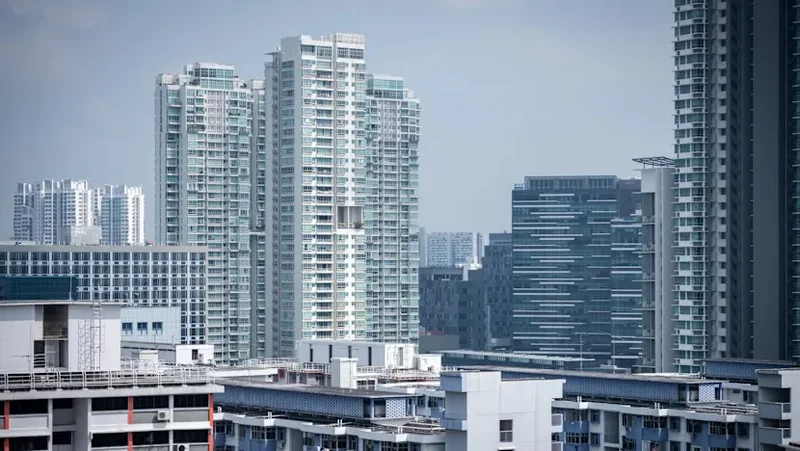
New law proposed to lower en bloc thresholds for older condominiums
The current consent thresholds for collective sales were first introduced in 1999. Since then, many developments have got significantly older, said the Ministry of Law.
SINGAPORE: As part of efforts to support the renewal of ageing estates, the Ministry of Law proposed on Tuesday (Aug 4) lower thresholds for older developments to secure an en bloc sale.
At the same time, safeguards will also be strengthened for those who do not wish to sell, said the ministry.
Under the Land Titles (Strata) (Amendment) Bill, the consent threshold for developments aged 40 to 59 years would be lowered from 80 per cent to 70 per cent, and from 80 per cent to 65 per cent for those aged 60 years and above.
The existing requirements would remain unchanged for newer developments – 90 per cent consent for estates less than 10 years old, and 80 per cent for those aged between 10 and 39 years.
MinLaw said many developments have got significantly older since Singapore's collective sale regime was introduced in 1999. Such estates often require substantial investment for maintenance, repairs and upgrading works to remain safe and liveable.
It added that lowering the thresholds would give owners of older developments a more practical option to consider redevelopment where there is broad support.
"At the same time, there will continue to be safeguards in place for owners who do not support a sale," it said.
The ministry added that the proposed amendments take into account feedback from the public, including individual property owners, as well as multiple rounds of consultations since 2023 with a wide range of stakeholders.
These include academics, lawyers, property consultants, industry associations, developers and representatives from the strata titles boards.
The amendments would also extend the collective sale regime to non-strata-titled private residential developments where flat owners hold long leases over their units but do not own the underlying land.
Such developments currently require unanimous agreement between flat owners and landowners before they can be sold. Under the proposed framework, they could instead proceed with a majority-consent sale, with safeguards to protect landowners' interests.
They can only undergo collective sale by majority consent if the flat owners own flat leases of at least 850 years.
The landowner’s interest in such cases is deemed to be of nominal value, as it is subject to the flat leases of at least 850 years, and the landowner will be deemed to have transferred his or her interest to the purchaser without consideration upon the issuance of a collective sale order.
NON-CONSENT
The proposed legislation would also tighten rules governing en bloc attempts.
Under the Bill, the threshold to convene a general meeting to form a collective sale committee would be raised to 35 per cent of owners, measured either by share value or the number of units.
That is up from the current requirement of 20 per cent of owners by share value or 25 per cent of the number of units in the development.
Collective sale committees would have six months instead of 12 months to secure signatures for a collective sale agreement.
"This addresses concerns about prolonged pressure faced by non-consenting owners while still providing sufficient time for signature collection," said MinLaw.
The Bill also proposes that the waiting period following a failed en bloc attempt would be extended from two years to three years. During that period, any fresh attempt to form a collective sale committee would be subject to the higher requisition threshold.
"This prohibits repeated attempts where support remains insufficient," said the ministry.
In addition, the proposed changes will also see the limit on court-ordered increases to the sale proceeds paid to objectors being raised to 0.5 per cent of the sale proceeds for each lot or flat, or S$2,000 (US$1,560) for each lot or flat, whichever is higher.
This is to increase the pool of proceeds available to be awarded to non-consenting owners.
Currently, the limit is 0.25 per cent of the sale proceeds for each lot or flat, or S$2,000 for each lot or flat.
WHAT HAPPENS NEXT
If passed, most of the amendments would apply to ongoing en bloc exercises where the first signature to the collective sale agreement has not been obtained before the law comes into force.
In estates where the first signature has already been obtained, the ministry said the existing rules will continue to apply.
This is to "preserve fairness for owners" who have already signed the agreements based on considerations under the current thresholds.
However, committees that are still collecting signatures will be allowed to convene general meetings to decide whether to terminate the agreement, and if so, to approve terms for a new agreement that will be subject to the new rules.
Such collective sale committees will be given seven months from the start date to meet the required consent threshold for the new agreement.
The Bill will be debated by Members of Parliament (MPs) at the next available sitting, before they vote on it at the third reading. If passed and assented to by the president, the amendments will take effect at a later date.
Last week, it was announced that housing developers taking on large en bloc projects will get more time to complete and sell units under revised additional buyer's stamp duty rules.
The changes took effect for residential land acquired on or after Jul 29.
The enhancement was intended to further support housing developers in undertaking large-scale redevelopment projects, and in doing so, facilitate rejuvenation and boost housing supply to meet demand, said the Ministry of Finance (MOF) and Ministry of National Development (MND) last Tuesday.