Japan draws lessons from Iceland, a renewable energy powerhouse
As concerns in Japan continue to mount over the impact of high crude oil prices on energy costs, one country has effectively harnessed its own geothermal resources, creating a contrasting energy landscape.
That country is Iceland, known for its volcanoes and high cost of living, where a simple order of bread and coffee at a cafe can easily cost over 2,000 yen ($12.7). But unlike Japan, another volcanic island nation, utility costs there are kept low thanks to its abundant renewable energy resources.
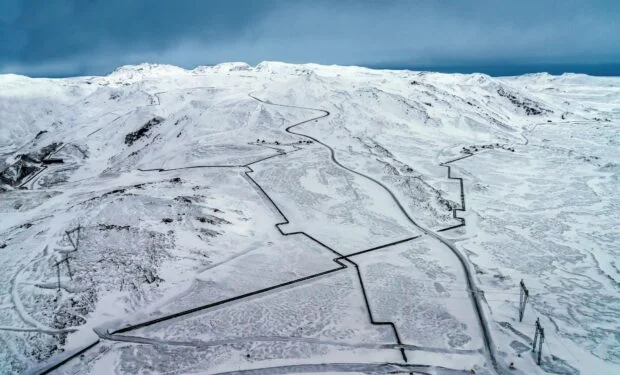
About a 30-minute drive from the capital, Reykjavik, pipelines run across the barren landscape. This infrastructure delivers hot water directly from geothermal power plants to individual households. Nearly all of Iceland’s electricity is generated from hydropower and geothermal energy.
Article continues after this advertisement
Hydropower accounts for about 70 percent of the country’s electricity, while geothermal energy provides the remainder and plays a key role in supplying heating and hot water.
READ: Japan urged to triple renewables capacity by 2035
Renewable energy makes up about 85 percent of energy consumption, excluding transportation and other sources.
“Low utility bills are a lifesaver for our household budget,” says Megumi Nishida, a resident of Reykjavik originally from Japan.
The Nishida family of three lives in an 80-year-old detached house. Their January utility bill, covering electricity and hot water for 24-hour heating, came to about 21,000 yen.
Article continues after this advertisement
“It would be even cheaper for us in a new, energy-efficient home (here in Iceland),” says Nishida.
Iceland seems affordable considering the high cost of living and utilities during the equally cold winters in Hokkaido, northern Japan. According to the Ministry of Internal Affairs and Communications, utilities cost around 30,000 to 40,000 yen per month in 2025, depending on the heating infrastructure.
Article continues after this advertisement
Electric vehicles are a common sight in Reykjavik, and charging stations are everywhere. Iceland relies on imports for gasoline and it remains expensive, but electricity is very cheap, which is why EVs have become so widespread.
At least one Japanese entrepreneur is taking advantage of Iceland’s low energy costs for his agriculture business. Kenichi Noda decided to cultivate premium Japanese strawberries such as Beni Hoppe because of Iceland’s low-cost geothermal energy, clean water and stable renewable electricity.
Noda is chief executive officer of the start-up iFarm Iceland located at the Iceland Eco-Business Park near the renowned Blue Lagoon geothermal spa.
Although daylight hours are short and winters are harsh, he operates an underground climate-controlled vertical farm around the clock using LED lighting and geothermal heating. Because of the optimal growing conditions, the operation has scaled to supply the highly sought-after premium Japanese fruit to the European market.
“We offset the high costs of materials and labor with low electricity bills. The abundant resources are expanding the possibilities for agriculture,” says Noda.
Iceland’s population of just 380,000 helps it meet most household electricity and heating need with massive, concentrated natural power. Japan, with a population over 120 million, requires far more power and faces geographic, regulatory and industrial roadblocks.
READ: Japan to maximize nuclear power in clean-energy push
Japan is heavily reliant on liquefied natural gas imports and coal to generate electricity, but it boasts the world’s third-largest geothermal resources (over 20 million kilowatts). However, geothermal power accounts for only 0.3 percent of its total electricity generation.
Since the devastating earthquake and meltdown of the Fukushima Daiichi nuclear complex in March 2011, reductions in nuclear energy generation forced Japan to rely even more on imported LNG and coal, increasing the base cost of generation.
According to Our World in Data, Japan’s per capita electricity generation from fossil fuels, nuclear and renewables in 2025 was 67 percent, 9.1 percent and 24 percent, respectively.
Because it lacks fossil fuel resources and imports the vast majority of its energy, Japan’s utility costs are highly dependent on global commodity cycles and exchange rate fluctuations.
However, huge initial investments, concerns about landscape destruction, and fears of hot spring depletion have long been barriers to geothermal power development in the nation.
Many promising geothermal resources are concentrated in mountainous areas of Japan or are located within highly regulated zones such as national parks and hot spring resorts. Without drilling, it is impossible to know whether sufficient hot water is present. This uncertainty is a factor driving up costs.
Japan’s deeply rooted onsen hot springs industry fiercely lobbies against geothermal development due to fears that tapping geothermal reservoirs will drain the shallow water-bearing permeable rock sediments that supply traditional bathhouses.
Nevertheless, since the March 2011 nuclear disaster in northeastern Japan, geothermal energy has still been regarded as the “last frontier” of renewable energy, according to a Ministry of Economy, Trade and Industry official. Development of such next-generation technologies is afoot.
Even without hot springs, power can be generated by injecting water into high-temperature bedrock, and expectations for this new technology are rising.
Pipelines stretching across lava plateaus and EV charging stations lining city streets. This Icelandic landscape, which “which harnesses its natural resources, could serve as a model for Japan’s energy strategy going forward. /dl