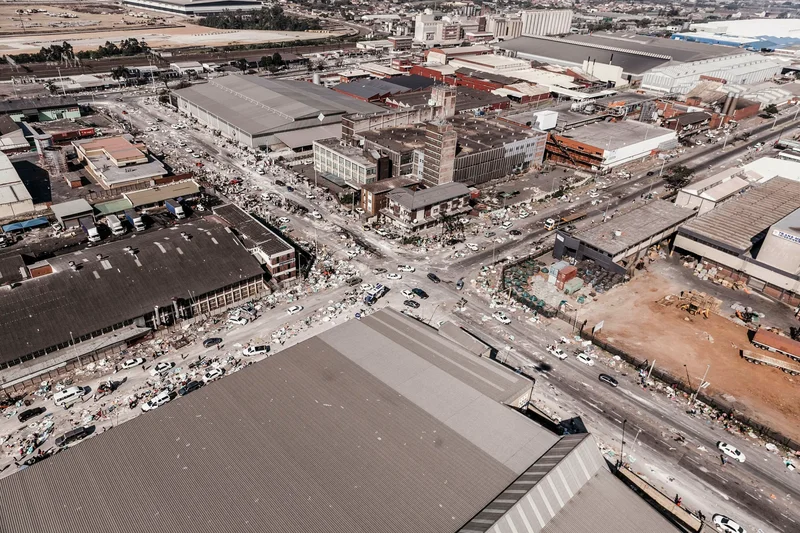
Thirty-two years into democracy, South Africans have been holding on to the promises of the Freedom Charter and of the democratic government led by people who look like them. Yet in 2026, poverty remains the order of the day. Frequently, the pain of South Africans and expression of social issues are evident in genuine social justice movements. Looting is another form of protest and a cry for help, as much as it is a crime and it always finds its expression in peaceful marches and violent protests. The high rate of unemployment is another major contributing factor to the persistent incidents of looting reported. A nation whose people steal food to survive paints a picture of a failed government. Government responses to looting often focus on criminal prosecution while paying insufficient attention to the socio-economic conditions that contribute to such incidents.
The visible legacy of exclusion
Looting is not only a criminal act but a cry for help and an expression of the persistence of poverty and inequalities. The black community remains excluded from economic freedom in the democratic South Africa, as revealed by the prevalence of looting incidents. The looting visuals show young and older men and women carrying basic needs such as maize meal and eggs. Some of the visuals show women carrying food for their children, confirming Professor Bonang Mohale's words: "Poverty still has the black and feminine face." The government is somewhat aware of the poverty crisis in South Africa, as all election campaigns include food parcel drives. From these recurring looting incidents, it can be concluded that the government has selective ears and priorities and addressing poverty and inequalities is not one of them.
Looting should not be viewed from a one-sided perspective but through multiple lenses, including as a symptom and consequence of being left behind, forgotten and economically excluded. Mboti (2024) said that the black community has normalised living with harm and in harm’s way; consequently, the black community has learned to live and cope with poverty and looting has become a coping mechanism. No one would want to break the law publicly, in front of cameras, if they have not normalised the situation; some walk confidently, carrying goods without fear of being arrested for a crime. This, though, is causing division, hatred and rage among the black community because some of the shops looted are in the areas where most black-owned businesses operate. A country with enterprising entrepreneurs is heading towards economic growth. Still, if fellow South Africans destroy that progress through looting, this country will remain a developing country, despite its potential to be developed.
From Free Zuma Campaign to ‘Mabahambe” Anti-Immigrant Marches
The looting of goods became notable in 2021 during the COVID-19 pandemic. Many assumed it was because people had lost their jobs and looting was the only way to feed their families under the circumstances. However, the 2021 looting occurred alongside the “Free Zuma Campaign,” which suggests that looting indicates a persistence of apartheid injustices. Visagie, Turok, and Swartz (2021) posit that “South Africa has among the highest recorded levels of social protest of any country in the world,” and that these protests always have a campaign as a face. Still, the true intent is to express social issues and dissatisfaction with service delivery. For example, the march and march movement campaign against illegal foreign nationals included the looting of spaza shops and bottle stores. This has created a culture and a norm in South Africa that, when there is a movement, supermarkets must close, because these protests and peaceful marches are another way for people to express society's issues. The rate of unemployment in South Africa should not be measured statistically by the number of graduates but by these looting incidents, because we see young and older adults carrying necessities such as maize meal. These incidents should tell the government that stealing food or forcibly taking it will be normalised in South Africa until the government creates jobs for both skilled and unskilled youth. Not only jobs but also entrepreneurial opportunities for those with an entrepreneurial mindset.
Government response and public frustration
Many citizens feel that government responses are often more immediate when protests become disruptive. Perhaps the government has proven them right and that the only language they understand is looting and violence, hence the looting patterns. The government should improve how they engage with communities, because the top-down approach is not working, as people are only addressed with promises, not engaged to suggest what can be done in the community. A participatory leadership style can enable citizens to engage with the government and help implement effective solutions to their problems. Overall, looting is rooted in the deep economic exclusion of the black community and the persistence of economic exclusion, such that in contemporary South Africa, poverty still has a black face. The current South Africa’s problems symbolise a time during the apartheid regime where people were fighting for freedom and better living; the only difference now is that the black community is fighting amongst each other. The enemy is no longer a white person but a fellow black South African. Thus, if looting is not declared a national crisis, it could collapse South Africa’s economy.
Lusanda Madikane is an award-winning author, founder and CEO of MoyaComms and its weekly LinkedIn newsletter, Mail \& Guardian 200 Young South African 2025 recipient, Sunday World Unsung Hero, Public Affairs writer and Students for Liberty Local coordinator.