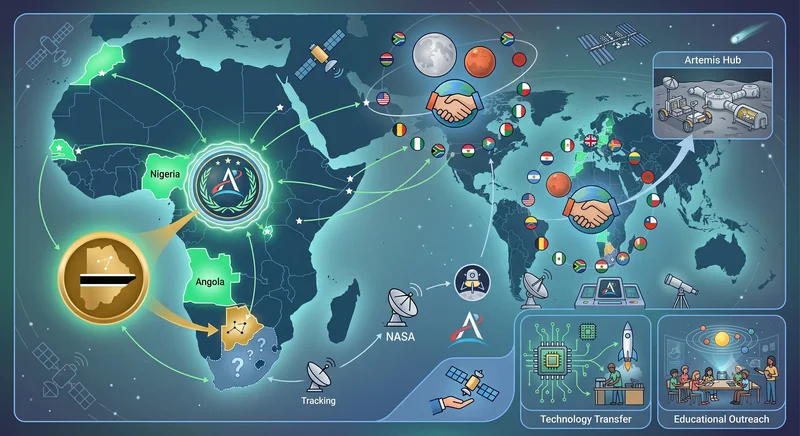
In June, Botswana became the sixth African nation to sign the Artemis Accords, joining Nigeria (2022), Rwanda (2022), Angola (2023), Senegal (2025) and Morocco (2026) as part of a growing bloc of more than 60 countries committing to the peaceful, transparent and responsible exploration of space.
South Africa to date has not signed – although to be fair, neither have Algeria, Egypt nor Kenya, which together represent a large portion of the continent's most developed space industries.
But South Africa's case is the most curious. It has one of Africa's oldest and most capable space sectors, a satellite heritage stretching decades and historic ties to NASA through the Hartebeesthoek tracking station, which supported Apollo-era missions. If any African country looked like a natural Artemis signatory, it was this one.
What the Accords offer
The Artemis Accords, launched by the United States in 2020 under the first Trump administration, are a set of principles for coordinating civilian space exploration among "like-minded" nations. Open to all spacefaring governments, they sit alongside (but outside) the formal UN treaty system and are structured as bilateral agreements between NASA and each signatory rather than a multilateral instrument.
In theory, signing brings a country one step closer to the Artemis programme itself: NASA's multinational effort to return humans to the Moon and eventually push on to Mars, with signatories in Europe, Japan and Canada supplying key hardware, while commercial partners like SpaceX and Blue Origin build the human landers.
For states without robust space-engineering or industrial capability, signing the Accords affords them a seat in conversations about technical standards, galactic governance and the policies behind them – a position that, on paper, lets a nation better plan for and de-risk investment into their own sector and opens space for smaller contributions like data processing, mission support and research.
So why, with such low barriers to entry and promising incentives, have some states not signed?
Because space is political
The Artemis Accords are but one effort to govern space, with space governance generally stuck in deadlock for almost as long as humans have been venturing into it.
In 1967, at the height of the first space race between the US and USSR, the Outer Space Treaty established that space belongs to all humanity and that no nation may claim sovereignty over celestial bodies. This was taken further in 1979, when the UN General Assembly adopted the Moon Agreement, enshrining lunar resources as the "common heritage of mankind" – i.e. to be shared, not claimed by any one state. Except almost no major space power ratified this later addition, with neither the US, USSR/Russia, China, Japan nor India prepared to sacrifice their individual advantage to a common-profit regime.
Fast-forward several decades, past the collapse of the Berlin Wall and occupying that vacuum today are two rival geopolitical hegemons: the US with its Artemis Accords and China, supported by Russia, with its similar but competing International Lunar Research Station (ILRS), a collaborative programme working towards a physical base on the Moon by 2035.
Politically unwilling and, in the US's case, legally unable to work together (see the "Wolf Amendment"), both sides are instead using the sheer scale of their planned lunar spending to pull nations into their orbit of influence through the promise of shared benefit.
A tale of two political instruments
Both programmes, in other words, are as much diplomatic tools as they are engineering projects; vehicles for the US and China to build legitimacy and international consensus around their own competing visions for how space should be run.
Viewed this way, African nations weighing up either coalition are, whether explicitly or not, weighing benefits against trade-offs.
So far, those signing on to ILRS have been handed fairly tangible opportunities: South Africa's Africa2Moon project has a confirmed payload slot on China's Chang'e-8 mission; Egypt is manufacturing a multispectral camera for Chang'e-7; and China is funding ground stations and tracking infrastructure on African soil. These deliver political wins for African leaders and diplomatic goodwill for Beijing, though the largely informal nature of these agreements (built on legally non-binding memoranda) offers no guarantee of concrete long-term opportunity for African partners.
For South Africa, the ILRS relationship also sits inside a wider push by the BRICS+ group to collaborate more closely on space. Member states are currently mulling the idea of formalising a Space Council to standardise production and grant preferential access to their respective orbital launch sites. That's in addition to sharing satellite data, running educational programmes and exploring joint procurement to build an independent supply chain for spacecraft propulsion and life-support technology.
Artemis, by contrast, remains largely symbolic for its African signatories. It confers prestige and signals an eagerness to work with the US and the West, but it's yet to be seen whether African signatories are securing anything more concrete – for example, payload slots, hardware contracts, mission roles or other opportunities for technology transfer – or whether they're afforded a genuinely meaningful say in Artemis forums, beyond the accord text itself.
What makes this more interesting is that South Africa, despite not being an Artemis Accords signatory, provided the Artemis II mission with Tracking, Telemetry and Command support, with the under-construction Matjiesfontein ground station expected to extend that support to future NASA missions to the Moon and beyond.
Cooperation continues regardless
Taking a step back, several things become clear: first, that signing the Accords is not a prerequisite for participating in the Programme, nor does it guarantee a signatory is included in NASA's plans; and second, that technical cooperation in space often continues regardless of the geopolitical climate (with those needing more proof needing only look at how NASA sent an astronaut to the International Space Station aboard a Soyuz rocket alongside two Russian cosmonauts in mid-July).
South Africa's decision to align with ILRS also makes sense. So far, the programme has delivered real, relatively immediate outcomes; it fits the country's trade ties to China and mutual interests in BRICS+; and China's general reluctance to attach political conditions to cooperation is likely an added bonus for the political class.
Meanwhile, why South Africa hasn't also signed the Artemis Accords is then best understood as a political decision rather than a puzzling omission. Pretoria's relationship with the Trump administration has been fractious and there's most likely some form of concession expected on each side that neither government, at least for now, is prepared to reconcile.
South Africa is most likely waiting for relations to improve before signing, particularly given that the Accords appear largely symbolic and given its longstanding relationship with NASA and its continued support for Artemis through Matjiesfontein and Artemis II, it wouldn't be surprising if Pretoria eventually does. For now, though, South Africa appears content to cooperate where its interests align, while steering clear of the political symbolism that formal accession would carry.
That may frustrate those who see the Accords as an obvious next step for one of Africa's leading space nations. As one may argue, “there is more to gain from being in than being out”. But it also reflects a broader reality, that space policy is increasingly an extension of foreign policy, with Botswana's decision to sign, and South Africa's decision not to (at least not yet), saying less about who's "right" than about the different strategic calculations each country is making.
Dillon Birns is a director at Plane Talking, a strategic communications consultancy based in Cape Town that specialises in the African aviation, defence and space sectors.