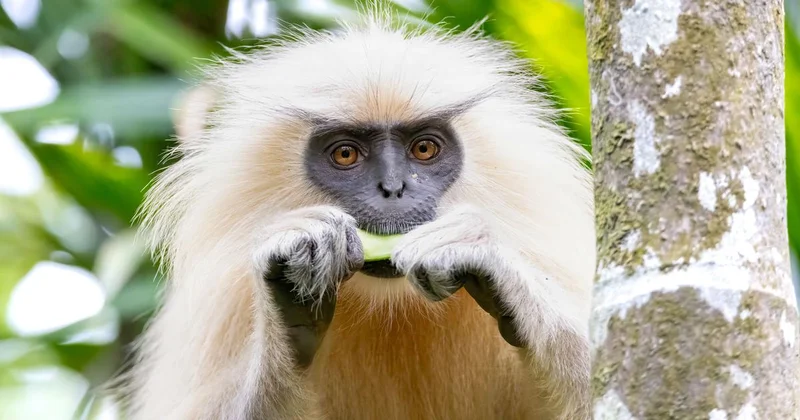
Being confined to the sal-dominated (Shorea robusta) tropical moist deciduous and semi-evergreen forests in India, and the sub-tropical and temperate broad-leaved forests in the India – Bhutan landscape, the golden langur stands out as the most restricted colobine (leaf-eating primate) species in India. Although described by earlier naturalists such as RB Pemberton and CM Inglis and co-workers during the 19th century as “cream colored monkey” and “Sankosh cream langurs”, the credit for suggesting that it could be a new species goes to EP Gee, a British tea planter and conservationist living in Assam. It was formally described in 1956 by H Khajuria of the Zoological Survey of India and named Presbytis geei in honour of Gee.
The golden langur is a medium-sized primate. Males weigh 10-12 kg and females 9.5-10 kg. They are less sexually dimorphic than other colobines such as grey langurs (Semnopithecus spp). Based on phylogeny and biogeography, T Wangchuk, a Bhutanese biologist, opined that Trachypithecus geei and T pileatus (capped langurs) branched off from an ancestral Trachypithecus from South Asia. In addition, the Sankosh River and Pele La mountain system in central Bhutan isolated a population of capped langurs during a warming period in central Bhutan, and this population later specialised into the morphologically distinct golden langur.
In India, a comprehensive survey to estimate the golden langur population in Assam was conducted in 2008-2009 by the Assam Forest Department with the support of local non-governmental organisations. Based on these results, the total population in India was estimated to be approx. 5,000 individuals in 566 troops, distributed over an area of 2,000 sq. km. The population in India comprises northern and southern populations that are now sadly completely separate, due to human-induced disturbances such as highways and habitat fragmentation. The northern population is distributed in the Ripu-Chirang and Manas Reserve Forests that extend between the Sankosh River in the west and the Manas and Beki rivers to the east. Until the 1970s, this population was more or less continuously distributed, except for a small gap between the numerous sal-dominated reserve forests in the Haltugaon and Kachugaon forest divisions of Kokrajhar district in southern Assam. The southern population is distributed in small fragments of Chakrashila Wildlife Sanctuary (WLS) and other adjacent forest fragments.
The golden langur thrives in the vicinity of human-dominated landscapes, especially in plantations and orchards. Tall trees for roosting and a continuous canopy determine the quality of habitat. Traditionally, the Bodo tribes considered the golden langur to be a direct descendant of Sugriva, the king of monkeys; hence, the species was never hunted. This also helped it to co-exist with humans. In fact, Chakrashila WLS was originally a People’s Protected Area – the local communities had come forward to get it notified as a WLS in 1994.
Golden langurs eat the leaves, buds, flowers, fruits and seeds of Bombax ceiba, Bauhinia vahlii, Careya arborea, Dillenia pentagyna, Ficus spp, Terminalia bellirica and T crenulata – young leaves were consistently consumed in all months and at least 53 plant species (45 trees, two shrubs and six climbers) were used. Like all leaf monkeys, they meet their water requirement from foliage. In acute summer months, they come down to drink water and feed on aquatic plants, as observed by Sonali Ghosh. In recent years, they have taken to feeding on the young leaves and seeds of the introduced rubber tree (Hevea brasiliensis) and on the leaves, flowers and fruit of English beechwood (Gmelina arborea), but these are clearly not their preferred food. They occasionally eat soil, and are known to raid plantations of cardamom, tapioca and guava.
Golden langurs mostly live as uni-male and/or multi-female groups. Young males are often forced to leave the group, resulting in all-male bachelor groups. The group size varies from three to 40, and the male-to-female sex ratio is 1:1.5-3.3. They occupy relatively large home ranges of 1.5 to 6 sq. km. Their population density was determined as eight, 46 and 64 individuals/sq. km. in Manas, Ripu and Chirang, respectively, in western Assam. The home range of a group may overlap intra- or inter-specifically with groups of rhesus (Macaca mulatta) and Assamese macaques (M assamensis) sympatric with golden langurs.
Golden langurs are polygamous; females and males start breeding around five and six years of age, respectively. The breeding season usually lasts two months, i.e., December and January. The gestation period is about six months, and a single young is born in July-August. The young stays with the mother for nearly a year. The infants are orange-brown in colour.
Golden langurs are diurnal and mostly arboreal. Vocalisation is minimal, restricted to high-pitched, barking alarm calls. Studies in Chakrashila give details about their diurnal behaviour (termed “time-activity budget”). Interestingly, langurs spent approx. 55% of their time resting. Because of their high endemicity and small population, the golden langur has received the maximum conservation attention. It is placed in Schedule I of the WL(P)AA, 2022, and listed as “Endangered” in the IUCN Red List.
Recent studies indicate that the once contiguous wild population of golden langurs in Kokrajhar, Bongaigaon and Chirang districts of Assam is now confined to 19 fragmented forest areas. Several of these populations are so small (less than five individuals) that they are doomed to become locally extinct with habitat degradation and isolation, besides being exposed to new threats of hunting and accidental killing from speeding vehicles and overhead high-tension electric wires. Their only hope in India remains in the Ripu-Chirang and Manas Reserved Forest areas that are contiguous with large tracts of forests in Bhutan. As already established in Bhutan in 1999, biological corridors need to be promulgated as a new legal entity to sustain current conservation and management practices across the habitats of this beautiful species in India.
Excerpted with permission from Mammals of India, AJT Johnsingh and PO Nameer, HarperCollins India.
We welcome your comments at letters@scroll.in.