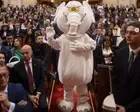
When 102 senators were sworn in for Colombia’s latest parliamentary session, they included 32 women, 69 men – and one cartoon elephant.
He had some difficulty making his way down the narrow central aisle of Congress’s ceremonial chamber, weaving past fellow senators in sharply tailored suits and dresses, before taking the oath in his pot-bellied white plush costume.
Blending in was never an option for the new senator, who ran almost his entire campaign without revealing his identity.
It was only three days before the election that Luis Carlos Rúa, 34, revealed himself as the person behind Elefante blanco, the White Elephant, a reference to the term used to describe overpriced, abandoned or ultimately useless public works, which he had spent the previous five years exposing on social media.
His videos attracted hundreds of thousands of views, some projects were resumed, and Rúa became one of Colombia’s most voted for senators, with about 124,000 votes.
“The inauguration day was spectacular because nothing like it had ever happened anywhere in the world,” said Rúa, who took off the head of his costume only occasionally during the swearing-in ceremony.
“No senator had ever taken office like that,” Rúa said during a video call from the Congress corridors, showing his face and dressed in formal attire. “I’m about to go into a plenary session, but I’m not wearing the costume because it’s for specific occasions and not every debate is that significant,” he added.
The character’s origins can be traced back to 2019, when Rúa was working for the mayor’s office in Pereira, a city of almost 500,000 people about 205 miles from the capital, Bogotá. He said it was during that time he witnessed the administration pressuring employees to secure votes for a candidate. Rúa recorded a conversation and leaked it to the press.
“I had to leave the city because I received death threats,” he said.
Rúa moved to Medellín and decided to continue exposing wrongdoing, but anonymously because “here in Colombia, if you don’t do things the way the crooked people want, you’re not welcome”.
He commissioned the elephant design from an illustrator and later had the costume made by a seamstress, and posted his first video in November 2021, about an unfinished road.
Since then, there have been dozens more about bridges, schools, tunnels and hospitals, all narrated in a distorted voice and sometimes showing Elefante blanco trudging through mud or wading through murky water that stains the white plush costume – Rúa keeps a spare.
“It’s extremely hot inside it, but it still has to be done because I’ll go to places the state doesn’t go,” he said.
Rúa funded his trips through freelance work, the sale of Elefante blanco plush toys and crowdfunding campaigns, but said it was not sustainable and decided to run for office so that, with a senator’s salary, he could continue his oversight work.
He announced his candidacy in December, but remained anonymous. “Revealing my face just three days before the election gave me enough time to protect my own safety,” Rúa said.
He received at least one vote in almost all of Colombia’s approximately 1,100 municipalities.
For the political analyst Gabriel Cifuentes, Elefante blanco’s election says as much about the growing influence of social media on elections as it does about “a growing weariness with traditional politics”.
“Politics is seen as a corrupt exercise and, in that sense, activists like him, who are not tied to political parties, tend to attract the attention of a public that is increasingly connected through social media,” Cifuentes said.
One of Rúa’s proposals is a law requiring municipalities to allocate dedicated budgets for repairing potholes. It would be named after his father, Darío Rúa, who was 85 when he fell on a potholed street and died in 2024.
The senator said he cast a blank vote in the presidential runoff between the leftwing senator Iván Cepeda and the far-right millionaire lawyer Abelardo de la Espriella, who won. “I’m not from the left, the right or the centre. I’m independent,” Rúa said.
Even so, the new senator has faced criticism for voting in favour of De la Espriella’s proposal to move this Friday’s presidential inauguration ceremony from Bogotá to 280 miles away in Cali. The proposal passed the senate by 58 votes to 30.
Critics argued that Rúa had campaigned against wasting public money, only to back moving the entire inauguration, with its hundreds of guests and staff, for a single day.
He said he wanted to send “a signal of state presence in a region that has historically been neglected” and that, even with the venue change, the inauguration would cost less than the one held when the leftist president Gustavo Petro took office in 2022.
Rúa said he would attend De la Espriella’s inauguration dressed as Elefante blanco. “My relationship with him will basically be one of political oversight, and it would have been exactly the same if the other candidate [Cepeda] had won,” he said.