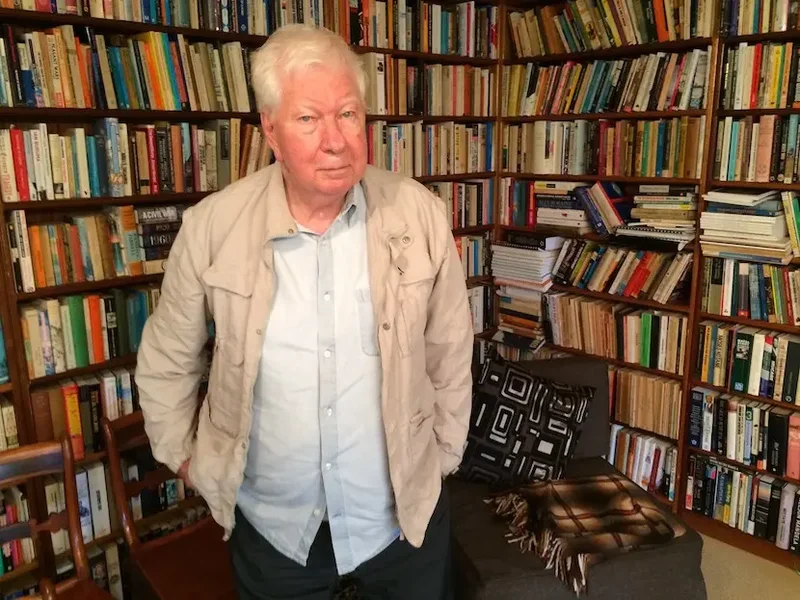
Richard William (RW) Johnson (1943 – 2026), one of South Africa's leading liberal public intellectuals and a good friend, passed away at his home in Cape Town recently.
‘Big Bill’ was a formidable, fearless and combative journalist, analyst and academic, with "the courage to keep challenging accepted wisdoms", and whose contributions to South Africa's "intellectual life will endure through the books, essays and ideas he leaves behind".
The Free Market Foundation wrote that "he understood that a free society depends on the courage to confront reality, challenge failed ideas and defend the principles that make liberty possible".
His output was prolific. Between 1970 and 2020, he authored 12 books, covering a wide range of his interests, including The Long March of the French Left (1981), ShootDown: The verdict on KAL007 (1986), an account of a Boeing 747 shot down over Soviet Union of Socialist Republics territory en route from Anchorage to Korea and Launching Democracy in South Africa (1996).
In his book, How Long Will South Africa Survive? The Looming Crisis (2015), he warned: “South Africa can either choose to have an ANC government or it can have a modern industrial economy. It cannot have both.”
Born in England, raised in Durban, he was educated at Natal University and left for Oxford University as a Rhodes Scholar in 1964,. He was a fellow in politics at Magdalen College, Oxford University, for 26 years and remained an emeritus fellow. During his years at Oxford, he led with the College President Keith Griffen, the turnaround of the college’s finances and the upgrade of its buildings. In 2015, he released a memoir of his years as fellow at Magdalen College, called Look Back in Laughter: Oxford's Postwar Golden Age. The Economist magazine in London, in its review of Johnson’s memoirs, described him as a “romantic contrarian liberal”.
His books never failed to provoke angry reactions from both the left and the right.
In 1995 he returned to South Africa to establish and head up the Helen Suzman Foundation (HSF), which he ran until 2001, and established Focus, the HSF’s journal. He was a South African correspondent for the London Sunday Times and a regular contributor to the London Review of Books.
I knew Helen Suzman well and joined as a member of the HSF Board and also of Focus, the journal, for which I wrote many articles. I was at St Antony's College, Oxford University as Senior Associate Member and Oppenheimer Fellow, teaching development.
Although there were many issues on which we disagreed, we had a warm friendship, and he quoted me often in his work – and I was often forced to explain to his critics that I did not agree with all his views.
Johnson left a commanding career, at 52, at Oxford University to fight the liberal cause in South Africa. The Citizen newspaper columnist William Saunderson-Meyer, who was at Oxford University in the late 1980s, wrote that Johnson had taught students who later had illustrious careers: “Five had gone on to become UK Cabinet ministers or chancellors of the Exchequer, two had become editors of The Economist and another became prime minister of Australia”.
Bill and his wife, the historian Irina Filatova, built a holiday house on KwaZulu-Natal’s south coast. Irina was a specialist on Africa at Moscow State University in the Soviet Union.
Anthea Jeffery wrote that Johnson fought for liberalism in South Africa on three fronts: "maintaining individual civil liberties, protecting free speech", and “creating equal opportunities that were accessible on the basis of merit, not race”.
As Johnson’s despair at the ANC’s corruption, cadre-deployee incompetence and fundamentalist ideological, captured and emotional policies destroying South Africa, in similar ways Zimbabwe’s ruling Zanu-PF’s corruption, cadre-deployment incompetence and patronage-based and ideologically outdated policies turned that country into a failed state, with its citizens fleeing to South Africa for food, jobs and safety, Johnson became increasingly biting in his writing.
Roger Southall in his review of Johnson’s 2009 book South Africa’s Brave New World for the London Review of Books wrote: “Johnson’s South Africa is a country of bitter disappointment, of dashed hopes and dreams, brought about by the botched utopias of Mbeki and the ANC”.
The London Review of Books took down a particularly acerbic piece he wrote during the 2010 FIFA World Cup in South Africa and published on 6 July 2010, when Johnson’s piece, "After the World Cup", started with the line: "We are being besieged by baboons again". In the next paragraph of the article Johnson continued, referring to African migrants seeking a livelihood in South Africa as "they too are here essentially searching for food".
Seventy-three United Kingdom cultural figures then wrote to the London Review of Books alleging that the article by Johnson contained 'highly offensive, age-old racist stereotypes'. The London Review of Books editor Mary Kay-Wilmers at the time told The Guardian: “He's (Johnson) not a racist but he's not always aware of how he comes across. He went back to South Africa and has done a lot of brave work in Zimbabwe with the (then opposition) MDC (Movement for Democratic Change)."
In 2017, Johnson resigned in anger as writer from the London Review of Books, after a critical review of his memoir Look Back in Laughter: Oxford’s Postwar Golden Age, which he described as “grossly insulting”.
In 2025, Johnson also wrote a particularly acerbic personal criticism of former Democratic Alliance leader John Steenhuisen in the Sunday Times. His disagreements with Steenhuisen were not resolved by the time of his death. When Alec Hogg, the founder and editor of Biznews afterwards interviewed Steenhuisen to respond to Johnson’s criticisms, Johnson quit as Biznews columnist.
Johnson also served on the council of the Institute for Race Relations (IRR). He wrote the IRR's 2011 report, Preventing Electoral Fraud in Zimbabwe, which exposed widespread fraud in the compilation of the country's voters' roll by the ruling Zanu-PF. The Zimbabwean voters’ roll included “large numbers of 110-year-olds, all born on the same day" and many child voters, "some of them as young as two years old”.
He delivered the IRR's 2011 Alfred and Winifred Hoernlé Lecture on “The Future of the Liberal Tradition in South Africa.” In his lecture, he argued that liberalism in South Africa was a key force in bringing about South Africa's smooth transition from apartheid to democracy.
He said that the African National Congress has turned South Africa into a state of “unmanageable corruption” and “a state which is both semi-criminalised and also failing”, and that ANC leaders were exhibiting "big-man displays of arrogance and self-aggrandisement”. He warned in 2011 that the South African state had been so mismanaged by the ANC, that "the state had 'unravelled', to such an extent that it many people were pushing their regions to seek independent futures to escape the breakdown, because of corruption, incompetence and disastrous policies, of the central state.
He emphasised in his 2011 lecture that despite this disastrous legacy of the ANC in power, this "should never make liberals regret that they struggled so long and hard for non-racialism and equal rights.”
In 2009, Johnson contracted a deadly bacterial infection, necrotising fasciitis after cutting his toes while swimming in the Mpenjati lagoon on the KwaZulu Natal south coast and his leg was amputated. Although he expressed his gratitude for surviving the deadly infection, writing in the London Review of Books, “I spend no time at all regretting my left leg. It’s just so good to be alive”, however, he appeared to have become more acerbic in his writing since this harrowing incident.
Whatever, my disagreements with some of analysis, he was a passionate South African patriot, who deeply loved his country, and despaired at the way it has been mismanaged by politicians who weaponise South Africa’s past racial divisions to secure a meal ticket through politics or to hide their state looting and incompetence, romanticised violence to solve problems and who push ideologically outdated, populist policies which have failed spectacularly in other African and developing countries.
Saunderson-Meyer said that the central conclusions of Johnson’s books on South Africa, “that governments which subordinate economic realities and institutional competence to ideology and political survival ultimately exhaust themselves and crumble”, will stand the test of time.
**Prof William Gumede was former senior associate Member and Oppenheimer Fellow, St Antony’s College, Oxford University. He was a Board Member of the Helen Suzman Foundation and its journal, FOCUS. He was a recipient of the British Chevening Scholarship (former Helen Suzman Scholarship), and worked as a mentor in the UK for recipients of the Chevening Scholarship, the Abe Bailey Travel Scholarship and the Rhodes Scholarship. **